
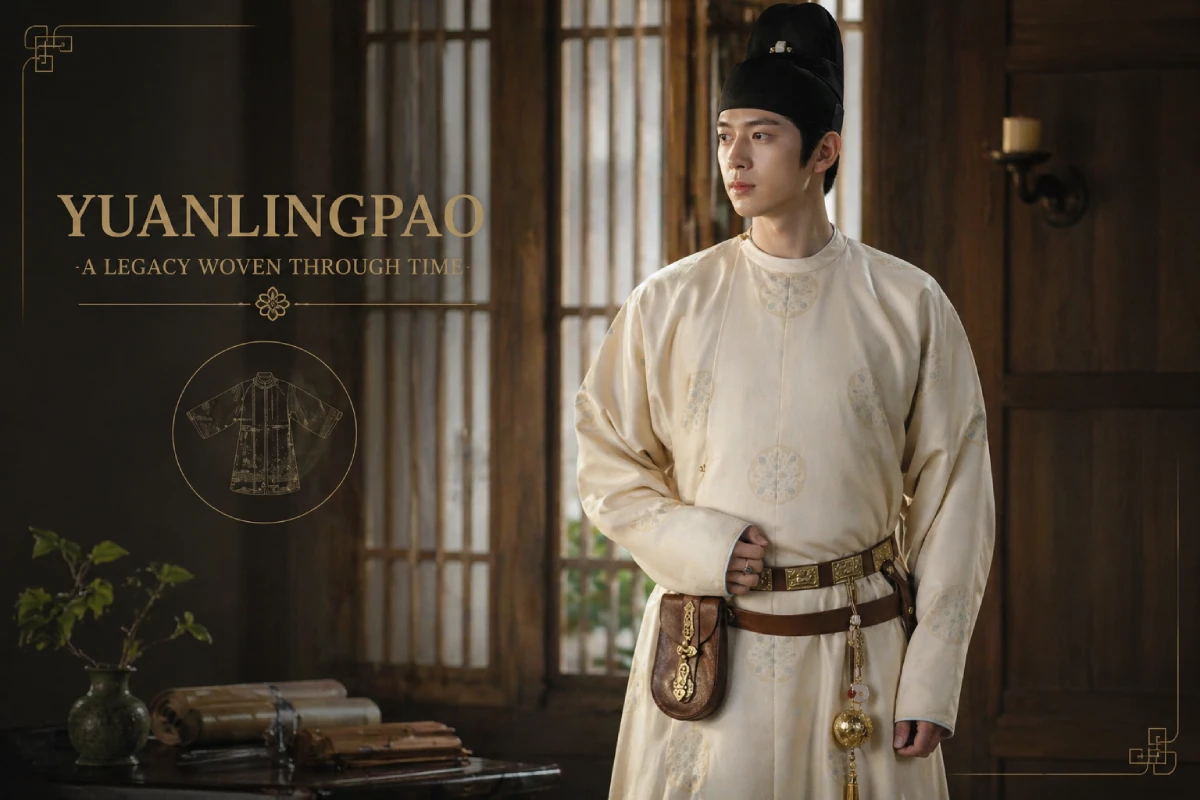
If you’ve watched a Chinese historical drama set in the Tang or Ming dynasty, chances are you’ve already seen the yuanlingpao. That dignified robe with the clean, round neckline — worn by emperors, ministers, and scholars — is one of the most recognizable garments in all of Hanfu history. Yet despite its visibility, most people outside China know surprisingly little about it.
This guide covers everything you need to know: where the yuanlingpao came from, how it evolved across dynasties, what made it culturally significant, and how it’s worn today.
Yuanlingpao (圆领袍, yuán lǐng páo) literally means “round collar robe.” It is a full-length paofu (袍服, a Chinese robe) distinguished by its circular neckline, right-side closure in the traditional youren style, and a straight central opening. It falls under the broader Hanfu system — the traditional clothing of the Han Chinese people.

The garment is also referred to by related names:
- Yuanlingshan (圆领衫) — when worn as a shorter upper garment rather than a full robe
- Panlingpao (盘领袍) — an alternate name emphasizing the wrapped, looped collar
- Lanshan (襕衫) — a specific variant that incorporated a horizontal seam (lán) at the hem, aligning the round-collar cut with traditional Hanfu shenyi proportions
As a formal dress garment, the yuanlingpao was primarily worn by men — but during certain dynasties, particularly the Tang, it became fashionable for women as well.
The origins of the yuanlingpao are intertwined with the cultural exchanges along China’s northern frontier. During the Eastern Han dynasty, round-collar clothing first appeared as an inner garment, influenced by the Hufu (胡服) — the attire of nomadic peoples such as the Donghu and later the Xianbei.
By the Six Dynasties period (222–589 AD), round-collar robes had transitioned from underwear to outerwear. Narrow sleeves and practical cuts borrowed from steppe clothing blended with Han Chinese tailoring traditions. The Xianbei rulers of the Northern Wei dynasty played a particularly important role: their elites adopted Chinese customs while Han Chinese absorbed elements of nomadic dress, creating a genuine cultural synthesis.
During this same era, Sogdian merchants traveling the Silk Road introduced their own yuanling-style kaftan to Chinese markets. Their garments were adapted to close on the right side (youren) to conform to Han Chinese norms — an early example of foreign styles being localized into the Hanfu system.
The earliest physical evidence of a round collar robe found in China comes from Loulan in Xinjiang, dating to the early Eastern Jin dynasty. Scholars have also noted similar round-collar garments in the cultural sphere of ancient Persia around 500 BC, suggesting the style may have traveled eastward along trade routes before being thoroughly absorbed and transformed by Chinese fashion.
The Tang dynasty marks the moment the yuanlingpao became a defining garment of Chinese civilization. It was formally institutionalized as court attire and worn by officials, nobles, and emperors. The Tang version typically featured:
- A round neckline secured with a button
- A straight central opening closing to the right
- Tight or narrow sleeves for martial roles; wide sleeves for scholars and nobles
- Vibrant colors and ornate embroidery
- Silk fabrics — ling (damask), luo (gauze), chou (satin), duan (brocade) — for the elite; coarse linen for commoners
Rank was displayed through color: purple robes for officials of the Third Rank and above, crimson for the Fifth Rank and above, cyan for lower-ranking officials. A futou (幞頭) headcloth was worn as a standard pairing.
It was also during the Tang that Central Asian decorative influences reached their peak. Brocade trims on collars, sleeves, and the robe’s front panel — known as “partial dress decoration” — reflected Sogdian aesthetics. Some robes featured a cloth band with Central Asian loop patterns running down the center.
The Tang yuanlingpao’s cosmopolitan elegance helped spread it across East Asia. Korea, Japan, and Vietnam all adopted variants of the round collar robe for their own court dress systems.
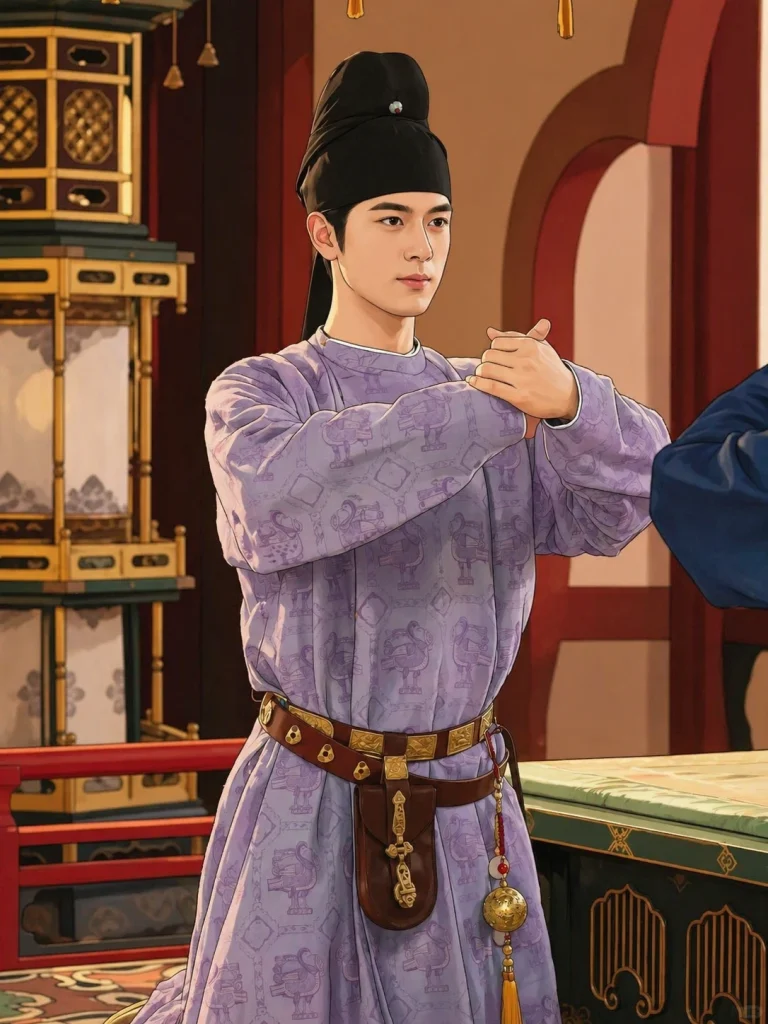
In the Song dynasty, the yuanlingpao retained its role as formal court and official attire but underwent a stylistic shift toward sobriety and scholarly modesty. Compared to the vibrant Tang versions:
- Colors became more subdued
- Silhouettes grew looser with wider sleeves
- The garment reflected Confucian values of learning over martial display
Officials wore the robe with leather belts, yudai (鱼袋, fish-shaped rank pouches), and black leather boots or shoes. The color of the robe remained regulated by rank. The Song yuanlingpao embodied the era’s literati aesthetic — intellectual authority expressed through restrained elegance.
When the Mongol Yuan dynasty replaced the Song, Han Chinese court attire was no longer the primary form of official dress. The Mongol aristocracy favored steppe-inspired garments. However, the yuanlingpao continued in use among Han Chinese officials and the general population, particularly in ritual and ceremonial contexts. Its persistence during this period underscores its deep cultural roots.
The Ming dynasty saw the most elaborate development of the yuanlingpao. When the Hongwu Emperor restored Han Chinese rule, he revived and formally codified the dress traditions of the Tang and Song. The yuanlingpao became the dominant official garment, worn by virtually all men — commoners, scholars, officials, and the emperor himself.
Ming-era features included:
- Multi-paneled construction (jishen 繼身) with precise tailoring
- Buzi (补子) — embroidered rank badges sewn to the chest and back, distinguishing civil officials (depicted with birds) from military officials (depicted with animals) and indicating exact rank
- Side panels called ànbǎi (暗擺, “hidden pendulum”) at the hem slits — a structural innovation unique to Ming garments that improved movement and reflected a hybrid of Han and Mongol construction techniques
- Pipa sleeves (琵琶袖) — large sleeves that narrowed at the cuff for practicality
- Yunjian, Tongxiulan, and Xilan decorations for ceremonial robes and imperial gifts
For formal occasions, the robe was paired with a wushamao (乌纱帽, a winged black gauze hat). Emperors wore specially embroidered variants featuring dragons and auspicious cloud motifs.
Color remained strictly regulated. Ming dynasty robes were predominantly red for formal wear, with specific hues assigned by rank. Certain imperial patterns — the four-clawed mangpao, the dragon-headed feiyu (flying fish), douniu (fighting ox) — were reserved as imperial gifts to meritorious officials.
The yuanlingpao of this period also served a social function beyond officialdom: the robes of officials and nobles doubled as ceremonial wedding attire for commoners. A groom would wear a wushamao and a ninth-rank official’s yuanlingpao; the bride, a fengguan xiapei headdress and the yuanlingpao of a noble lady.

When the Manchu Qing dynasty conquered China, it enforced the tifayifu (剃发易服) policy requiring Han Chinese to adopt Manchu dress — the chaofu, mangpao, and changfu with their characteristic horse-hoof cuffs. The yuanlingpao was officially abolished from court use.
However, it survived in the margins: Han Chinese women (who were exempt from the dress mandate) continued wearing Ming-style Hanfu in private quarters, and theatre performers were also exempt, keeping the round collar robe alive on stage. The garment thus became preserved in cultural memory through performance traditions that persisted through the entire Qing period.
| Feature | Description |
|---|---|
| Collar | Round (yuanling), no standing band, fastened with a button |
| Closure | Right-side (youren style), following traditional Hanfu convention |
| Sleeves | Narrow (for practicality / martial use) or wide sleeves (for formal/scholarly use) |
| Hem slits | Side slits for freedom of movement |
| Decoration | Plain, dark-pattern jacquard, or ceremonial embroidery depending on rank and occasion |
| Layering | Worn over a changao (长袄) or changshan (长衫) as an inner layer |
The Ming dynasty added several features unique to that era: pipa sleeves (琵琶袖) with wide bodies that narrowed at the cuff; ànbǎi panels (暗擺) at the hem slits for improved movement; and buzi (补子) — embroidered rank badges on the chest and back distinguishing civil from military officials and indicating exact rank.
One of the yuanlingpao’s most remarkable legacies is its influence beyond China’s borders. The Tang dynasty’s cultural prestige spread the garment to:
- Korea: The danryeong (단령), nearly identical in form, became standard court and official dress throughout the Joseon dynasty. By the late Joseon period, the robe’s hem grew progressively longer.
- Japan: The round-collar robe influenced the sokutai and kariginu court garments of the Heian and later periods.
- Vietnam: Vietnamese court dress absorbed Tang and Ming Chinese styles, including the round-collar formal robe.
This cross-cultural adoption makes the yuanlingpao one of the most geographically widespread garments in pre-modern Asian history.
Within the modern Hanfu revival, the yuanlingpao — especially Ming dynasty versions — has become one of the most popular choices for formal occasions. Contemporary wearers use it for:
- Weddings: Red yuanlingpao paired with wushamao for grooms; layered with mamian skirts for women
- Traditional festivals: Chinese New Year, Mid-Autumn Festival, cultural ceremonies
- Hanfu events and photography: The robe’s dramatic silhouette photographs exceptionally well
- Cosplay and drama-inspired looks: Tang and Ming court aesthetics have a strong following
Styling guidance for modern wear:
The yuanlingpao is an outer layer — it should not be worn alone against the skin. Layer it over a stand-collar or cross-collar changao or changshan. Women can pair it with a mamian (horse-face) skirt in coordinating patterns or colors.
For formal occasions in a red robe, a fengguan (phoenix crown) or diguan headdress is the traditional complement. Other colors pair well with a liangguan (beamed crown) or diji (a layered hairpiece). For men, the wushamao headwear remains the classic pairing.
Fabric and color: Contemporary reproductions prioritize fabrics with good drape — silk, silk-blend jacquard, and brocade are all appropriate. Jacquard weaves with subtle duotone patterns are particularly popular for achieving the Ming-era look of understated richness. Color choices today are less restricted than in imperial times, though deep, dignified tones remain the norm: midnight blue, wine red, forest green, and imperial gold.
Is yuanlingpao the same as yuanlingshan? Almost, but not quite. Yuanlingshan technically refers to the shorter upper-garment version; yuanlingpao refers to the full-length robe. In practice, the terms are often used interchangeably.
Can women wear yuanlingpao? Yes. While the robe was primarily men’s formal attire historically, women wearing yuanlingpao was fashionable during the Tang dynasty and remained practiced through the Ming. Today, women frequently wear the Ming-style version for formal occasions.
What’s the difference between yuanlingpao and the Qing changpao (長袍)? The Qing changpao is a Manchu-origin garment with horse-hoof cuffs and a distinctly different collar construction. The yuanlingpao is a Han Chinese garment with a round collar and right-side button closure. They are related only in being full-length robes; their cultural origins and visual appearance are quite different.
What is buzi and why does it matter? Buzi (补子) are the rank badge squares sewn to the chest and back of Ming-era official robes. Civil officials wore bird motifs (cranes for the first rank, golden pheasants for the second, etc.); military officials wore animal motifs. Today, buzi-embellished robes are prized for their visual richness and historical authenticity.
The yuanlingpao is more than a garment — it is a record of Chinese history itself. From its nomadic origins on the northern frontier to its codification as the supreme symbol of Ming imperial authority, from its suppression under Qing rule to its revival in 21st-century Hanfu culture, the round collar robe has proven remarkably durable.
Whether you’re drawn to the cosmopolitan drama of a Tang-dynasty court scene, the scholarly gravity of a Song official’s robe, or the precision and grandeur of a Ming wedding ensemble, the yuanlingpao offers a direct, wearable connection to over a thousand years of Chinese civilization.
Interested in other traditional Hanfu styles? Explore our guides to the ruqun, beizi, and mamian skirt — or browse our curated collection of historically inspired Hanfu for the modern wearer.