
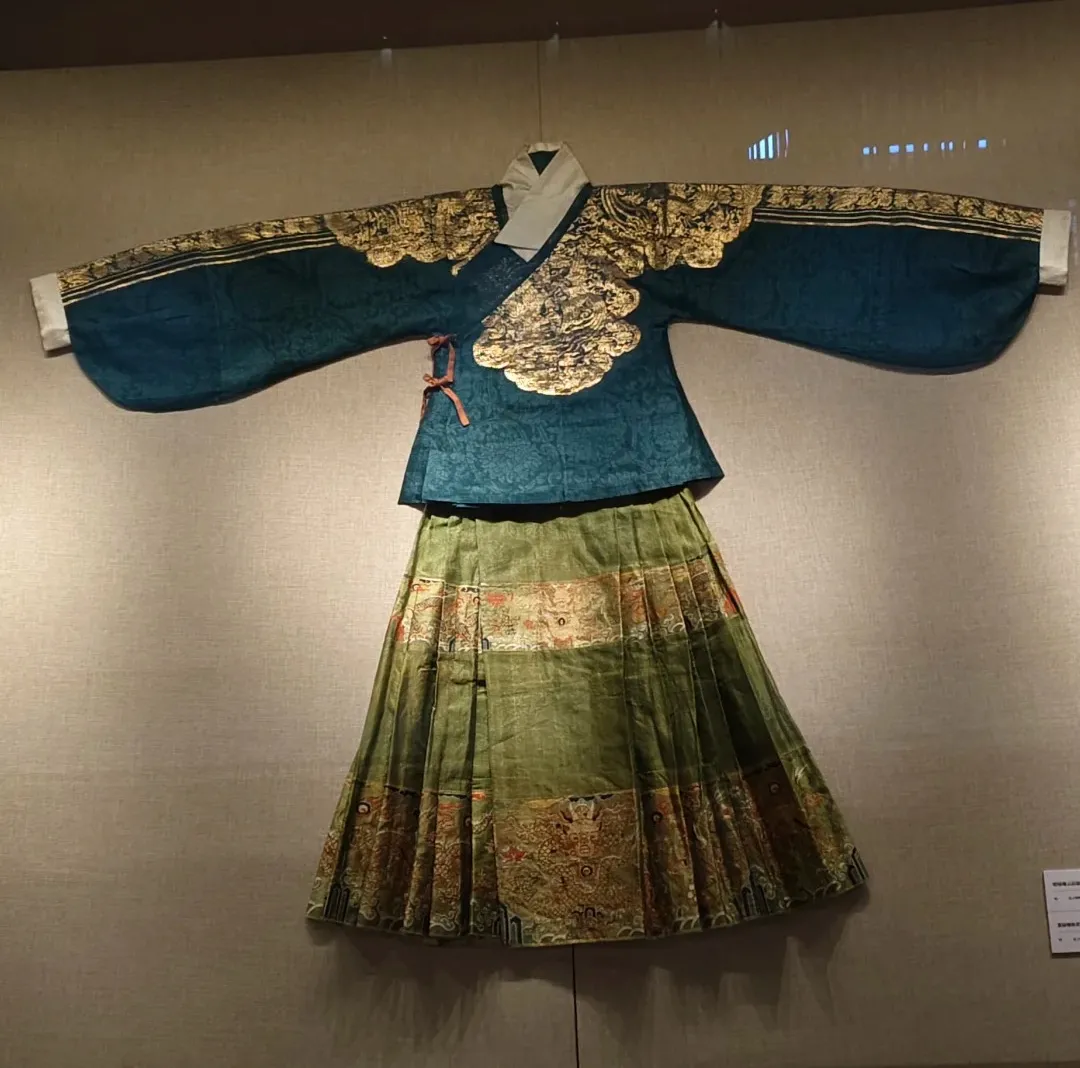
If you’ve spent any time exploring hanfu, you’ve almost certainly come across the term aoqun (袄裙). It’s one of the most recognizable silhouettes in traditional Chinese clothing — a structured lined jacket worn over a long flowing skirt — and for centuries it was the everyday dress of women across China. Whether you’re a newcomer to hanfu or looking to deepen your knowledge, this guide covers everything you need to know about aoqun: its history, defining features, how it differs from ruqun, and how to wear it today.
Aoqun is a collective name for the traditional Han Chinese women’s outfit consisting of a lined jacket (ao 袄) worn over a skirt (qun 裙). The two characters explain the garment perfectly: ao refers to a padded, lined coat — warmer and more structured than a simple blouse — while qun simply means skirt.
While the aoqun style appears across multiple dynasties, the term today is most closely associated with the Ming Dynasty’s double-layered upper jacket paired with a lower skirt. It represents one of the most enduring silhouettes in Chinese fashion history — refined, practical, and deeply rooted in Han Chinese cultural identity.
The origins of aoqun can be traced back as far as the Warring States period (475 BC), with early examples visible on clay figurines from that era. However, it didn’t reach cultural dominance until many centuries later.
From the Tang Dynasty onward, the ao coat began to replace the lighter ru shirt as the standard upper garment for cooler weather, evolving steadily through the Song and Yuan periods. By the mid-to-late Ming Dynasty, it had become the most commonly worn style for autumn and winter clothing — embraced by commoners and royalty alike.
A key innovation of the Ming period was the invention of interlocking metallic buttons called zimukou (子母扣). These enabled the rise of the stand-up collar (liling 立领) style, which became one of the most iconic visual signatures of Ming-era women’s fashion. Standing collar jackets — modest, elegant, and distinctly Chinese — spread across virtually all social classes by the dynasty’s later years.
The aoqun style continued into the Qing Dynasty and even the Republican era, though its cultural heart remains firmly in the Ming.
Aoqun is recognizable by several consistent design elements that have remained relatively stable across centuries:
- The ao jacket — lined and padded, worn over (not tucked into) the skirt. Sleeves are often pipa-shaped (lute-shaped), tightened at the cuffs, though straight sleeves also appear.
- A white protective collar — a narrow inner collar visible above the ao’s neckline, serving both a decorative and practical function.
- Collar styles — cross-collar (jiaoling 交领), round collar, or stand-up collar (liling 立领), always with a right-over-left closure (youren 右衽).
- Jacket length — short ao (above the knee) in earlier Ming styles; long ao (da ao 大袄, below the knee) becoming more prevalent later.
- The skirt — most typically a Mamianqun (马面裙, horse-face skirt) in heavier brocade fabric, or a Baidiequn (百迭裙, hundred-pleats skirt) in lighter fabric for daily wear.
A useful practical rule used in the modern hanfu community: if the top is long enough to cover the skirt’s waistband, it’s aoqun. If the top needs to be tucked into the waistband, it’s ruqun.
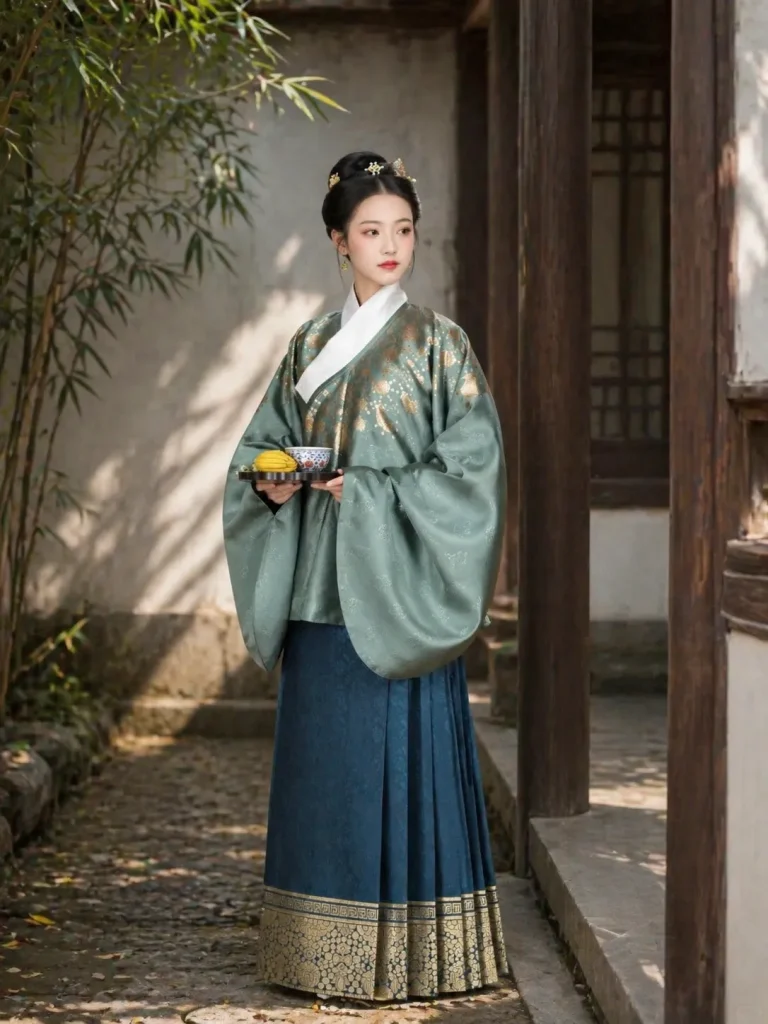
Both aoqun and ruqun follow a two-piece top-and-skirt structure, which is why newcomers often confuse them. The differences, however, are meaningful — in construction, layering logic, and cultural associations.
| Aoqun (袄裙) | Ruqun (襦裙) |
|---|---|
| Lined, padded ao coat worn over the skirt | Lighter ru blouse often tucked into the skirt |
| Best for autumn and winter — designed for warmth | Suitable year-round, including summer |
| Most popular in the Ming Dynasty | Peak style from Han through Tang Dynasty |
| Paired with a Mamian or hundred-pleats skirt | Skirt styles vary widely depending on the period |
| Structured and layered — suits formal occasions | More versatile, from casual daily wear to formal |
The core distinction lies in the ao itself: it is a lined coat with more body and weight than the ru shirt of the ruqun. Because the ao is worn on top rather than tucked under the skirt, it creates a distinctly different silhouette — one that reads as more structured and layered.
Wearing aoqun correctly involves a specific layering sequence. Here’s how a classic Ming-style aoqun is assembled:
- Inner layer — begin with a light cotton or linen undershirt beneath everything.
- Skirt first — put on the Mamian or pleated skirt and secure it at the waist before adding the jacket.
- Ao jacket — wrap the right side of the jacket over the left (jiaoling youren 交领右衽). Tie the inner sash beneath the armpit first, then fold the outer lapel over and secure it on the right side.
- Outer layer (optional) — add a pifeng (披风) outer coat for warmth. The pifeng features broad sleeves, often embroidered, and is typically secured with a jade buckle button just below the half-collar.
- Accessories — hairpins, jade pendants, a yingluo (璎珞) necklace, or an embroidered waist belt complete the look.
Because the ao functions as outerwear, a lighter inner garment made of cotton or linen is always worn underneath — both for comfort and to allow layering as temperatures change.
The broader hanfu revival movement that took root in China in the early 2000s has brought aoqun back into everyday visibility — and international awareness. The style’s combination of clear historical grounding and wearable elegance makes it one of the most accessible entry points into hanfu for modern audiences.
Today, aoqun is a popular choice for hanfu festivals, National Day and Spring Festival gatherings, coming-of-age ceremonies, and themed photoshoots. Its structured jacket and flowing Mamian skirt strike a balance between formality and cultural authenticity that few other hanfu styles match.
Contemporary designers — both in China and internationally — have also embraced aoqun as a design reference. Modern adaptations retain the core silhouette while incorporating updated fabrics, construction techniques, and color palettes, making the style accessible to wearers who may never have engaged with traditional clothing before.
Historically, yes. The aoqun and ruqun together form the foundational clothing system for Han Chinese women, with a tradition spanning thousands of years. That said, the modern hanfu community increasingly embraces cross-gender styling, and some contemporary interpretations adapt the silhouette for all wearers.
Silk and brocade were the prestige fabrics, reserved for wealthier households and the royal court. Cotton and hemp were standard for everyday commoner wear. Today, high-quality cotton, ramie, polyester-silk blends, and jacquard reproductions are all widely available and commonly used in both heritage-grade and entry-level aoqun sets.
The ao was originally designed for cooler weather, given its lined construction. Lighter, unlined versions in thin silk or ramie are made for spring and early autumn wear. For summer, most hanfu enthusiasts prefer the ruqun or qixiong ruqun, which use single-layer fabric and offer better ventilation.
The dividing line is the knee. A short ao ends above the knee, exposing more of the skirt beneath — common in earlier Ming styles. A long ao (大袄, da ao) extends past the knee, creating a more covered, layered silhouette that became fashionable in the later Ming period alongside the rise of the stand-up collar.
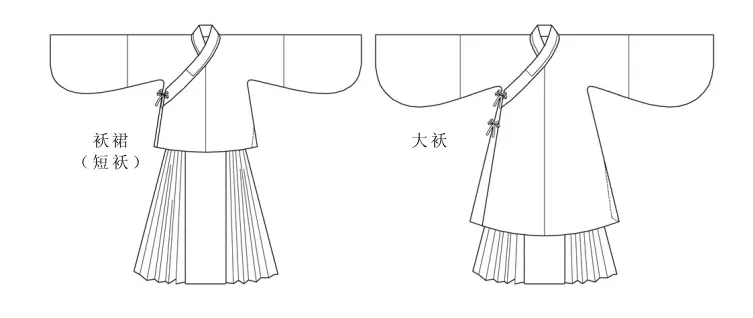
For a historically accurate Ming-style aoqun, a Mamian skirt (horse-face skirt) in brocade is the classic choice. A hundred-pleats skirt (baidiequn) is a lighter, more casual alternative. Both pair well with either a short or long ao jacket.
Aoqun sits at the center of Ming Dynasty fashion — refined in construction, layered in meaning, and visually unmistakable. Understanding it means understanding one of the longest chapters in Chinese clothing history, from the Warring States clay figurines to the embroidered court jackets of the Ming imperial household to the modern enthusiast photographed at a hanfu festival today.
Whether you’re sourcing an aoqun set for the first time or looking to understand the finer distinctions between collar styles and skirt types, the more time you spend with this garment category, the more its depth reveals itself.