

Embroidery is the craft of decorating fabric or other materials using a needle to stitch thread or yarn into intricate patterns, images, and designs. It is one of the oldest and most universal forms of textile art in human history — practiced across every continent, in every era, from ancient royal courts to modern fashion runways.
Whether you’ve admired the golden phoenixes on a Chinese silk robe, the delicate whitework on a European bridal gown, or the bold cross-stitch patterns on folk costumes, you’ve seen embroidery at work. This guide covers everything you need to know: its definition, its long history, the most important types and techniques, and why it remains so culturally significant today.
At its simplest, embroidery is the art of stitching decorative designs onto fabric using a needle and thread. The word itself comes from the Old French broderie, meaning “embellishment.” But embroidery is far more than mere decoration — it is a form of storytelling, cultural identity, and artistic mastery that has shaped the way humans dress and express themselves for thousands of years.
Unlike weaving (where pattern is built into the fabric structure itself) or printing (which applies color to the surface), embroidery builds texture and dimension on top of an existing fabric. The stitched thread rises above the base material, creating a tactile, three-dimensional quality that no other textile technique can quite replicate.
Embroidery can be worked on virtually any fabric — silk, linen, cotton, wool, leather, even bark — using threads of silk, cotton, wool, metal, or synthetic fiber. It can also incorporate beads, sequins, pearls, and ribbons for additional texture and sparkle.

Embroidery is astonishingly old. Drilled shells stitched onto garments have been found in Siberia from around 5,000–6,000 BC, and ancient Chinese documents describing embroidery techniques date to approximately 3,500 BC.
Ancient Egyptian tomb paintings depict embroidered clothing, couch covers, hangings, and tents. In Greece, the goddess Athena was mythologically credited with teaching humans the art of embroidery. By the time of the Persian Wars (490 BC), quilted garments covered in embroidery were worn as armor.
The earliest surviving embroideries are Scythian, dated to between the 5th and 3rd centuries BC — already highly sophisticated in their craft.
The medieval period saw embroidery reach extraordinary heights in both East and West. In England, a style known as Opus Anglicanum flourished from the 12th to the 14th centuries, renowned for its use of silk and gold thread with stitching so fine it could exceed 1,000 stitches per square inch. Popes, kings, and cardinals across Europe sought out English embroiderers for ceremonial vestments and altar cloths.
In Asia, Chinese imperial embroidery reached its most celebrated expression during the Tang Dynasty (618–907 AD) and later achieved its peak of splendor in the robes of the Qing Dynasty (1644–1912). Meanwhile, in India, Mughal patronage from the 16th century onward produced the opulent Zardozi tradition of gold and silver thread embroidery still considered among the world’s most luxurious.
The invention of commercial embroidery machines in Switzerland in 1828 transformed the craft, enabling mass production of embroidered goods. By the 20th century, computerized embroidery machines could execute intricate designs in minutes. Today, embroidery thrives in two parallel worlds: industrial machine embroidery for fashion and branding, and a vibrant global community of hand embroiderers who carry forward centuries of tradition.
No discussion of embroidery is complete without special attention to Chinese embroidery — widely regarded as the pinnacle of the art form. China’s embroidery tradition spans more than 3,000 years and produced techniques of such refinement that they remain unmatched anywhere in the world.
Chinese embroidery is traditionally organized around four regional schools, each with its own distinctive aesthetic:
1. Suzhou Embroidery (苏绣) — Jiangsu Province The most famous of the four, Suzhou embroidery is known for its incredibly fine silk threads, luminous colors, and lifelike naturalism. Suzhou embroiderers are celebrated for their ability to depict animals, landscapes, and portraits with photographic precision. The technique of double-sided embroidery — creating a different design on each side of the same piece of fabric — originated here and represents one of the highest achievements in the entire history of textile art.

2. Hunan Embroidery (湘绣) — Hunan Province Distinguished by bold colors, strong contrasts, and a realistic three-dimensional quality, Hunan embroidery is particularly celebrated for its depictions of lions and tigers. The thick, rich texture of its lion-fur stitching is legendary among collectors.
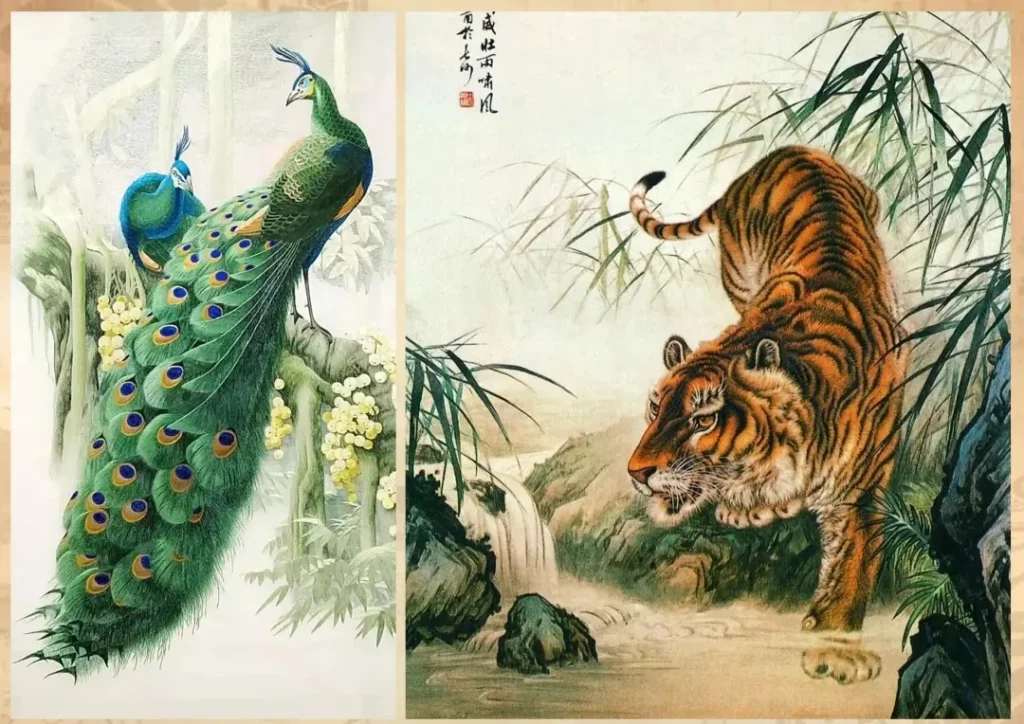
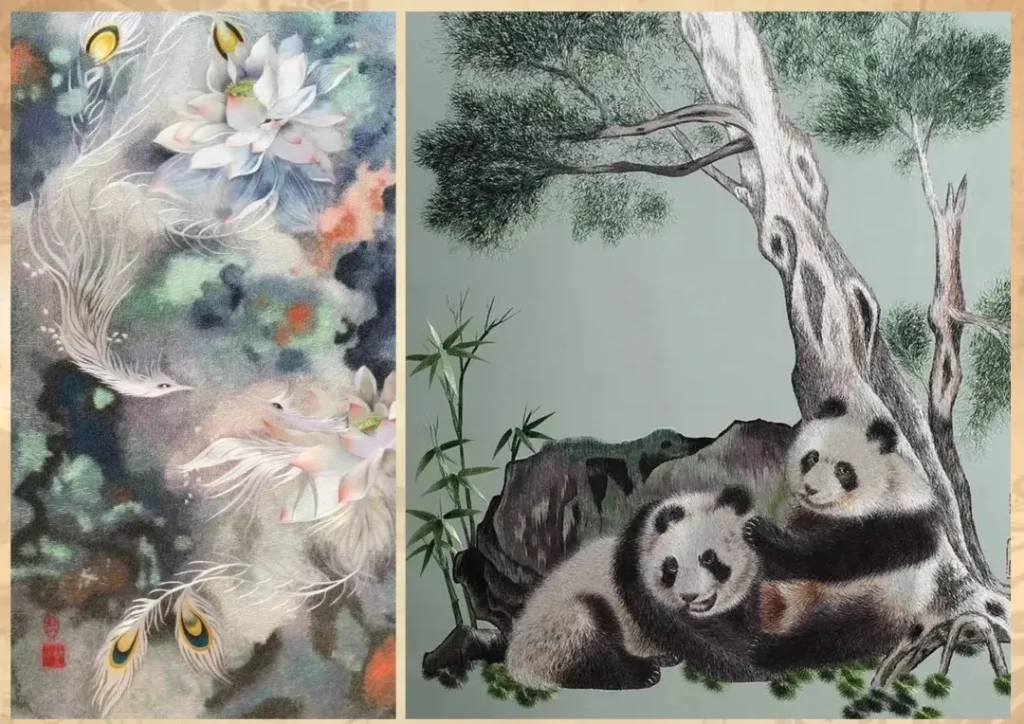
3. Sichuan Embroidery (蜀绣) — Sichuan Province One of the oldest of the four schools, Sichuan embroidery is known for its smooth, even stitches and fluid, graceful designs. Carp, pandas, and landscapes are among its most iconic subjects.
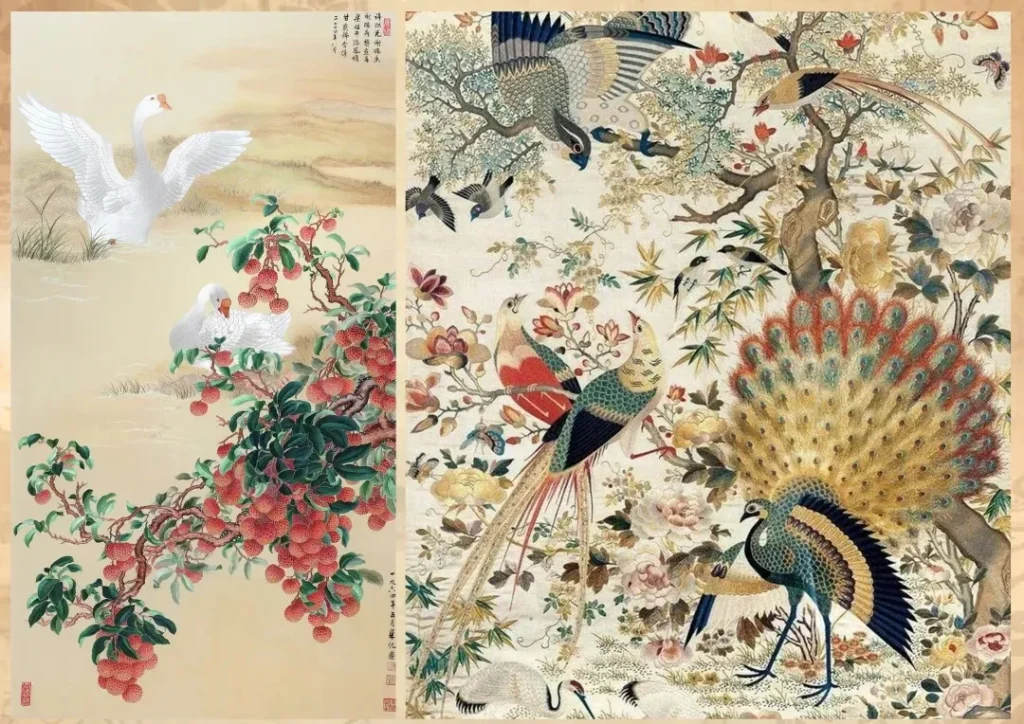
4. Guangdong Embroidery (粤绣) — Guangdong Province Bold, bright, and exuberant, Guangdong embroidery features strong outlines, vivid colors, and compositions filled with phoenixes, peacocks, and floral abundance. It was among the first Chinese embroidery styles to be exported to Europe during the Qing Dynasty trade era.
In traditional Chinese culture, embroidery was far more than decoration — it was a language. Specific motifs carried specific meanings:
- Dragon — imperial power and the emperor
- Phoenix — the empress, feminine virtue, and rebirth
- Peony — wealth, honor, and prosperity
- Lotus — purity and spiritual perfection
- Crane — longevity and wisdom
- Bat (蝠, fú) — good fortune (a homophone of the word for luck)
In Hanfu (traditional Chinese dress), embroidery dictates not just beauty but rank. During the Ming and Qing dynasties, the type, color, and motif of embroidery on an official’s garment — especially the famous Mandarin squares (补子) — indicated his exact rank within the imperial bureaucracy. A civil official of the first rank wore a golden crane; a military official of the first rank wore a qilin. Every stitch was a statement of status.
This deep entanglement of embroidery with meaning, hierarchy, and identity is what makes Chinese embroidery so fascinating — and so endlessly relevant to anyone interested in Hanfu and Chinese traditional culture.

Embroidery is a global craft, and every culture has developed its own distinctive style:
- Counted-thread embroidery — Stitches are made over a predetermined number of fabric threads, creating precise, often geometric patterns. Cross-stitch is the most familiar example.
- Freestyle (surface) embroidery — Stitches are worked freely across the fabric surface, allowing naturalistic and figurative designs. Chinese silk embroidery is largely freestyle.
- Whitework — White thread on white fabric, requiring exceptional skill and precision. Used historically for ecclesiastical linens and bridal wear.
- Goldwork — Metallic threads couched or stitched onto fabric. Central to Opus Anglicanum, Zardozi, and Chinese imperial robes.
- Crewelwork — Uses wool thread on a linen foundation, creating rich, textured designs. Popular in England from the 16th century onward.
- Needlepoint (Canvaswork) — Thread worked through a stiff canvas to create dense, patterned designs that fully cover the base fabric.
- Appliqué embroidery — Pieces of fabric are stitched onto a base fabric to create pattern and dimension.
| Tradition | Origin |
|---|---|
| Suzhou Embroidery (苏绣) | China (Jiangsu) |
| Zardozi | India / Mughal |
| Sashiko | Japan |
| Hardanger | Norway |
| Kantha | Bangladesh / India |
| Blackwork | Spain / England |
| Tradition | Key Characteristics |
|---|---|
| Suzhou Embroidery (苏绣) | Ultra-fine silk, photorealistic, double-sided |
| Zardozi | Gold/silver threads, 3D effects, bridal wear |
| Sashiko | Repetitive geometric patterns, running stitch |
| Hardanger | Geometric whitework, drawn threads |
| Kantha | Running stitch, quilting, folk storytelling |
| Blackwork | Geometric patterns in a single color on linen |
Embroidery has hundreds of named stitches, but most designs rely on a handful of fundamentals:
- Running stitch — The simplest stitch: thread passes in and out of fabric in a straight line. Used in Sashiko and Kantha.
- Chain stitch — A series of connected loops forming a chain. One of the oldest stitches in history; creates beautiful outlines and fills.
- Satin stitch — Parallel stitches laid closely together to fill a shape with a smooth, lustrous surface. Essential in Chinese silk embroidery.
- Stem stitch — A slightly overlapping angled stitch used to create smooth lines and outlines, especially for floral stems and lettering.
- Cross stitch — Two diagonal stitches crossed in an X shape. One of the earliest and most widely used stitches globally; the earliest example dates to around 850 AD.
- French knot — Thread wrapped around the needle and pulled through to create a small raised dot. Used for texture, eyes, flower centers.
- Backstitch — A strong, continuous line stitch used for outlines and as the base of other techniques.
- Couching — Thread or cord is laid on the surface of the fabric and secured in place with a second thread. Essential for goldwork.

Modern embroidery divides broadly into two worlds:
- Total creative control — the embroiderer decides every stitch in real time
- Unique, unrepeatable results — no two hand-embroidered pieces are identical
- Deeply personal and cultural — carries the maker’s skill, personality, and tradition
- Time-intensive — a single Suzhou embroidery piece can take months or years
- Materials: needle, thread, embroidery hoop, scissors, fabric
- Speed and consistency — computerized machines replicate identical designs precisely and at scale
- Commercial applications — used widely in fashion, uniforms, branded merchandise, and home textiles
- First introduced in Switzerland in 1828; modern computerized versions became widespread in the late 20th century
- Digital embroidery — designs are created using software and sent directly to the machine
Neither is superior — they serve different purposes. For cultural heritage, artistic expression, and luxury goods, hand embroidery remains irreplaceable. For branding and mass production, machine embroidery is indispensable.
Getting started with hand embroidery requires just a few essential tools:
Needles — Embroidery needles have a sharp point and a larger eye than sewing needles to accommodate thicker thread. Different projects use different needle sizes.
Thread — The most common is stranded cotton floss (like DMC brand), which comes in hundreds of colors and can be split into individual strands for finer work. Silk thread is used for the finest embroidery; wool for crewelwork; metallic thread for goldwork.
Fabric — Even-weave fabrics like linen and cotton are ideal for most embroidery. Silk is the traditional base for Chinese embroidery.
Embroidery hoop or frame — Holds the fabric taut while you stitch, preventing puckering and distortion.
Scissors — Small, sharp embroidery scissors for precise thread cutting.
Transfer method — A way to transfer your design onto fabric: tracing paper, water-soluble pens, iron-on transfers, or printed fabric.

Embroidery remains remarkably vital across many fields:
- Fashion and haute couture — Major fashion houses like Dior, Valentino, and Chinese designers use embroidery as a signature luxury element in their collections.
- Traditional dress — Hanfu, Indian saris, Japanese kimonos, Mexican huipils, and many other forms of traditional dress rely on embroidery as a central design element.
- Home décor — Cushions, wall hangings, tablecloths, and bed linens.
- Corporate branding — Logos on uniforms, hats, and workwear.
- Art and expression — Contemporary artists use embroidery as a fine art medium for storytelling and cultural commentary.
- Cultural preservation — Communities worldwide use embroidery to preserve endangered patterns, symbols, and traditions for future generations.
Q: What is the difference between embroidery and needlepoint? Both use needle and thread, but needlepoint is worked on a stiff canvas and covers the entire surface with stitches (like a textile painting). Embroidery is worked on fabric and typically adds decorative elements to an existing base.
Q: What is the oldest type of embroidery in the world? Cross-stitch is among the oldest documented styles, with surviving examples dating to around 850 AD. However, evidence of embroidery techniques in China dates back to at least 3,500 BC.
Q: What country has the best embroidery in the world? Many cultures produce extraordinary embroidery, but Chinese silk embroidery — particularly from Suzhou — is widely regarded as the most technically refined in the world. Indian Zardozi is the most opulent. English Opus Anglicanum was unrivaled in medieval Europe.
Q: What does embroidery symbolize in Chinese culture? In Chinese culture, embroidery motifs carry specific symbolic meanings tied to luck, longevity, rank, and virtue. Dragons symbolize imperial power; phoenixes represent feminine grace; lotuses signify purity; bats represent good fortune. During the imperial era, embroidered insignia on official robes indicated an official’s exact rank.
Q: Is embroidery easy to learn for beginners? Yes — the basic stitches (running stitch, backstitch, chain stitch) can be learned in an afternoon. The challenge is in mastering the advanced techniques that allow for the extraordinary precision and beauty of traditional embroidery styles.
Embroidery is one of humanity’s oldest and most universal arts — a practice that transforms humble thread into cultural memory, status, beauty, and meaning. From the golden dragon robes of Chinese emperors to the geometric folk patterns of Scandinavian whitework, every stitch carries the weight of a living tradition.
Understanding embroidery is understanding how cultures express who they are through what they wear and what they make. In Chinese tradition, this is perhaps nowhere more visible than in Hanfu — where every embroidered motif, from the crane to the lotus, carries centuries of meaning stitched into the fabric itself. Whether you’re drawn to the photorealistic perfection of Suzhou silk embroidery,or simply the satisfaction of making something beautiful with your own hands, embroidery offers a connection to something enduring.
It is, in the end, one of the most human things we do.