

Mid-Autumn Festival is one of the most important holidays in Chinese culture, second only to Chinese New Year. If you’ve ever wondered exactly when it falls, why it’s also called the Moon Festival, or what people actually do to celebrate it, this guide covers all of it.
Mid-Autumn Festival always falls on the 15th day of the 8th month on the Chinese lunar calendar, which is why it lands on a different day on the Gregorian calendar every year — usually somewhere between early September and early October. The festival gets its name because the 15th day of the 8th lunar month sits right in the middle of autumn on the traditional Chinese calendar, and it always coincides with a full moon.
Because the date shifts every year, here’s a quick reference table covering recent years and years ahead, so you don’t have to look it up again next season.
| Year | Date |
|---|---|
| 2024 | Tuesday, September 17 |
| 2025 | Monday, October 6 |
| 2026 | Friday, September 25 |
| 2027 | Wednesday, September 15 |
| 2028 | Tuesday, October 3 |
| 2029 | Saturday, September 22 |
| 2030 | Thursday, September 12 |
| 2031 | Wednesday, October 1 |
| 2032 | Sunday, September 19 |
| 2033 | Thursday, September 8 |
| 2034 | Wednesday, September 27 |
| 2035 | Sunday, September 16 |
| 2036 | Saturday, October 4 |
In mainland China, Mid-Autumn Festival is a public holiday, typically paired with a short break of two to three days. Hong Kong observes the holiday on the day after the festival, since most celebrations happen at night.
Mid-Autumn Festival, known as Zhongqiu Jie (中秋节) in Chinese, is a harvest festival with roots going back more than 3,000 years to moon-worship rituals from the Shang Dynasty. At its core, it’s a celebration of the full moon, the autumn harvest, and — most importantly — family reunion.
The festival is built around three ideas that show up in nearly every tradition connected to it: completeness, brightness, and coming together. The full moon is seen as a symbol of a complete, unbroken family circle, which is why so many people try to travel home to be with relatives around this time, much like Chinese New Year.
Mid-Autumn Festival and the Moon Festival are the same holiday — just different names for it. In English, both “Mid-Autumn Festival” and “Moon Festival” are used interchangeably, along with “Mooncake Festival.” The name “Moon Festival” comes directly from the fact that the celebration always lands on a full moon, and moon-viewing is one of the festival’s oldest and most central traditions.
The legend most closely tied to this name is the story of Chang’e, the Moon Goddess. According to the most common version, her husband Hou Yi — a legendary archer — was granted an elixir of immortality after shooting down nine of the ten suns scorching the earth. To keep it from falling into the wrong hands, Chang’e drank the elixir herself and drifted up to the moon, where she has lived in quiet exile ever since. Many moon-gazing customs during the festival trace back to this story, with families looking up at the full moon and, according to tradition, thinking of Chang’e watching back down at them.
Chang’e isn’t alone up there in the traditional telling. She’s said to be accompanied by the Jade Rabbit (Yutu, 玉兔), who spends its days endlessly grinding herbs with a mortar and pestle to make more elixir of immortality — the rabbit-shaped shadows people sometimes point out on the moon’s surface are said to be this very rabbit. Nearby grows a magical cassia (osmanthus) tree that can never be fully chopped down: a woodcutter named Wu Gang (吴刚), banished to the moon as punishment, is condemned to cut at the tree forever, only to watch it heal itself back together every time. Together, Chang’e, the Jade Rabbit, and Wu Gang form the trio of characters most associated with the moon in Chinese folklore, and all three still appear regularly in Mid-Autumn decorations, lanterns, and children’s stories today.

Since Moon Festival and Mid-Autumn Festival refer to the exact same holiday, they fall on the same date every year — the date table above applies equally whether you’re searching for “Mid-Autumn Festival” or “Moon Festival.”
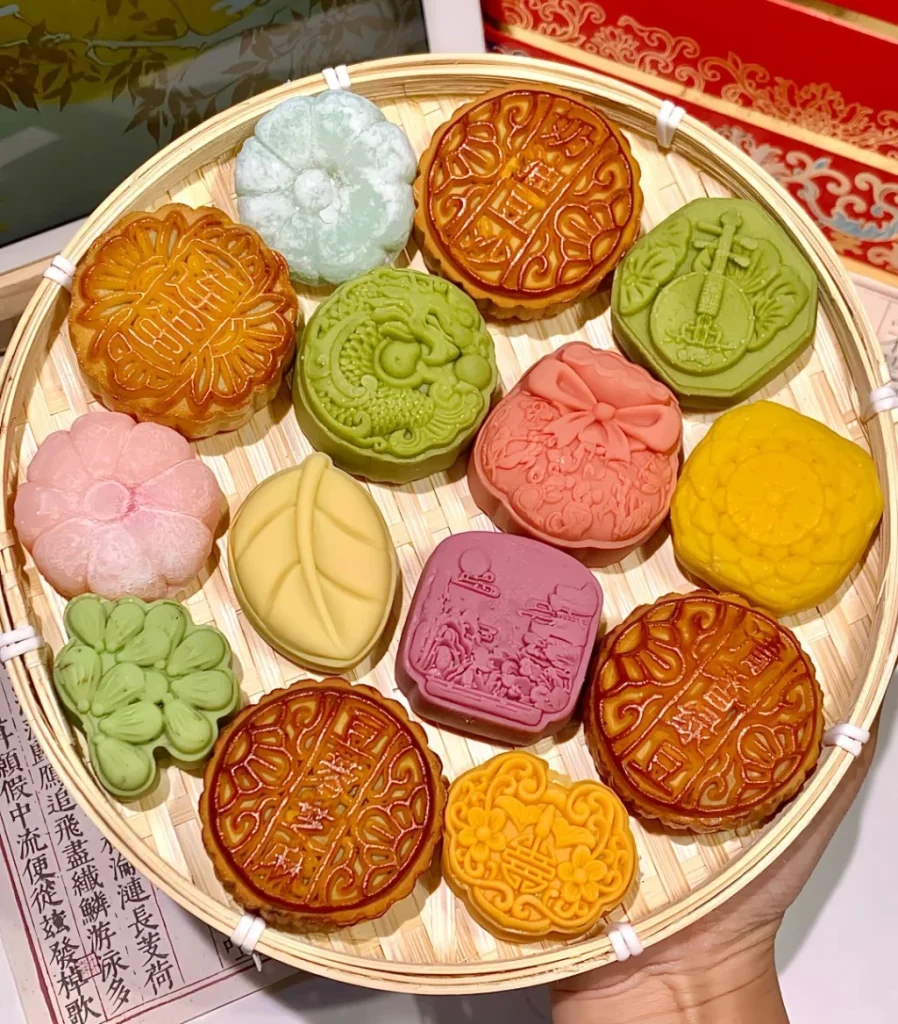
Eating mooncakes. Mooncakes (yuebing, 月饼) are the single most iconic food of the festival — round pastries traditionally filled with lotus seed or red bean paste, sometimes with a salted egg yolk in the center to represent the moon itself. They’re rarely bought for personal eating; instead, they’re given as gifts to family, friends, and colleagues in the weeks leading up to the festival.
Beyond the classic styles, mooncakes have branched out into several regional and modern variations that are increasingly popular outside China too:
| Style | What Makes It Different |
|---|---|
| Cantonese (广式) | Baked, golden-brown crust; the “classic” style most people picture |
| Snow skin (冰皮) | Chilled, made with a glutinous rice dough instead of baked pastry — no oven needed, often in bright colors |
| Custard / lava (流心) | A modern favorite with a warm, molten custard center that oozes out when cut |
| Five-kernel (五仁) | A traditional savory-sweet mix of nuts and seeds — divisive among younger generations, but a nostalgic favorite for many |
| Ice cream mooncake | A frozen, novelty take that’s become popular in recent years, especially in bigger cities |
Family reunion dinners. Much like Chinese New Year, Mid-Autumn Festival is a homecoming holiday. Extended families gather for a big evening meal, and it’s common for people to travel long distances to be there.
Moon-gazing. After dinner, families often go outside — to a rooftop, a park, or simply their own courtyard — to admire the full moon together. This is considered the most meaningful part of the night, tying back to the “reunion under one moon” symbolism.
Lanterns. Brightly colored lanterns, often in the shape of animals or written with riddles, are lit and carried or displayed in parks and along rivers. In places like Hong Kong and Singapore, large public lantern displays draw big crowds.
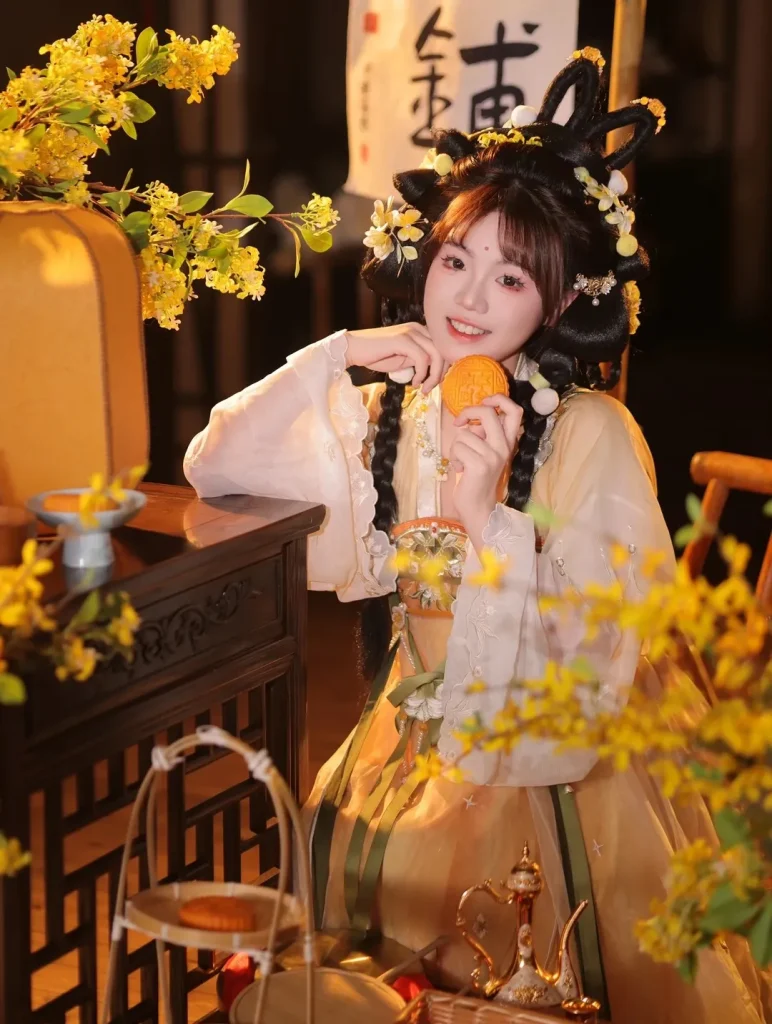
Traditional attire. In recent years, wearing Hanfu (traditional Chinese clothing) for Mid-Autumn gatherings and moon-viewing has become increasingly popular, especially among younger generations reconnecting with traditional culture.
While it originated in China, Mid-Autumn Festival is celebrated across much of East and Southeast Asia, often under different names. In Vietnam it’s Tết Trung Thu, sometimes called the Children’s Festival. In Japan, a related but distinct moon-viewing tradition is called Tsukimi. Korea celebrates Chuseok around the same time of year, with its own harvest and ancestor-honoring customs. Countries with large Chinese communities — including Singapore, Malaysia, and Hong Kong — also hold major public celebrations.
No piece of writing is more tied to Mid-Autumn Festival in Chinese culture than “Shui Diao Ge Tou” (水调歌头), written in 1076 by the Song Dynasty poet Su Shi while he was separated from his brother during the festival. It’s still memorized by Chinese schoolchildren today and often quoted, sung, or recited during Mid-Autumn celebrations.
The poem opens by questioning the bright moon and wondering what year it is in the heavens above, with the poet imagining riding the wind up to those distant palaces in the sky but fearing the cold up there, before deciding he’s happier dancing with his own moonlit shadow here on earth.
Its most famous closing lines reflect on how the moon waxes and wanes and people meet and part, just as no such thing has ever been perfect since ancient times — and end with a wish that, though far apart, loved ones can still share in the same beautiful moonlight together. That closing sentiment — being united under one moon even while physically apart — is really the emotional core of the entire festival, and it’s why the poem still resonates so strongly every autumn, more than 900 years after it was written.