
The Hungry Ghost Festival, known in Chinese as Zhongyuan Jie (中元节), falls on the 15th day of the seventh lunar month, usually landing sometime in August or early September on the Western calendar. According to Chinese folk belief, this is the one day of the year when the gates of the underworld swing open, allowing spirits to wander freely among the living for the entire month.
The seventh lunar month itself is often called “Ghost Month,” and Zhongyuan Jie sits right in the middle of it as the most important day for honoring the dead. Families burn incense, prepare food offerings, and light paper money to comfort both their own ancestors and the restless “hungry ghosts” who have no living descendants to care for them.
In the West, this occasion is almost always translated as the Hungry Ghost Festival, a name that captures its most vivid imagery but doesn’t quite explain where the tradition comes from. To really understand the day, it helps to know that it actually grew out of two separate religious traditions that eventually merged into one shared observance.
Although people in the West tend to use “Hungry Ghost Festival” as a catch-all term, Chinese culture actually recognizes two related but distinct traditions on the same day.
Zhongyuan Festival (中元节) comes from Daoism. In Daoist cosmology, the year is divided into three “yuan” periods governed by three officials: the Officer of Heaven, the Officer of Earth, and the Officer of Water. The Officer of Earth, who oversees forgiveness of sins, holds his birthday on the 15th day of the seventh month. On this day, the earth realm opens and spirits are released to receive prayers and offerings.
Yulanpen Festival (盂兰盆节), sometimes called the Ghost Festival in Buddhist contexts, traces back to the story of Mulian (目连), a disciple of the Buddha who used his supernatural powers to see that his deceased mother had been reborn as a hungry ghost, suffering from eternal starvation. The Buddha instructed him to make offerings of food to monks on the 15th day of the seventh month, which would relieve his mother’s suffering. This story became the basis for community offerings that free trapped souls from torment.
Over centuries, these two traditions blended together in Chinese folk practice, which is why modern celebrations of Zhongyuan Jie often include both Daoist rituals and Buddhist elements like feeding hungry ghosts. The English term “Hungry Ghost Festival” borrows its most iconic image directly from the Yulanpen story, even when people are technically observing the Daoist Zhongyuan Festival.
Zhongyuan Jie traditions center on two goals: honoring one’s own ancestors and pacifying the “hungry ghosts” who have no one to look after them.
Common practices include:
- Burning joss paper and paper money — Families burn paper replicas of money, clothing, and household goods so that ancestors have what they need in the afterlife.
- Preparing food offerings — Tables are set with dishes, fruit, and incense, often placed outdoors or at the roadside for wandering spirits who have no family altar to visit.
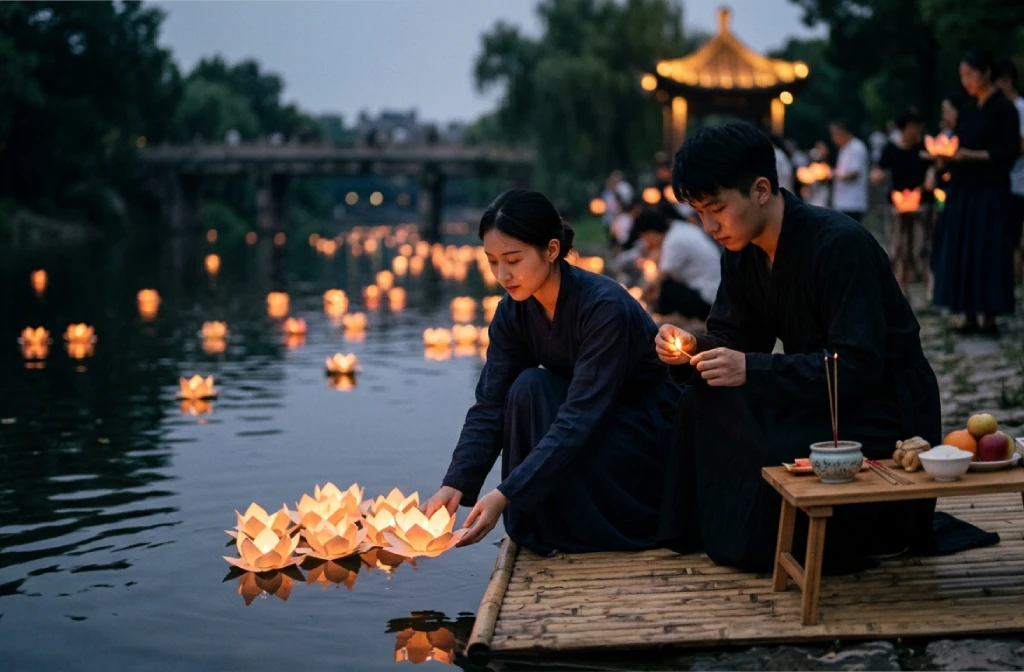
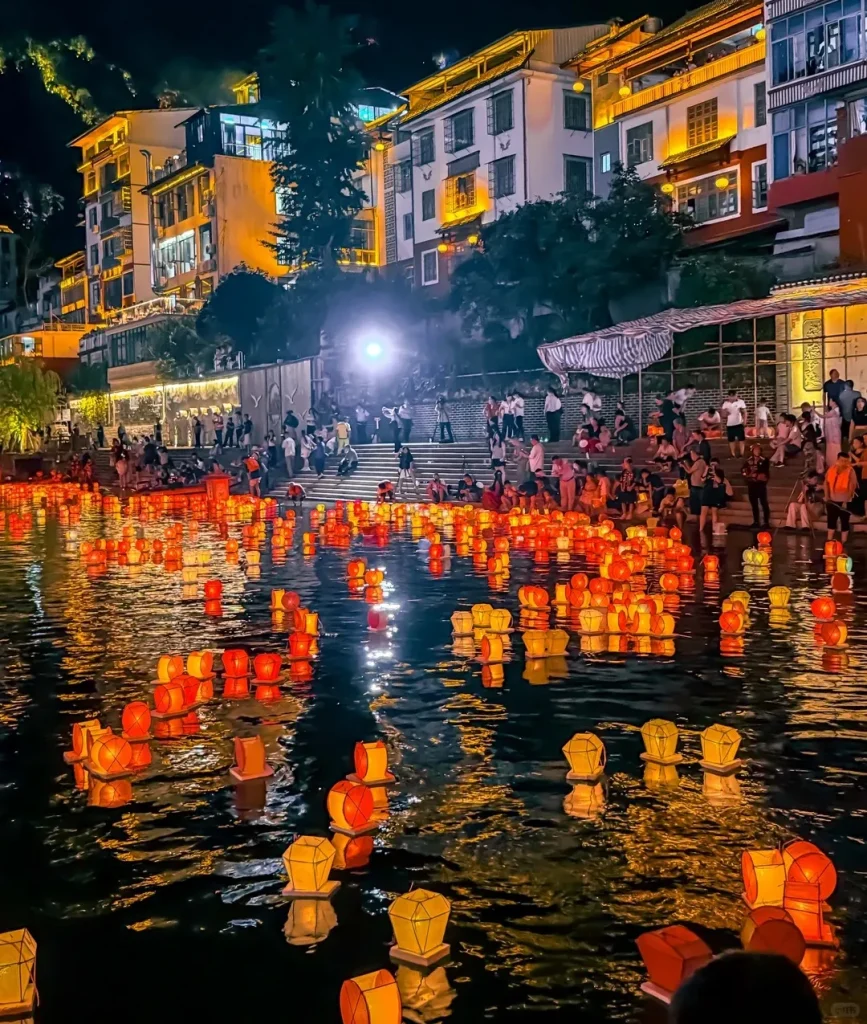
- Releasing floating lanterns — In many regions, lotus-shaped paper lanterns are set adrift on rivers and lakes at night, believed to guide lost souls back to the underworld once the festival ends.
- Avoiding certain activities — Many people avoid swimming, moving house, getting married, or staying out late during Ghost Month, out of caution around wandering spirits.
- Staging ghost operas — In parts of southern China and Southeast Asia, outdoor opera performances are held with a front-row seating area left empty, reserved for spirit audiences.
| Custom | Purpose |
|---|---|
| Burning paper money | Provides wealth for ancestors in the afterlife |
| Food offerings at roadside | Feeds wandering ghosts with no descendants |
| Floating river lanterns | Guides lost souls back to the underworld |
| Ghost opera performances | Entertains and appeases visiting spirits |
| Avoiding weddings/moves | Reduces risk of disturbing spirits during Ghost Month |
Clothing has always carried meaning in Chinese ritual life, and Zhongyuan Jie is no exception. Unlike celebratory festivals such as Chinese New Year, ancestor worship calls for restrained, respectful dress rather than bright colors. Most people today simply avoid flashy or festive outfits on this day, opting for plain, neutral clothing out of the same instinct that leads people to dress modestly for a memorial service in any culture.
Historically, this same principle shaped traditional Hanfu dress as well. Ritual clothing for ancestral offerings favored plain fabrics in white, black, or muted grey and blue tones, reflecting reverence rather than festivity. Styles like the straight-lined zhiduo or simpler, subdued forms of ruqun were considered appropriate for solemn occasions, in contrast to the layered, vividly dyed garments worn during joyful festivals.
Full traditional dress isn’t part of everyday observance now, but it still appears in temple ceremonies, folk rituals, and ghost opera performances during the seventh lunar month, where performers and ritual specialists often wear period-accurate Hanfu to lend authenticity to the occasion. It’s a useful reminder that in Hanfu culture, color and cut were never just aesthetic choices — they were tied directly to the emotional and spiritual purpose of the moment.
Quick dress code tips for Ghost Month:
- Colors to wear: Plain, neutral tones (white, black, grey, or muted blue).
- Styles to avoid: Flashy, neon, or overly festive outfits.
Zhongyuan Jie always falls on the 15th day of the seventh month in the Chinese lunar calendar, but because that calendar doesn’t line up neatly with the Gregorian calendar, the Western date shifts from year to year — typically landing sometime between mid-August and mid-September.
| Lunar Date | Typical Gregorian Window |
|---|---|
| 7th lunar month, day 15 | Mid-August to mid-September |
Ghost Month observances aren’t limited to a single day, either. Many families begin offerings as early as the 1st day of the seventh lunar month, when the gates of the underworld are believed to open, and continue various rituals through to the last day of the month, when the gates close again. Anyone planning to attend a temple ceremony or cultural event should check a Chinese lunar calendar converter for the exact Gregorian date in the relevant year, since it changes annually.
Is Zhongyuan Festival the same as Hungry Ghost Festival?
Yes, in everyday English usage they refer to the same occasion. Zhongyuan Festival is the Daoist name for the observance, while “Hungry Ghost Festival” is the common English translation that draws on imagery from the related Buddhist Yulanpen tradition.
Is Hungry Ghost Festival the same as Qingming Festival?
No. Qingming Festival, or Tomb-Sweeping Day, falls in early April and focuses on visiting and cleaning ancestral graves. Zhongyuan Jie falls in the seventh lunar month and focuses on offerings to both ancestors and wandering spirits, without the grave-visiting component.
Do people still celebrate this festival today?
Yes. Zhongyuan Jie is widely observed across mainland China, especially in southern regions such as Guangdong, Fujian, and the Jiangsu-Zhejiang area, where street offerings and paper burning remain common each year. The festival is also strongly kept in Taiwan, Hong Kong, Malaysia, Singapore, and among overseas Chinese communities worldwide, often alongside large-scale ghost opera performances and communal rituals.