
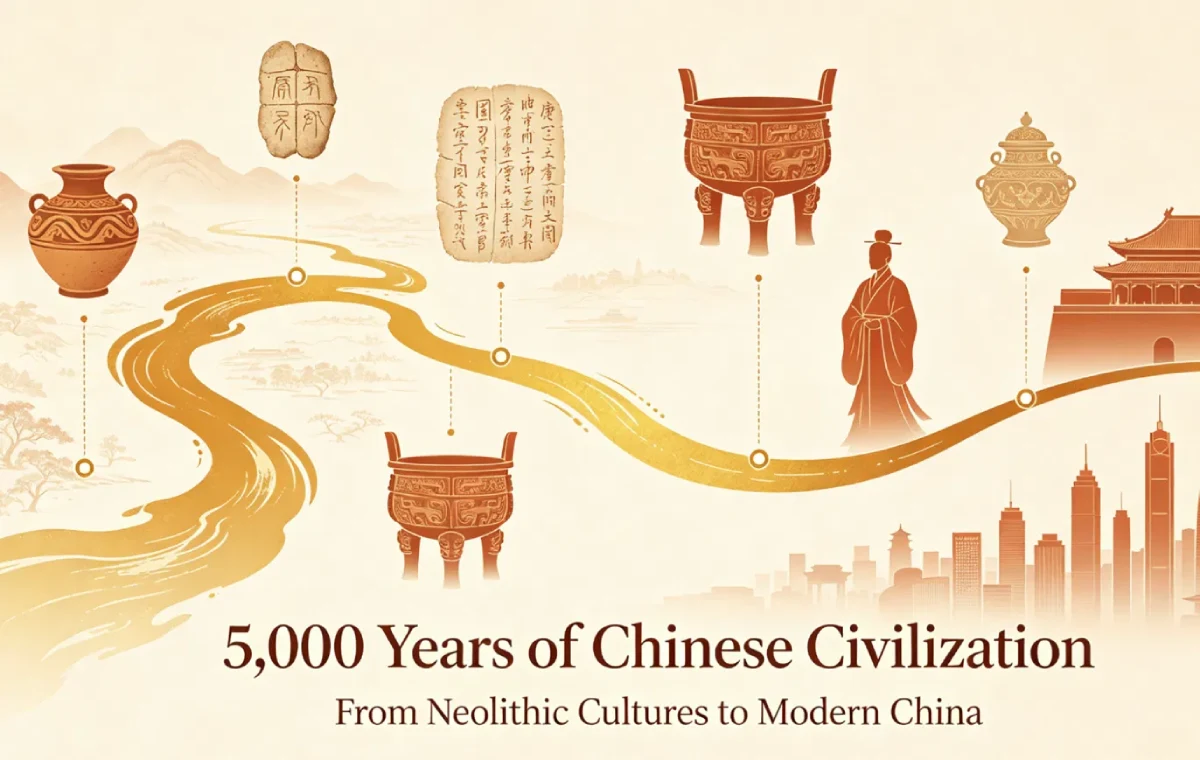
China is often called one of the world’s oldest continuous civilizations, but the exact answer to “how long has China been around” depends on how you define it. Are we counting from the first written records? The first unified dynasty? Or the earliest evidence of organized society along the Yellow River? Each answer gives a different number — and each tells a different part of the story.
This guide breaks down the timeline clearly, so you can understand not just how old China is, but why its history matters so much to the culture, art, and traditions that are still alive today.
The short answer: Chinese civilization stretches back roughly 5,000 years, though the number you’ll see depends on the measuring stick:
By written history — Around 3,300 years, starting with the oracle bone inscriptions of the Shang Dynasty (c. 1600 BCE).
By the first unified dynasty — Around 2,200 years, starting with the Qin Dynasty’s unification of China in 221 BCE.
By continuous cultural and civilizational identity — Around 5,000 years, tracing back to early Yellow River Neolithic cultures and the legendary Xia Dynasty (c. 2070 BCE).
China is frequently ranked alongside Mesopotamia, Ancient Egypt, and the Indus Valley as one of the world’s earliest cradles of civilization — but it is the only one of these to have maintained a continuous cultural, linguistic, and political identity all the way to the present day.
Here’s a simplified overview of the major periods that make up China’s long history:
| Period | Approximate Dates |
|---|---|
| Neolithic Cultures (Yangshao, Longshan) | c. 5000–2000 BCE |
| Xia Dynasty (semi-legendary) | c. 2070–1600 BCE |
| Shang Dynasty | c. 1600–1046 BCE |
| Zhou Dynasty | 1046–256 BCE |
| Qin Dynasty (first unification) | 221–206 BCE |
| Han Dynasty | 206 BCE–220 CE |
| Tang Dynasty | 618–907 CE |
| Song Dynasty | 960–1279 CE |
| Ming Dynasty | 1368–1644 CE |
| Qing Dynasty (last imperial dynasty) | 1644–1912 CE |
| Modern China | 1912–present |
The “5,000 years of civilization” phrase is a source of national pride in China, and it’s grounded in real archaeological findings, even if the earliest period blends into legend:
Yellow River Neolithic cultures — Sites like Yangshao (c. 5000 BCE) show organized farming villages, pottery, and early social structures along the Yellow River, considered the cradle of Chinese civilization.
The Xia Dynasty — Traditionally dated to around 2070 BCE, the Xia is considered China’s first dynasty in classical histories, though archaeological confirmation is still debated among historians. Sites like Erlitou are widely believed to correspond to this period.
The Shang Dynasty and written language — This is where legend gives way to hard evidence. Oracle bones inscribed with an early form of Chinese characters have been excavated in large numbers, giving historians a direct written record and marking the beginning of confirmed Chinese written history.
Unlike many ancient civilizations whose language, writing system, and cultural practices have been lost or radically discontinued, China represents a rare case of cultural continuity. The Chinese script used today can be traced back, through a long evolutionary process, to those Shang Dynasty oracle bones. Many philosophical ideas from the Zhou and Han dynasties — Confucianism, Daoism — still shape social values today.
This continuity is exactly why traditional clothing, festivals, and customs from thousands of years ago aren’t just historical curiosities — they’re living traditions. Hanfu, for example, isn’t a costume frozen in a museum; it’s a style of dress with roots stretching back to the Han and Tang dynasties that people around the world still wear and reinterpret today. Understanding just how long this history runs helps explain why these traditions carry so much cultural weight.
| If you’re asking about… | The answer is roughly… |
|---|---|
| Confirmed written history | 3,300+ years |
| A unified Chinese state | 2,200+ years |
| Continuous civilization / cultural identity | 5,000+ years |
There’s no single “correct” number — it depends on what exactly you’re measuring. But by any definition, China’s history is among the longest continuously documented and culturally unbroken in the world.