

From the bronze-plated charioteers of the Shang dynasty to the magnificently lacquered generals of the Ming, Chinese armor tells a story of craft, power, and cultural identity stretching across three thousand years. Unlike the heavy full-plate suits of medieval Europe, Chinese warriors wore armor that prized movement, artistry, and symbolism as much as brute protection — making it one of the most visually distinctive military traditions in the world.
Whether you’re fascinated by Chinese history, drawn to the aesthetic of ancient warriors, or exploring the broader world of traditional Chinese clothing and Hanfu, understanding Chinese armor opens a window into the same world of silk, lacquer, and dragon imagery that defines China’s visual heritage.
In Chinese, armor is written as 铠甲 (kǎijiǎ) — a compound of two characters. 甲 (jiǎ) is the older term, used since the pre-Qin era for leather-based body protection. 铠 (kǎi) emerged during the Qin and Han dynasties as iron armor became widespread. Together, they represent the full evolution of Chinese protective battle dress.
The phrase 甲胄 (jiǎzhòu) — meaning “armor and helmet” — appears frequently in classical literature and military texts, underscoring how inseparable the two pieces were in Chinese military culture.
The earliest Chinese armor was made from buffalo and rhinoceros hide, cut into overlapping pieces and lacquered for hardness. Nobility fighting from war chariots wore bronze-reinforced versions, often with elaborate engravings that mirrored the ritual bronzeware of the era.
By the middle of the Zhou dynasty, a more flexible design emerged: small overlapping rectangles of leather laced together with hemp cord or leather thongs, forming a tunic-style garment. Helmets of this period were typically spherical bronze caps, lined inside with soft material to cushion blows, weighing around 2–3 kilograms.

The Terracotta Warriors of Qin Shi Huang’s burial complex are one of the most detailed records of early Chinese armor. The thousands of clay soldiers show infantry armor constructed from small overlapping scales, with V-shaped braided red rope connecting each piece — functional, but also distinctly decorative.

During the Han dynasty, metal scale armor became widespread across both infantry and cavalry. Scales were made from bronze, iron, or steel, and horses began receiving armored protection for the first time. Written records frequently refer to Xuanjia (玄甲) — “black armor” — named for the dark lacquer applied both to protect against rust and to project a unified, formidable appearance on the battlefield.
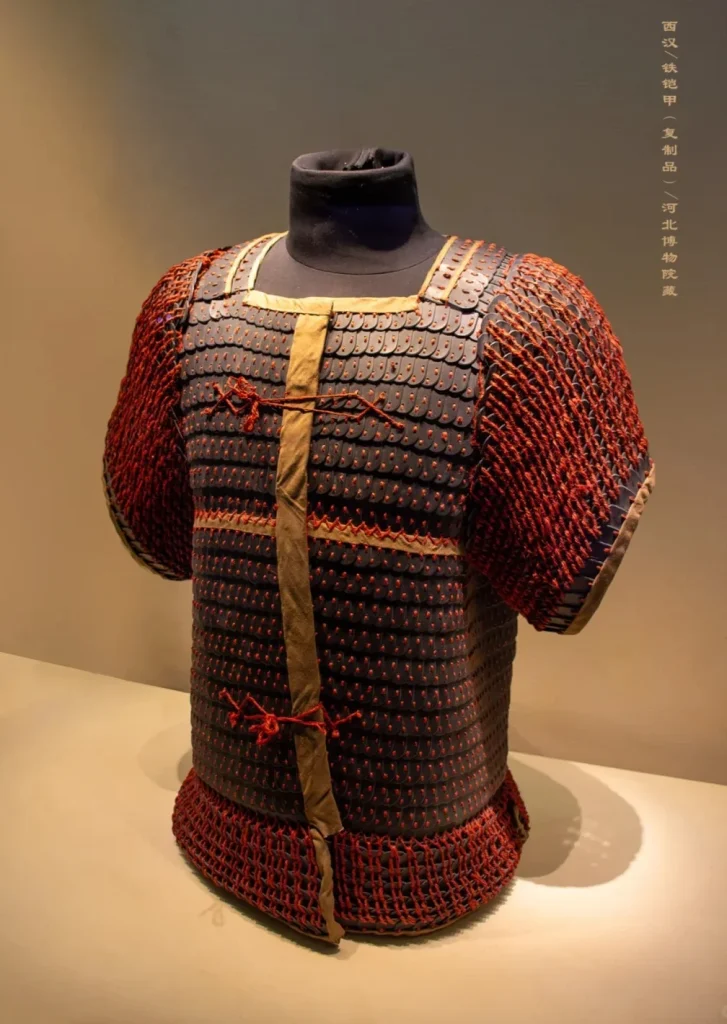
This turbulent era of fragmented kingdoms pushed armor technology forward rapidly. By the early 4th century, fully armored horses (马铠, mǎkǎi) appeared on the battlefield — the rider and mount together forming an iron-clad unit of devastating force. Banded armor, made from long horizontal iron strips similar to the Roman lorica segmentata, also emerged during this period.
The Tang dynasty represents the artistic and technological peak of Chinese armor-making. Mingguang armor (明光甲, “bright armor”) became the iconic style of the era: large polished iron mirrors were mounted on the chest and back, reflecting sunlight to dazzle and intimidate enemies. The rest of the suit combined lamellar sections, cloth padding, and decorative lacquered leather — a synthesis of protection and pageantry.
Tang generals’ armor featured full tube-shaped sleeve guards, separate thigh protection, and helmets assembled from multiple overlapping iron plates, sometimes engraved with silver. Mail armor — introduced via Central Asian tribute gifts to the Tang emperor in 718 CE — also entered the Chinese arsenal during this period.
The Tang armor silhouette, with its broad shoulders, layered skirts, and gleaming chest mirrors, is one of the most recognizable in East Asian visual culture and remains a major influence on Chinese historical dramas (C-dramas) and fantasy art today.

Song dynasty armor is often cited as the most technically refined in Chinese history. The signature innovation was mountain pattern armor (山文甲, shānwén jiǎ) — small interlocking iron pieces assembled into a pattern that resembles the Chinese character for “mountain” (山). The design created an exceptionally flexible yet protective surface without the need for lacing or backing material.
Song military texts praised their weapons and armor as “exceedingly effective, never before seen in recent times.” The dynasty’s major engineering investment in heavy infantry protection reflected the constant military pressure from northern states like the Liao, Jin, and later Mongol forces.
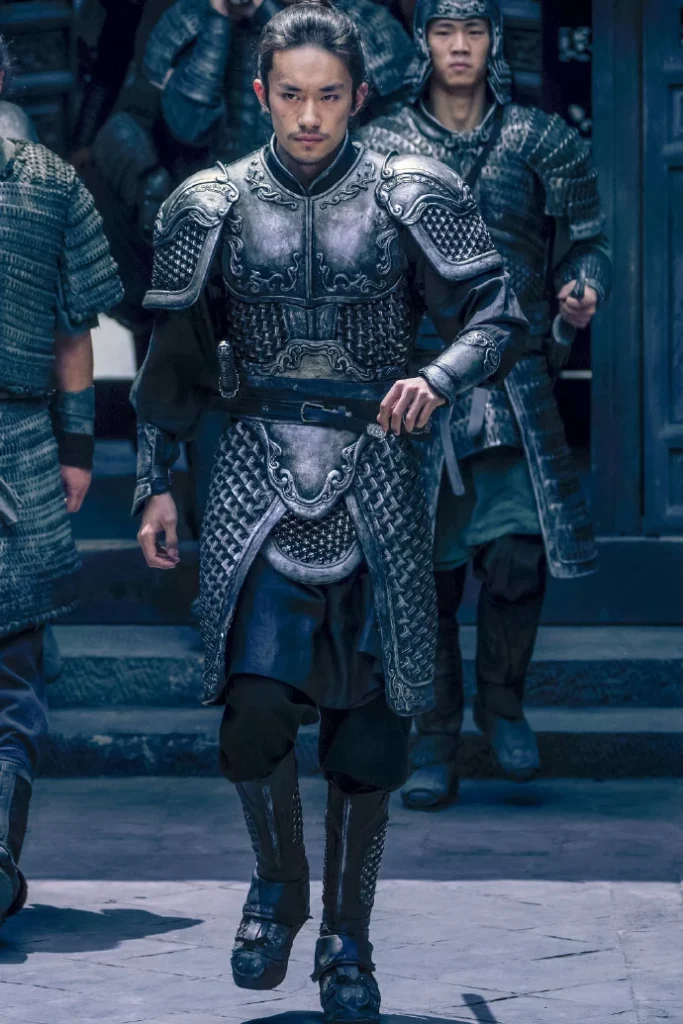
The Ming period saw widespread use of brigandine armor (布面甲) — a cloth or leather outer garment with small iron or steel plates riveted inside. This design, consisting of five components (vest, pauldrons, skirting, underarm guards, and groin section), was comfortable, practical, and adaptable for both infantry and cavalry.
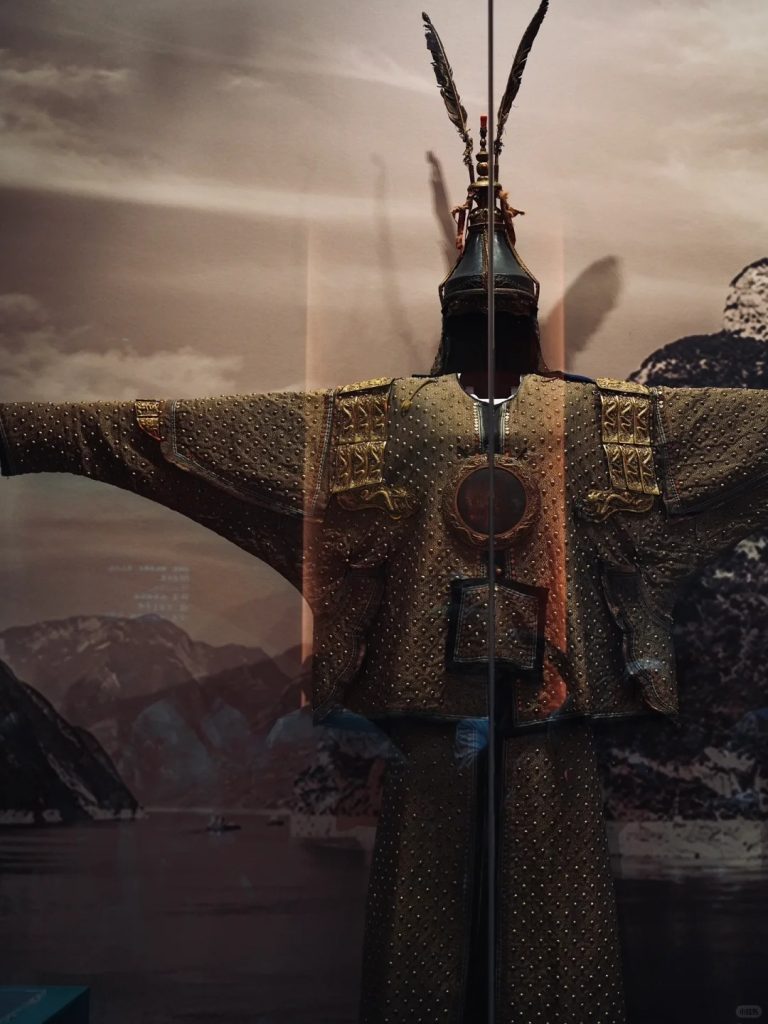
Ming ceremonial armor reached extraordinary levels of decoration. Dragon motifs in gilt metalwork, embedded gemstones, and enameled inlay made high-ranking generals’ suits as much works of art as instruments of war. The tui qun (腿裙, leg skirt) was refined with hooks so it could be folded up while walking — a small but telling detail of the practical ingenuity built into even the most ornate suits.
By the Qing dynasty, as firearms rendered traditional armor increasingly obsolete, armor became primarily ceremonial — a symbol of rank and dynastic prestige rather than battlefield protection. Qing imperial armor is recognizable from countless period dramas: layered fabric construction with decorative metal studs, elaborate helmet crests, and color-coded components indicating the wearer’s banner and rank.

| Dynasty / Era | Key Characteristics |
|---|---|
| Pre-Qin | Lacquered buffalo/rhinoceros hide; foundational leather construction |
| Qin–Han | Overlapping metal scales; iron widespread; horse armor introduced |
| Han–Tang | Laced lamellar columns; vertical plate rows tied with cord |
| Tang | Polished chest mirrors (明光甲); full sleeve and thigh guards |
| Tang–Song | Interlocking 山-shaped pieces; no lacing needed |
| Ming–Qing | Cloth exterior with riveted interior plates; brigandine style |
Chinese armor was never purely functional. Like Hanfu and other forms of traditional Chinese dress, it served as a public statement of identity, rank, and cosmic alignment.
Dragon motifs were reserved for imperial and high-ranking military figures, symbolizing the mandate of heaven, strength, and protection in battle. Tigers represented ferocity and authority in war. The Taotie (饕餮) — a mysterious animal-face motif from ancient bronze culture — appeared on armor to invoke awe and spiritual protection.
The choice of color was equally significant. Black signified the disciplined armies of Qin. Gold-trimmed armor in the Liang dynasty was deliberately designed to be seen — its brilliance reportedly demoralizing enemy soldiers before battle began. Tang imperial guards wore red and blue banded armor color-coded by regiment, creating a visual system of military identity.
Decorative techniques included:
- Painting and lacquering: multiple layers applied for color, protection, and preservation
- Braided rope patterns: dyed silk, hemp, or leather woven between plates in geometric designs
- Gilding and silver inlay: reserved for elite officers and ceremonial pieces
- Engraved bronze and iron: surface designs ranging from abstract patterns to mythological scenes
A common question among enthusiasts is how Chinese armor compares to the full-plate armor of medieval Europe. The differences are rooted in contrasting combat philosophies.
European plate armor prioritized maximum frontal protection for knights fighting on horseback in close formation, accepting significant weight and restricted movement as trade-offs.
Chinese armor consistently prioritized mobility and versatility. The ideal was a suit that allowed a warrior to ride, dismount, draw a bow, and employ martial techniques in fluid succession. This is why lamellar, scale, and brigandine constructions dominated Chinese military history — all offer superior flexibility compared to solid plate.
This is also why Chinese armor aligns so naturally with the aesthetic sensibility of traditional Chinese clothing: both traditions value layering, textile-metal combinations, decorative craft, and the visual expression of status and identity through material culture.
Today, Chinese armor enjoys a vibrant afterlife in popular culture. C-dramas set in dynasties from Han to Qing have created an enormous global audience fascinated by the visual language of ancient Chinese military dress. Series like Nirvana in Fire, The Untamed, and The Legend of Fuyao have brought Tang and Song armor aesthetics to millions of viewers worldwide.
For Hanfu enthusiasts, warrior or general-style Hanfu coordinates inspired by armor — featuring structured shoulder pieces, layered robes in military colors, and accessories like jade sword pendants — represent a growing category of traditional dress. The visual dialogue between civilian Hanfu and military armor has always been close: both draw on the same dynasty-specific silhouettes, color traditions, and craft heritage.
Cosplayers, historical reenactors, and photographers regularly combine armor-inspired pieces with Hanfu to create striking visual compositions that honor the full range of traditional Chinese material culture.
What materials were used in Chinese armor? Chinese armor used a wide range of materials across different eras: rhinoceros and buffalo hide (early periods), lacquered leather, bronze, iron, steel, silk padding, and hemp cord for lacing.
Did Chinese soldiers actually wear armor in battle? Yes, though access varied by rank and era. Elite cavalry and infantry were well-armored; lighter skirmishing units often wore little or no armor. Armor ownership was strictly regulated — private possession of a full suit could be treated as evidence of rebellion in some dynasties.
What is the most famous type of Chinese armor? Tang dynasty Mingguang armor (明光甲) is arguably the most visually iconic, recognized for its polished mirror breastplates. Song dynasty mountain pattern armor (山文甲) is often cited as the most technically sophisticated.
How does Chinese armor relate to Hanfu? Both belong to the same dynasty-specific visual tradition. The silhouettes, colors, decorative motifs, and fabric-metal combinations seen in armor reflect and complement the civilian dress of the same era. Many Hanfu styles draw direct inspiration from military dress, particularly the cross-collar robes and layered shoulder structures seen in Tang and Ming general costumes.
Is authentic Chinese armor available for collectors? Original pieces from the Song dynasty or earlier are extremely rare — armor was state-controlled property collected after wars, and most was destroyed or lost during dynastic transitions. Late Qing ceremonial armor exists in museum collections. Reproduction armor crafted by traditional methods is available from specialist workshops in China.
Chinese armor is far more than a military artifact. It is a three-thousand-year conversation between craft and warfare, between individual identity and dynastic power, between the practical and the beautiful. The same cultural values that shaped the flowing silhouettes of Hanfu — reverence for material quality, symbolic richness, and the expression of cosmic order through dress — are woven into every lamellar plate and lacquered scale.
For anyone exploring traditional Chinese culture through clothing and history, Chinese armor is an essential chapter in the story.
Explore more traditional Chinese clothing history on our site, including guides to Hanfu styles by dynasty, Chinese hairstyles, and the symbolism of traditional accessories.