
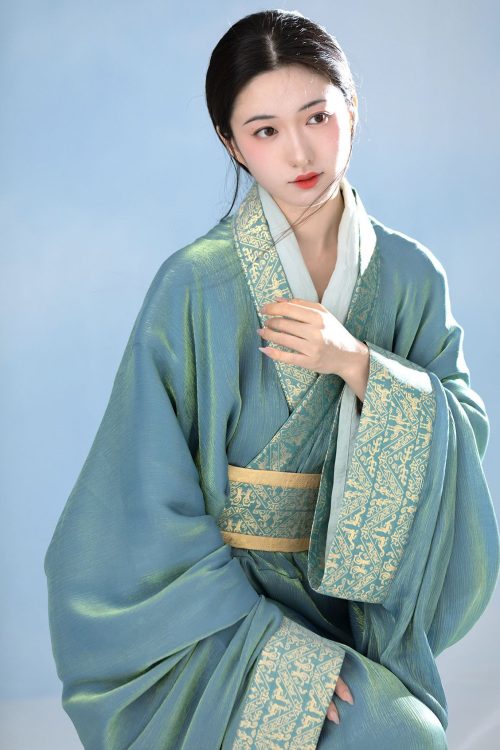
If you’ve ever admired a Hanfu garment and noticed how the front panels cross gracefully at the chest — one layered over the other, forming a neat diagonal line — you’ve already seen Jiaoling Youren in action. Jiaoling Youren (交領右衽, jiāo lǐng yòu rèn) — literally “cross-collar, right lapel” — it is not merely a style choice. It is a signature of Chinese civilization, a design element that has endured across dynasties spanning more than three thousand years.
Whether you are a Hanfu newcomer, a cosplayer, a cultural researcher, or simply someone who picked up a beautiful 襦裙 (Ruqun) and isn’t quite sure where to start, this guide will walk you through everything you need to know about Jiaoling Youren — what it is, why it matters, and step-by-step how to wear it correctly.
Jiaoling Youren (交領右衽) describes a neckline construction in which two front fabric panels overlap each other diagonally. The right panel always goes beneath, and the left panel folds over the top, creating a smooth “Y”-shaped opening at the chest. This left-over-right configuration is called 右衽 (yòu rèn) — literally “right lapel” — and it is one of the most culturally significant details in all of Chinese dress.
“The direction of the collar is not decoration — it is identity. Ancient texts record that Han Chinese wore the right lapel; this single detail distinguished one civilization from another.”
Jiaoling Youren appears across virtually every major Hanfu category: the 曲裾 (qūjū) deep-robe of the Han dynasty, the loose 直裾 (zhíjū) robes of the Wei and Jin scholars, the layered 襦裙 (Ruqun) ensembles of the Tang dynasty, and the refined 道袍 (dàopáo) of the Ming dynasty. In each era, the form evolved, yet the Jiaoling Youren principle remained constant.
✦ Correct vs. Incorrect: The Two Directions
✅ Right way — 右衽 (yòu rèn), “Right Lapel”
Left panel over right. Right panel goes underneath. This is the standard direction for all everyday and formal Hanfu wear.
❌ Wrong way — 左衽 (zuǒ rèn), “Left Lapel”
Right panel over left. Historically associated with non-Han dress traditions and certain ritual contexts. For this reason, modern Hanfu wearers generally avoid using it in everyday clothing.

The origins of Jiaoling Youren can be traced to oracle bone inscriptions and bronze vessel carvings of the Shang dynasty (c. 1600–1046 BCE). By the time of the Zhou dynasty (1046–256 BCE), the configuration was codified in ritual texts such as the Rites of Zhou — establishing 右衽 as the proper dress of the living.
Understanding this history matters because it reveals why Jiaoling Youren is more than a silhouette: it is a visual language connecting the wearer to a Chinese cultural inheritance that stretches deep into antiquity.
Dynasty Timeline
Shang & Zhou · c. 1600–221 BCE
Jiaoling Youren first codified in ritual texts. 右衽 established as the Han Chinese dress convention, explicitly contrasted with 左衽 in classical writing.
Han Dynasty · 206 BCE–220 CE
The spiral-hemmed 曲裾 robe becomes the defining garment of the imperial world. Jiaoling Youren reaches its most dramatic and sculptural form.
Wei–Jin Period · 220–589 CE
Scholars favor loose 直裾 robes. Jiaoling Youren takes on a philosophical, unhurried aesthetic associated with the literati ideal.
Tang Dynasty · 618–907 CE
Jiaoling Youren 襦 blouses worn with dramatic colors and sometimes wide, expressive openings. Cosmopolitan and confident in style.
Ming Dynasty · 1368–1644 CE
道袍 and 直身 robes refine the Jiaoling Youren collar into elegant wide-sleeved scholarly dress. One of the most popular eras for Hanfu revival enthusiasts today.
The mechanics of wearing a Jiaoling Youren garment are straightforward — but getting them right matters both visually and culturally. Follow these six steps for a clean, correct result every time.
Step 1 — Put the garment on with both panels open
Slip your arms through the sleeves. Let both front panels hang freely before you begin crossing them. Make sure the garment sits squarely on your shoulders with the center back seam running straight down your spine.

Step 2 — Bring the right panel across your body first
Take the right front panel and draw it across to your left side, angling it diagonally toward your left hip. This panel goes underneath. It should lie flat against your body, not twisted or bunched.

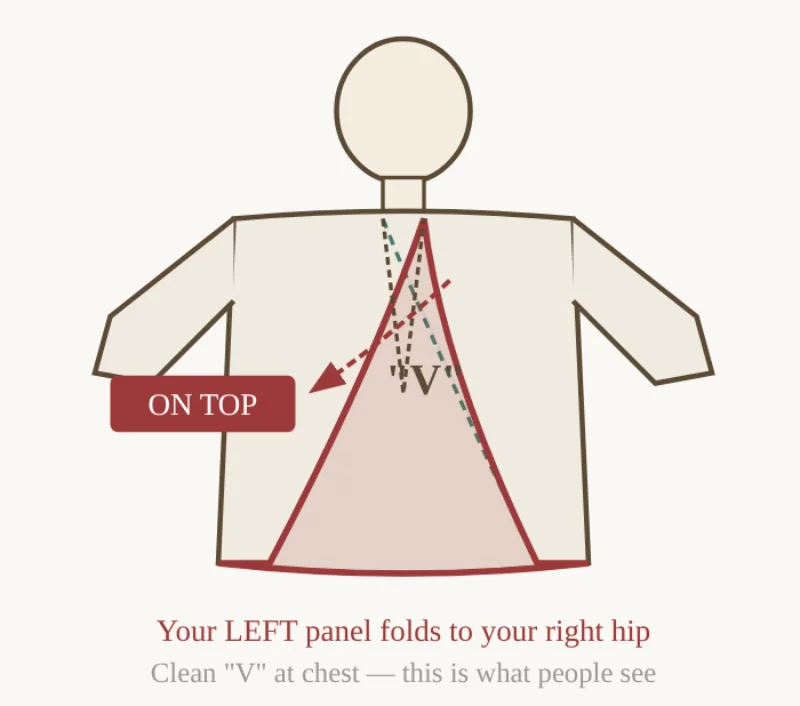
Step 3 — Fold the left panel over the top
Take the left panel and lay it over the right, crossing diagonally to your right side. This is the visible layer. Adjust its angle so the collar forms a clean, symmetrical “V” at your chest. The crossing point should sit at approximately the level of your natural waist or slightly above.
Step 4 — Secure with the inner tie first
Most Jiaoling Youren garments have a small inner tie sewn to the right panel. Tie this to the inner left side of the garment first — this anchors the right (underneath) panel in place and prevents the collar from splaying open as you move.

Step 5 — Tie the outer ribbons or add a sash
Secure the outer ribbons at the left side. For layered looks, a 大带 (dàdài) — a wide fabric sash — is then wrapped over the whole garment and tied at the front or side. This sash holds everything in place and creates the characteristic cinched silhouette seen in historical portraits.

Step 6 — Check and refine the collar line
Stand in front of a mirror. The collar should form a smooth diagonal from each shoulder down to a single crossing point at the chest. The right panel should be completely hidden behind the left. Pull gently at the collar edges to remove any wrinkles, and ensure the left panel lies perfectly flat with no gaping.

✅ Things to Do
- Always cross left over right — right panel goes underneath
- Secure the inner tie before the outer ribbons
- Re-check and adjust the collar after putting on any sash or belt
- Use collar clips or mild fabric tape for photoshoots
- Iron or steam the collar area before wearing
- Use collar stiffeners for formal or stage wear
❌ Things to Avoid
- Crossing right over left — this is the mourning direction
- Skipping the inner tie and relying only on the outer ribbons
- Letting the collar gap open at the chest
- Pulling the collar so wide it exposes the inner panel
- Wearing the crossing point too high, up at the throat
- Leaving the two panels at unequal angles
Jiaoling Youren appears in many Hanfu silhouettes. While the wrapping principle stays the same, each style has its own nuances.
曲裾 (Qūjū) — Curved Hem Robe
The most dramatic application of Jiaoling Youren. The entire robe wraps around the body in a spiral, with the hem sweeping across the front. Jiaoling Youren is the beginning of a long, flowing diagonal line that defines the whole garment. Originated in the Warring States period and peaked during the Han dynasty.
直裾 / 深衣 (Zhíjū / Shēnyī) — Straight Hem Robe
A simpler, more versatile form. The Jiaoling Youren collar opens into a straight-hemmed garment without a spiral wrap. Beloved by scholars of the Wei–Jin period for its unadorned aesthetic. An excellent starting point for Hanfu beginners.
襦裙 (Ruqun) — Short Jacket with Skirt
Here Jiaoling Youren appears on the short upper jacket — the 交領襦 (jiāo lǐng rú). The collar opening tends to be shallower than in robes, and the garment is often worn with inner collars visible beneath for a layered effect. One of the most popular Hanfu styles today.
道袍 (Dàopáo) — Scholar’s Robe
A Ming dynasty refinement with wide sleeves, side gussets, and a broad, relaxed Jiaoling Youren opening. The collar often shows the contrasting inner collar fabric. Elegant and well-suited to formal occasions.
圓領袍 (Yuánlǐng Páo) — Round-Collar Robe
Technically not a Jiaoling Youren style — included here to clarify the difference. The round-collar robe, common in Tang official dress, buttons at the right shoulder and side rather than crossing at the chest. Knowing this distinction helps you identify garments correctly when shopping or studying historical costumes.
Does it really matter which way the collar crosses?
Yes — historically and culturally, it matters very much. The right-lapel crossing (右衽, left panel over right) is the living Han Chinese convention, referenced explicitly in classical texts including the Analects of Confucius. The reversed direction (左衽) was associated historically with mourning. In modern Hanfu practice, wearing it correctly is a sign of cultural literacy and respect.
My garment doesn’t have inner ties. How do I keep the collar in place?
Some modern Hanfu garments, especially inexpensive ones, omit inner ties. In that case, use dress snaps or lightweight fabric clips sewn inside the right panel at the chest. For photoshoots, a small strip of double-sided fabric tape between the panels at the crossing point works well. A properly tightened outer sash or 大带 also helps hold the shape.
How wide should the “V” opening be?
This depends on the garment style and dynasty. Han dynasty 曲裾 robes typically show a narrow V, often with the inner collar barely visible. Tang-style 襦 jackets can have a considerably wider opening. Ming 道袍 collars are moderate. As a general rule, the opening should reveal the inner collar fabric if layered, but should not expose bare chest skin in formal or public settings.
Can I wear Jiaoling Youren Hanfu for everyday life?
Absolutely — the modern Hanfu revival movement is built around exactly this. Many practitioners wear simplified 襦裙 and 直裾 styles to university, cafés, and everyday outings. Jiaoling Youren is a living garment tradition, not a museum piece. Start with a relaxed, machine-washable version in a comfortable fabric if you’re new to daily wear.
I see some Hanfu styles with a standing collar instead. Are those not authentic?
Standing collars (立領, lì lǐng) did appear in late Ming dynasty garments, influenced by evolving fashion of the period. They are considered part of the broader Hanfu historical record. However, Jiaoling Youren remains the most historically prevalent and culturally resonant collar form across the longest span of Chinese history.
Jiaoling Youren is a thread connecting you to thousands of years of living culture. Once you understand it, you see it everywhere — in museum paintings, in ancient poetry, in the folds of a silk robe across millennia. Wear it with knowledge, and wear it with pride.