

Every year on the fifth day of the fifth lunar month, millions of people across China and the wider Chinese-speaking world gather at riversides, unwrap fragrant sticky rice dumplings, and cheer on teams of paddlers racing to the thunder of drums. This is Dragon Boat Festival — known in Chinese as 端午节 (Duānwǔ Jié) — one of the oldest, most culturally layered holidays in the Chinese calendar.
Whether you are planning to attend a race, cook zongzi at home, or simply deepen your understanding of Chinese culture, this guide covers everything worth knowing about Duanwu — its origins, its traditions, its foods, and what the festival looks and feels like today.
Dragon Boat Festival falls on the 5th day of the 5th lunar month, which shifts each year on the Gregorian calendar, typically landing in late May or June. Mainland China observes a three-day public holiday starting on the festival day.
| Year & Date | Day & Holiday |
|---|---|
| 2025 — May 31 | Sat · May 31–Jun 2 |
| 2026 — Jun 19 | Fri · Jun 19–21 |
| 2027 — Jun 9 | Wed · Jun 9–11 |
| 2028 — May 28 | Sun · May 28–30 |
| 2029 — Jun 16 | Sat · Jun 16–18 |
| 2030 — Jun 5 | Wed · Jun 5–7 |
Dragon Boat Festival is one of the four grandest traditional holidays in China, alongside Chinese New Year, Mid-Autumn Festival, and Qingming. It has been observed for more than 2,000 years and in 2009 was inscribed on the UNESCO Intangible Cultural Heritage list — recognition of its living significance not just in China but across East and Southeast Asia.
The festival is called Duanwu (端午), which translates roughly as “upright noon” or “the beginning of the fifth.” The “double fifth” nickname comes from the date itself: the fifth day of the fifth lunar month, a date traditionally associated in Chinese cosmology with heightened yang energy, the peak of summer heat, and the rise of the “five venomous creatures” — centipede, snake, scorpion, toad, and gecko — that ancient people believed threatened human health.
As a result, the festival carries two distinct layers: one of mourning and patriotism tied to the legend of Qu Yuan, and one of protective ritual designed to ward off illness and evil during the most dangerous season of the year.
The best-known origin story of Dragon Boat Festival centers on Qu Yuan (屈原, c. 340–278 BCE), a poet, statesman, and loyal minister of the ancient state of Chu during the Warring States period.
Qu Yuan was known for his integrity and his advocacy for an alliance against the growing power of the Qin state. When political rivals slandered him to the king, he was stripped of his office and exiled to the countryside. During those years of wandering, he poured his grief and devotion into poetry — works that would become foundational texts in Chinese literary history. His longest poem, Li Sao (离骚, “Encountering Sorrow”), runs to more than 370 lines and remains one of the most celebrated works in classical Chinese literature.
When he received news that the Chu capital had fallen to Qin forces, Qu Yuan waded into the Miluo River and drowned himself on the fifth day of the fifth lunar month, in an act of protest and despair. He was 62 years old.
Local people who revered him raced out in boats to try to save him, or at least to recover his body, beating drums to frighten away fish. They threw rice wrapped in leaves into the water, hoping to keep the fish from consuming his remains. These two acts — the boat race and the rice offering — evolved over centuries into the defining rituals of the festival we know today.
Qu Yuan’s story resonated so deeply because it spoke to themes that transcended his era: loyalty over self-interest, principle over survival, love of homeland. He was posthumously declared a national hero and is considered the father of Chinese poetry.

Note on other origin legends: Some historians believe the festival predates Qu Yuan and was originally a water dragon worship ritual practiced by southern Chinese ethnic groups. A separate tradition in Wu and Yue regions associates the festival with the loyal minister Wu Zixu. Qu Yuan’s legend, however, is by far the most widely known and emotionally resonant.
Dragon Boat Racing (赛龙舟)
The most visually spectacular tradition is dragon boat racing. Teams of paddlers — typically 20 to 22 people per boat — power long, narrow vessels carved and painted to resemble dragons, while a drummer at the bow beats a pounding rhythm to synchronize the crew.
Races take place on rivers, lakes, and reservoirs across China, and the atmosphere at a major race is electric: banks lined with cheering crowds, the crack of the starting gun, boats launching in tight formation with paddles churning the water white. The best-known international events include the Hong Kong International Dragon Boat Races and Singapore’s annual competition, which draws teams from around the world.
Dragon boat racing has spread globally over the past few decades. Clubs now exist in cities across North America, Europe, and Australia, making it one of the most internationally adopted elements of Chinese traditional culture.

Eating Zongzi (粽子)
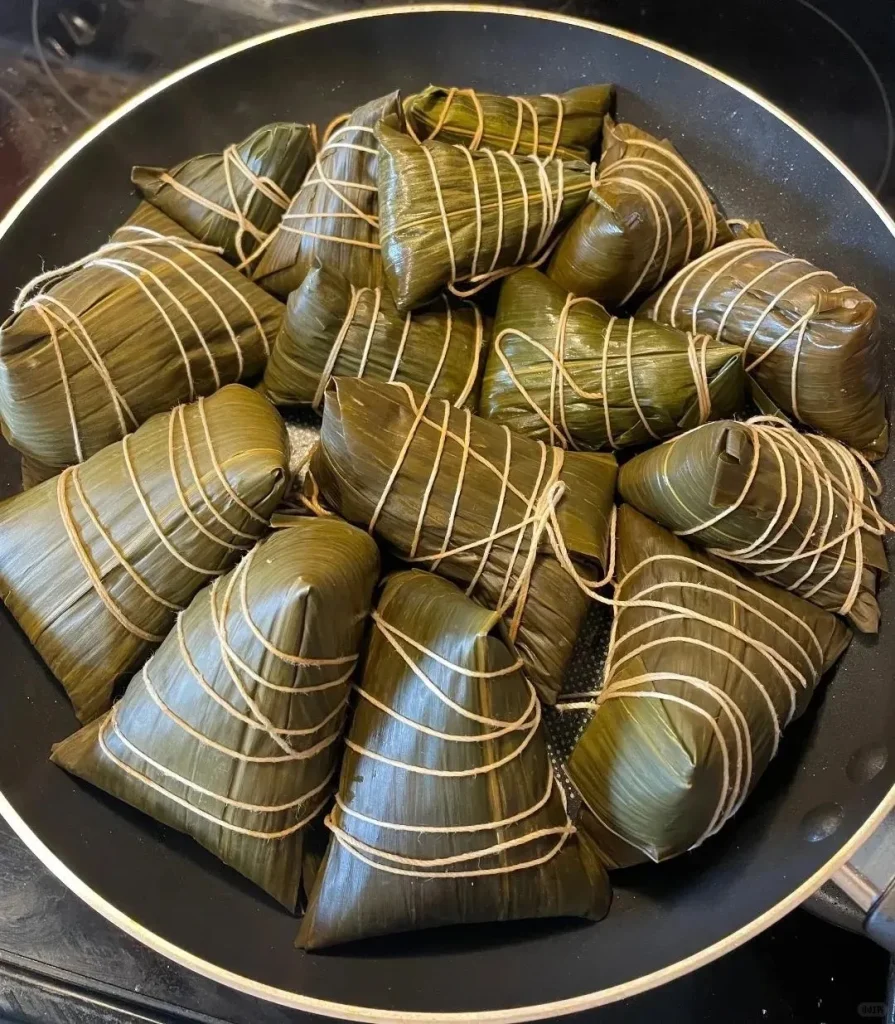
The essential festival food is zongzi — glutinous rice dumplings wrapped in bamboo or reed leaves, folded into a pyramid or pillow shape, then steamed or boiled. The result is dense, aromatic, and deeply satisfying. Regional varieties differ dramatically.
Northern China favors the sweet style: red bean paste, jujube dates, or plain sweetened rice. Guangdong / Cantonese zongzi are savory and generous — pork belly, salted egg yolk, mushrooms, dried shrimp, chestnuts, and mung beans. Jiangnan (Zhejiang / Jiangsu) produces the most famous variety: a balanced sweet-savory style with braised pork, flavored with soy sauce. Fujian / Minnan zongzi use complex savory fillings with rice sometimes pre-fried in lard. Yunnan and the Southwest are known for ash lye zongzi (碱水粽) — golden, chewy, and eaten with honey.
Folding and tying zongzi is a skill passed down through families. The wrapping process — soaking leaves, layering fillings, folding the leaf into a tight cone, binding with string — is meditative and social. Many families treat it as the primary holiday ritual, gathering multiple generations in the kitchen.
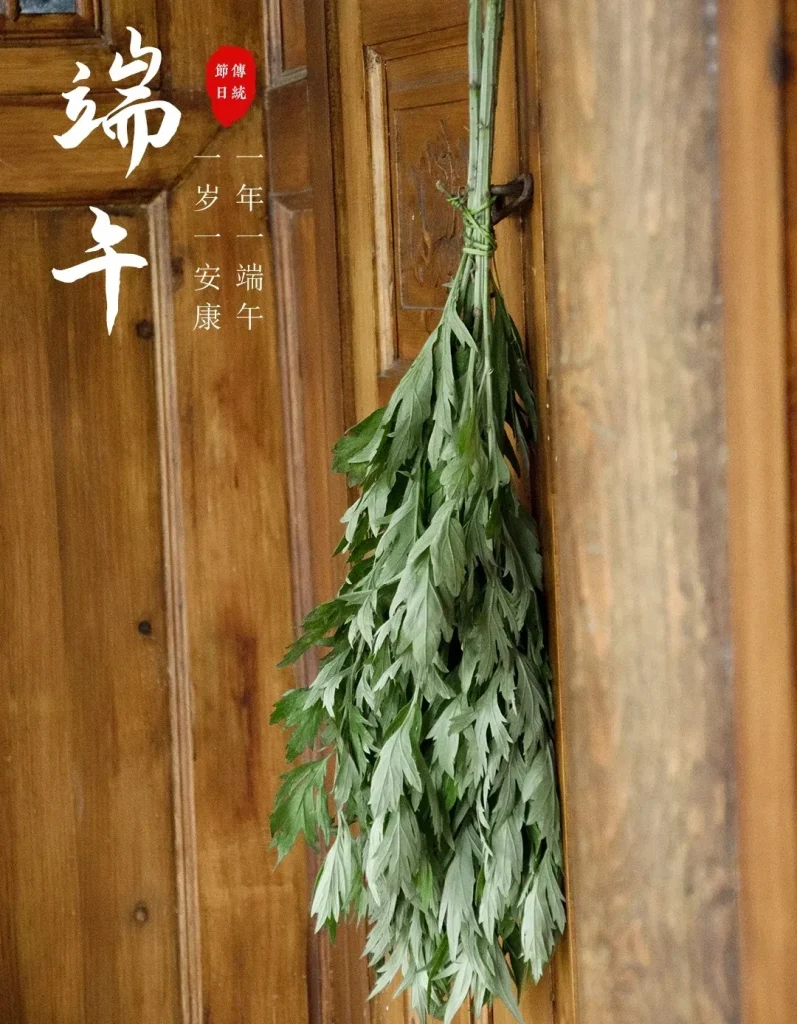
Hanging Mugwort and Calamus (挂艾草菖蒲)
On the morning of the festival, households traditionally hang bundles of mugwort (艾草, ài cǎo) and calamus (菖蒲, chāng pú) from doorframes and windows. Both plants have strong, sharp herbal scents historically believed to repel insects and disease-carrying spirits.
Calamus leaves, long and sword-shaped, are sometimes said to represent a sword that cuts away evil. Together, they functioned as both a practical insect deterrent in the summer heat and a symbolic act of protection — a reminder that Duanwu was originally as much a health festival as a commemorative one.
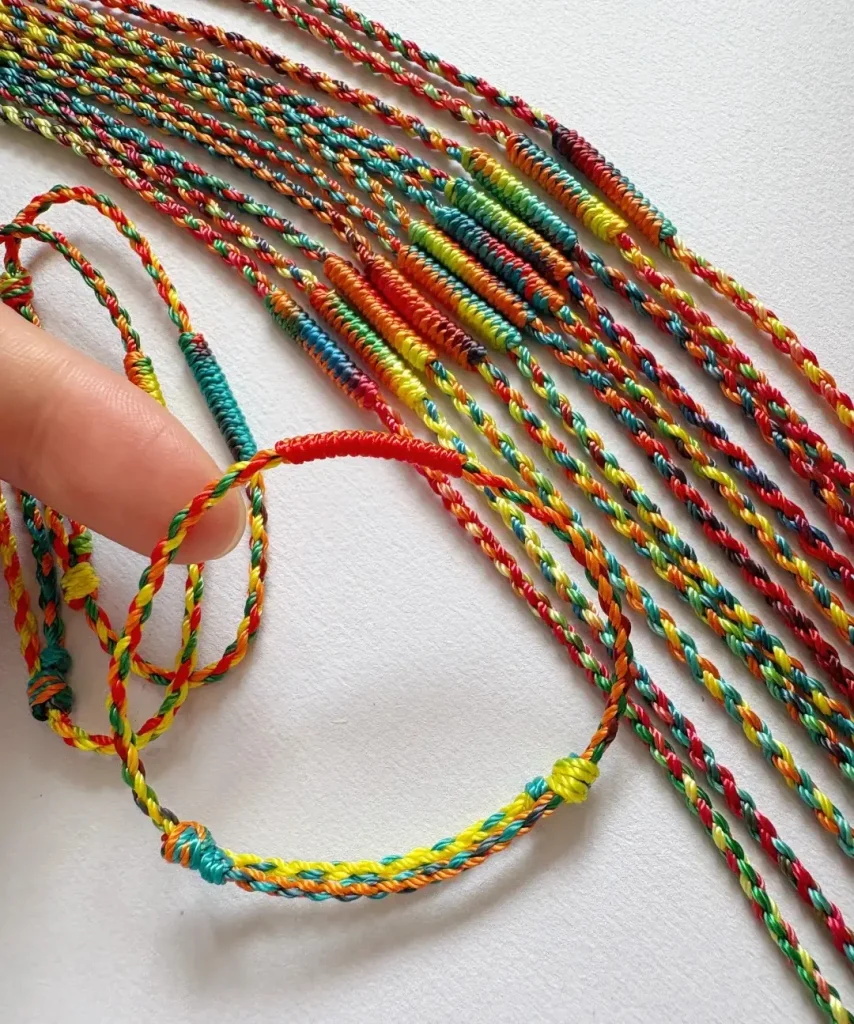
Wearing Five-Color Silk Threads (五彩绳)
Parents tie five-color silk bracelets (五彩绳, wǔcǎi shéng) around the wrists, ankles, and necks of young children at dawn on the festival day. The five colors — red, yellow, blue, white, and black — correspond to the five elements in Chinese cosmology and are believed to provide protective power against the “five poisons” of summer.
The bracelets are worn until the first rain after the festival, then thrown into the rainwater so that it washes away illness for the year. Today the custom has evolved into a general good-luck charm worn by people of all ages.
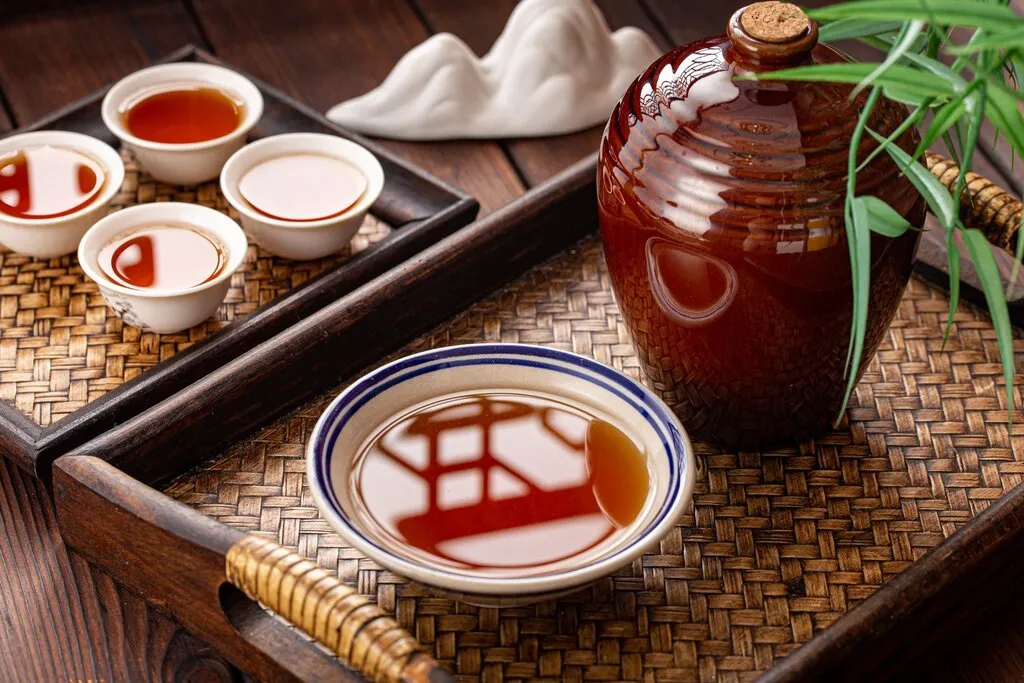
Drinking Realgar Wine (雄黄酒)
Drinking realgar wine (雄黄酒, xióng huáng jiǔ) — rice wine mixed with realgar, a sulfur-arsenic mineral — is a traditional custom practiced mainly in central and southern China. Realgar was believed in traditional medicine to detoxify the body and drive away snakes, insects, and evil spirits.
The practice is largely symbolic and ceremonial today; realgar contains arsenic compounds and is not consumed in significant quantities. Some households dip a finger in the wine and draw the Chinese character 王 (“king”) on children’s foreheads instead, as a protective blessing.
Sachets and Herbal Incense Pouches (香包)
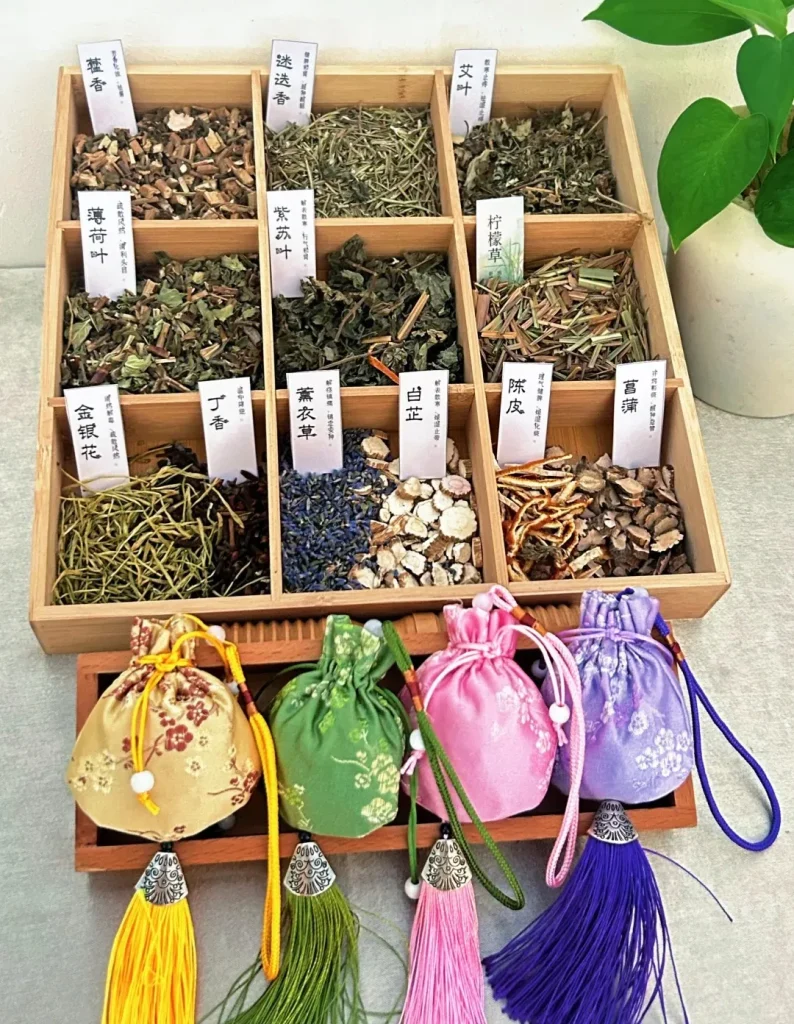
Sachets (香包, xiāng bāo) are small embroidered pouches filled with aromatic herbs — typically including wormwood, cloves, sandalwood powder, and dried flowers. Worn around the neck or pinned to clothing, they were originally intended to keep mosquitoes and disease at bay through their strong fragrance.
Over time, the sachet became a folk art form. Skilled embroiderers craft them in the shapes of tigers, fish, gourds, and other auspicious symbols. They are popular gifts during the festival season and are especially associated with children’s protection.
While zongzi is the star of the festival table, regional food traditions extend further. Salted duck eggs (咸鸭蛋) are a festival staple throughout the Yangtze Delta, with their rich orange yolks appearing both inside zongzi and as a standalone dish. In Jiangnan cuisine, yellow eel (黄鳝) reaches peak flavor around Duanwu and is considered a seasonal delicacy. Some regions eat braised or pickled garlic (大蒜) for its protective, medicinal properties. In Guangdong, jiandui (煎堆) — sesame-coated glutinous rice balls fried until crispy — round out the festival spread.
Today Duanwu has evolved without losing its essential spirit. Dragon boat clubs operate in cities across the United States, Canada, the United Kingdom, Germany, and Australia, introducing the sport to non-Chinese communities who often know nothing of Qu Yuan but find themselves captivated by the teamwork, rhythm, and energy of the race.
In China itself, the festival is a moment for family reunion, often the first major gathering since Lunar New Year for families spread across different cities. Children make or receive sachets at school. Supermarkets stack elaborate gift boxes of zongzi weeks in advance — the “mooncake economy” dynamic, applied to Duanwu.
The cultural significance of Qu Yuan has also gained renewed attention in an era of national cultural heritage campaigns. His image appears on commemorative stamps, his poems are recited at school events, and the Miluo River in Hunan — where he drowned — hosts one of the country’s most prominent race festivals each year.
If you want to engage with Duanwu wherever you are:
- Find a local dragon boat race. Most major cities with sizable Chinese communities host public races in late May or June. Search for your city name + “dragon boat festival” to find events and spectator information.
- Make zongzi at home. Dried bamboo leaves, glutinous rice, and common fillings are available at most Asian grocery stores. The folding technique takes practice but is genuinely rewarding.
- Read Qu Yuan. English translations of Li Sao and the broader Songs of Chu (楚辞) are widely available. David Hawkes’ translation, “The Songs of the South,” is considered the definitive scholarly edition.
- Hang mugwort. Fresh or dried mugwort can be found at Chinese herb shops and some farmers markets. The sharp green fragrance is itself a sensory connection to the festival.
In recent years, a growing number of Chinese cultural enthusiasts have begun celebrating Duanwu wearing Hanfu — traditional Chinese clothing that draws from historical styles spanning the Han, Tang, Song, and Ming dynasties. At riverside races and temple fairs, it is increasingly common to see people in flowing robes and cross-collar tops participating in festival activities.
The connection feels natural: Qu Yuan himself lived in the Warring States period, an era well represented in Hanfu historical research, and many traditional sachet and silk bracelet designs pair beautifully with period-inspired clothing. For those already interested in Chinese cultural heritage, Duanwu is a meaningful occasion to explore traditional dress as part of a living festive context rather than as costume.
If you are curious about what traditional Chinese clothing looks like, or how to choose a style suited to different occasions, our other articles on this site go deeper into the history and variety of Hanfu.

Chinese name: 端午节 (Duānwǔ Jié)
Date: 5th day of the 5th lunar month (late May or June each year)
Origins: Commemoration of poet Qu Yuan (c. 278 BCE); earlier dragon worship and summer health rituals
Main activities: Dragon boat racing, making and eating zongzi, hanging mugwort and calamus, wearing five-color threads
Festival food: Zongzi, salted duck eggs, eel
UNESCO status: Intangible Cultural Heritage, inscribed 2009
Dragon Boat Festival is many things at once: a solemn commemoration of a poet’s sacrifice, a boisterous community sport, a kitchen ritual passed between generations, and a seasonal act of protection against the dangers of midsummer. Few holidays compress so much cultural meaning into three days.
For anyone exploring Chinese culture from the outside — through language learning, through travel, through food, or through traditional arts and clothing — Duanwu is one of the most accessible entry points. The stories are vivid, the food is delicious, and the sight of dragon boats cutting through the water to drumbeats is genuinely thrilling. It rewards curiosity at every level.