

Struggling to find a name that sounds as epic as your character deserves? Whether you’re writing a wuxia novel, building a game character, or simply fascinated by the poetic depth of Chinese naming culture, this guide walks you through the most cool Chinese names from the jianghu — with meanings, pronunciation, and the cultural stories behind them.
Before diving into names, it helps to understand where they come from.
Jianghu (江湖) — literally “rivers and lakes” — is a term from Chinese martial arts fiction (wuxia) that refers to the shadow world of warriors, wanderers, outlaws, and heroes who operate outside of mainstream society. It’s a place of codes of honor, sworn brotherhoods, deadly rivalries, and legendary fighters.
Names in the jianghu carry enormous weight. A name can signal a warrior’s weapon of choice, their home sect, their personality, or a defining moment in their story. These aren’t just labels — they’re identities carved in steel.
Chinese names follow a family-name-first structure: the surname comes before the given name. Single-character surnames like 李 (Lǐ), 王 (Wáng), and 张 (Zhāng) are the most common. Rarer compound surnames like 诸葛 (Zhūgě) or 第五 (Dìwǔ) lend an ancient, striking air — and are especially popular in wuxia fiction for exactly that reason.
Beyond the given name, a wuxia hero often carries a courtesy name (字, Zì) adopted at adulthood, typically thematically linked to the given name. Addressing someone by their courtesy name was a mark of respect; using the given name implied intimacy.
In the jianghu, fighters also earn titles — epithets that describe their skills, reputation, or weapon. These are often the most evocative and “cool” names of all.
Great wuxia names follow recognizable patterns. Characters use surname + given name (e.g., Li Xiaoyun, Chen Wuji). Given names often carry meaning — Qingfeng (清风, “clear wind”), Mingyue (明月, “bright moon”), Jianxin (剑心, “sword heart”). Sects use evocative phrases like Flying Snow Sect or Nine Swords Sect.
The best jianghu names tend to draw from these thematic pools:
- Nature — wind, moon, river, mountain, snow, phoenix, dragon
- Weapons — sword, blade, dagger, staff, bow
- Virtues — righteousness, loyalty, iron will, silence
- Mystery — shadow, void, ghost, mist, darkness
- Celestial — heaven, stars, jade, cloud
| Name | Meaning |
|---|---|
| Wei Canglong 魏苍龙 Wèi Cānglóng | Azure Dragon |
| Shen Bingfeng 沈冰锋 Shěn Bīngfēng | Ice Edge |
| Lu Tiansha 陆天煞 Lù Tiānshā | Heaven’s Killer |
| Mo Wujian 墨无间 Mò Wújiān | Boundless Ink Sword |
| Yan Qianhuan 燕千幻 Yàn Qiānhuàn | Thousand Illusions |
| Zhuge Hanxiao 诸葛寒啸 Zhūgě Hánxiào | Cold Howl |
| Dugu Yifeng 独孤一峰 Dúgū Yīfēng | Lone Peak |
| Fang Tiesheng 方铁声 Fāng Tiěshēng | Voice of Iron |
| Xiao Chenyuan 萧尘远 Xiāo Chényuǎn | Far from Dust |
| Bai Mingsha 白鸣煞 Bái Míngshā | Resonant Killer |
| Name | Meaning |
|---|---|
| Hua Lingjian 花灵剑 Huā Língjian | Spirit Sword Blossom |
| Yue Xuanbing 岳玄冰 Yuè Xuánbīng | Mysterious Ice |
| Su Qianmei 苏千媚 Sū Qiānmèi | Thousand Charms |
| Leng Wuyue 冷无月 Lěng Wúyuè | Moonless Cold |
| Ji Fengshuang 纪凤霜 Jì Fèngshuāng | Phoenix Frost |
| Qin Yingying 秦影影 Qín Yǐngyǐng | Shadow upon Shadow |
| Mu Tianxue 穆天雪 Mù Tiānxuě | Heaven’s Snow |
| Xue Qingling 薛清灵 Xuē Qīnglíng | Pure Spirit |
| He Zifeng 贺紫凤 Hè Zǐfèng | Purple Phoenix |
| Nangong Yue 南宫月 Nángōng Yuè | Moon of the South Palace |
In the jianghu, your title is often more famous than your real name:
| Title | Meaning |
|---|---|
| 剑神 Jiànshén | Sword God |
| 鬼手 Guǐshǒu | Ghost Hand |
| 铁面 Tiěmiàn | Iron Face |
| 冷血刀 Lěngxuè Dāo | Cold-Blooded Blade |
| 天煞孤星 Tiānshā Gūxīng | Heaven’s Lone Killing Star |
| 无情剑 Wúqíng Jiàn | Heartless Sword |
| 幽冥使 Yōumíng Shǐ | Emissary of the Underworld |
| 笑独行 Xiào Dúxíng | Laughing Lone Walker |
| 白衣侠 Báiyī Xiá | White-Robed Hero |
| 千面狐 Qiānmiàn Hú | Thousand-Faced Fox |
No guide to jianghu names would be complete without the legends of the genre. These characters defined what a “cool Chinese name” looks like:
令狐冲 (Lìnghú Chōng) — From Jin Yong’s The Smiling Proud Wanderer. The compound surname 令狐 is rare and ancient-sounding; 冲 means “surge forward” or “break through.” A perfect name for a freewheeling, rule-breaking swordsman.
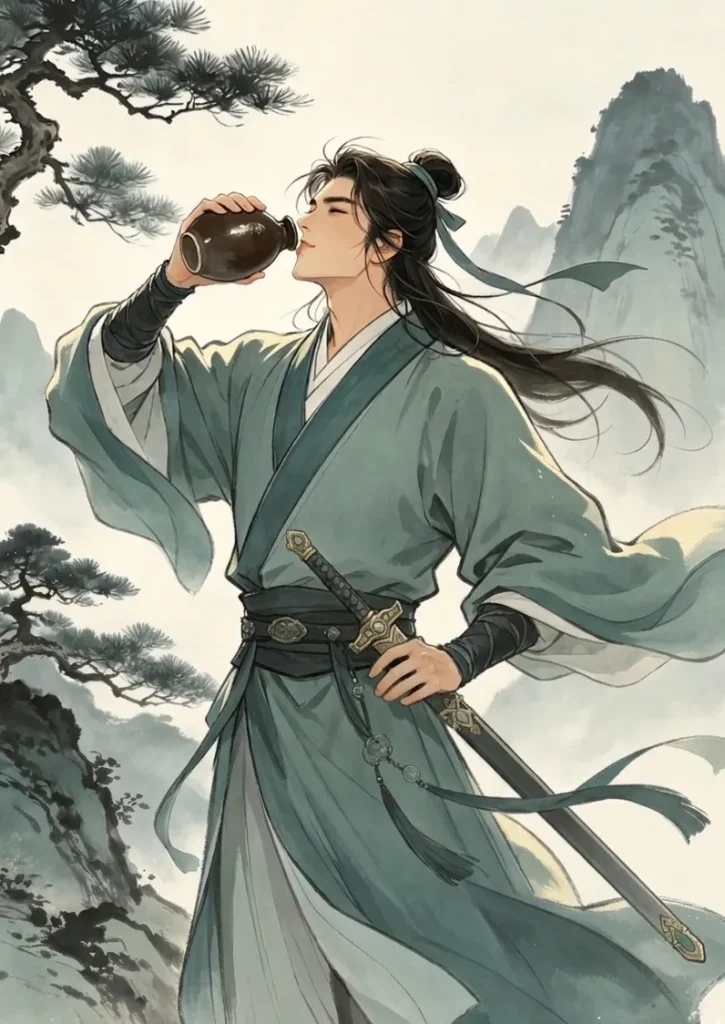
独孤求败 (Dúgū Qiúbài) — “The Lone One Who Seeks Defeat.” Perhaps the single coolest name in all of wuxia fiction. A legendary swordsman so powerful he spent his life searching for a worthy opponent.
东方不败 (Dōngfāng Bùbài) — “Invincible from the East.” The surname 东方 means “east” — a classic compound surname that immediately sounds mythological.
杨过 (Yáng Guò) — From The Return of the Condor Heroes. A deceptively simple name: 过 means “to pass through” or “transgression” — hinting at a hero who lives outside society’s rules.
小龙女 (Xiǎo Lóngnǚ) — “Little Dragon Maiden.” One of the most iconic female names in wuxia — three simple characters that somehow capture ethereal beauty and quiet power.
Use this simple four-step framework:
Step 1 — Choose a surname.
Pick a common single-character surname (Li, Wang, Chen, Zhao, Xiao, Mo, Yan) for authenticity, or a rare compound one (Zhuge, Murong, Dugu, Nangong, Dongfang) for an epic, ancient feel.
Step 2 — Pick a thematic pool for your given name.
What defines your character? A weapon? A personality trait? A natural element? Choose characters that reflect that essence.
Step 3 — Layer the meaning.
The best Chinese names consider character meaning, sound harmony (how the tones flow together when spoken aloud), and balance — virtues, natural elements, and desirable qualities are traditionally popular choices.
Step 4 — Add a title.
Give your character a jianghu nickname. Combine an adjective (cold, jade, ghost, iron, shadow) with a noun (sword, palm, step, fang, eye). The stranger and more specific, the better.
Wuxia names are often closer to code names or epithets than ordinary names — functioning more like a reputation than a label. Famous examples from Crouching Tiger, Hidden Dragon include Jade Fox and Dark Cloud, names that immediately telegraph personality, danger, and backstory all at once.
This is what makes jianghu names so uniquely cool to Western audiences: they’re legible as concept. A name like “Shadowless Blade” or “Laughing Ghost Sword” doesn’t just identify a character — it describes them in poetic shorthand.
Chinese characters carry profound symbolic weight. Unlike Western naming traditions, every character in a Chinese name has its own meaning, pronunciation, and written form — so a name is simultaneously a word, a visual image, and a sound, all compressed into two or three syllables.
| Character & Pinyin | Meaning |
|---|---|
| 剑 Jiàn | Sword |
| 龙 Lóng | Dragon |
| 凤 Fèng | Phoenix |
| 影 Yǐng | Shadow |
| 霜 Shuāng | Frost |
| 冰 Bīng | Ice |
| 云 Yún | Cloud |
| 月 Yuè | Moon |
| 玄 Xuán | Mysterious / Dark |
| 天 Tiān | Heaven / Sky |
| 魂 Hún | Soul |
| 血 Xuè | Blood |
| 无 Wú | Without / Void |
| 烟 Yān | Smoke / Mist |
| 孤 Gū | Lone / Solitary |
The jianghu isn’t just a world of names — it’s a window into a broader Chinese cultural universe. The warriors of wuxia fiction wore distinctive robes, followed ancient rituals, and moved through a world steeped in tradition. If the artistry of jianghu names has sparked your curiosity about Chinese culture, there’s another fascinating thread worth following: Hanfu, the traditional clothing of ancient China.
Much like jianghu names, Hanfu carries centuries of meaning in its silhouette, fabric, and form. The flowing robes you see on wuxia heroes aren’t just costume — they reflect real historical garments worn across dynasties, each style tied to social rank, occasion, and aesthetic philosophy. Whether you’re a cosplayer, a history enthusiast, or simply someone who finds beauty in tradition, exploring Hanfu is the natural next step after falling in love with the jianghu.

Cool Chinese names from the jianghu aren’t just aesthetic flourishes — they’re compressed storytelling. A great wuxia name tells you who a person is, what they’ve mastered, and what kind of legend they’re destined to become, all in two or three characters.
Whether you’re writing a story, naming a game character, or simply exploring the rich world of Chinese martial arts culture, the jianghu is an inexhaustible source of names that carry genuine mythological weight.
Pick one. Make it yours. Enter the jianghu.