
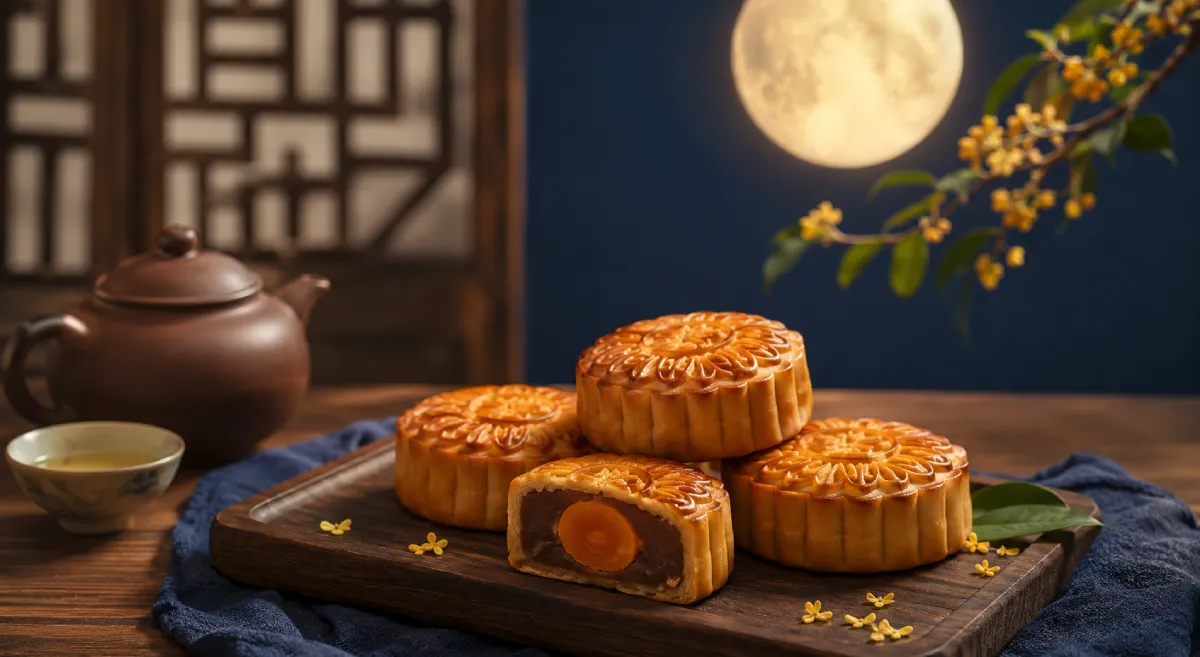
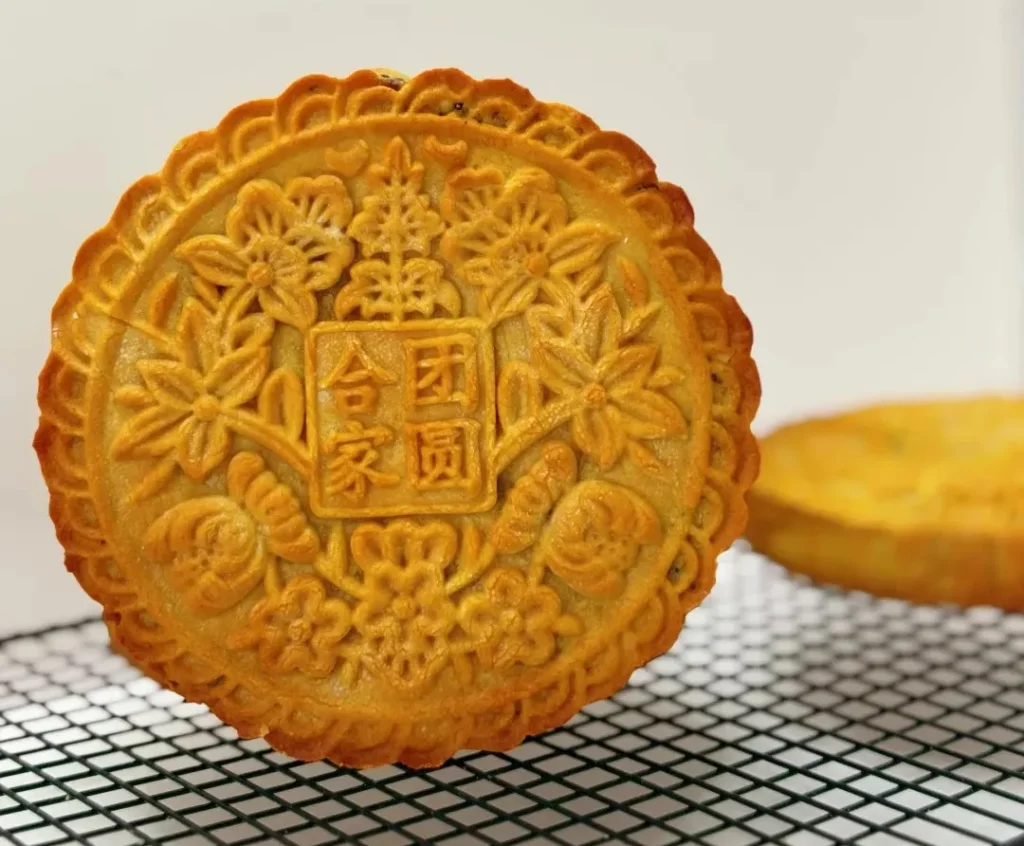
A Chinese mooncake is a round, dense pastry traditionally eaten during the Mid-Autumn Festival, one of the most important holidays in Chinese culture. The round shape symbolizes the full moon and, by extension, family reunion and completeness. Mooncakes are typically filled with a sweet or savory paste, wrapped in a thin pastry crust, and stamped with decorative patterns that often include Chinese characters for longevity, harmony, or the name of the bakery producing them.
A traditional mooncake is small but rich, usually about the size of a large muffin, weighing anywhere from 100 to 200 grams. Because the filling is so dense and sweet, mooncakes are almost never eaten the way a Western cake is eaten. Instead, one mooncake is sliced into four, six, or even eight small wedges so that everyone at the table can taste a piece, similar to sharing a dessert platter rather than a personal slice of cake.
Mooncakes are also one of the most commonly gifted foods in Chinese culture. In the weeks before the Mid-Autumn Festival, bakeries, hotels, and supermarkets across China and other parts of Asia sell mooncakes in elaborate gift boxes, and it is common for companies to give boxes of mooncakes to employees, clients, and business partners as a seasonal gesture of goodwill.
The tradition of eating mooncakes during the Mid-Autumn Festival dates back well over a thousand years, with most historians tracing organized moon-worship customs to the Tang dynasty and the mooncake itself becoming a fixed festival food by the Song and Yuan dynasties. It was during the Ming dynasty, however, that the custom of eating mooncakes truly became widespread among ordinary households, cementing the cake’s place as the signature food of the festival rather than an offering reserved for the upper class.
The legend of Chang’e. The most famous story tied to the mooncake is the legend of Chang’e, the moon goddess. According to the myth, Chang’e’s husband Hou Yi was granted an elixir of immortality after shooting down nine of ten suns that were scorching the earth. To keep the elixir from falling into the wrong hands, Chang’e drank it herself and floated up to the moon, where she has lived ever since, accompanied only by a jade rabbit that pounds herbal medicine. On the night of the Mid-Autumn Festival, families gaze at the full moon and tell this story, and the mooncake is treated as an offering to Chang’e as well as a treat for the living.
A legend of rebellion. A separate and much later legend, set in the late Yuan dynasty, claims that rebels hid secret messages calling for an uprising inside mooncakes, since the guards distrusted the cakes far less than they distrusted letters or messengers. While historians view this story as folklore rather than fact, it remains a popular tale told alongside the Chang’e legend and helps explain why the mooncake carries a sense of unity and secrecy passed down through generations.
The Mid-Autumn Festival, also known as the Mooncake Festival, falls on the 15th day of the 8th month of the Chinese lunar calendar, the night the moon is considered to be at its roundest and brightest of the year. Because the date follows the lunar calendar rather than the Western Gregorian calendar, it shifts every year, usually landing sometime between early September and early October.
| Year | Mooncake Festival Date | Day of Week |
|---|---|---|
| 2026 | September 25 | Friday |
| 2027 | September 15 | Wednesday |
| 2028 | October 3 | Tuesday |
Looking for dates further out? See the full year-by-year table (through 2036) in When Is Mid-Autumn Festival? Dates, Meaning & Moon Festival Traditions Explained.
In China, the Mid-Autumn Festival is a public holiday, and it is common for the government to arrange a short break of several days around the date so families can travel home. Outside of mainland China, the festival is also widely celebrated in Hong Kong, Taiwan, Vietnam, Singapore, Malaysia, and among overseas Chinese communities around the world, though it sometimes goes by a different local name, such as Tết Trung Thu in Vietnam.
Mooncake fillings and styles vary enormously by region, generation, and modern taste, ranging from centuries-old recipes to contemporary reinventions found in bakeries and supermarkets today.
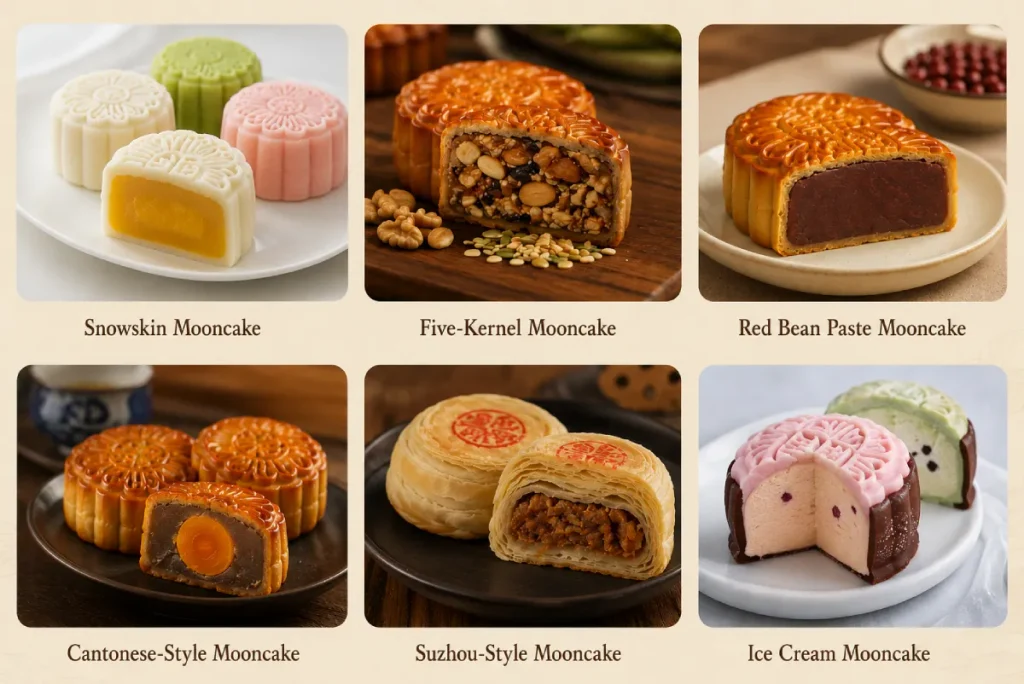
Lotus seed paste mooncake. Considered the most traditional and prestigious variety, made from finely ground lotus seeds slowly cooked down into a smooth, sweet paste. It is often paired with one, two, or even four whole salted duck egg yolks in the center, arranged so that when the mooncake is cut, the yolks resemble small moons inside the pastry.
Snowskin mooncake. A modern, non-baked variation that uses a soft, chewy glutinous rice skin instead of the traditional baked pastry crust. Snowskin mooncakes are served chilled rather than at room temperature, and they often come in bright colors and non-traditional flavors such as mango, matcha, chocolate, or custard, making them especially popular with younger consumers and easier to eat in hot climates.
Five-kernel mooncake (Five-nut mooncake). A savory-sweet, old-fashioned style filled with a mix of chopped nuts and seeds such as walnuts, almonds, sesame, and melon seeds, bound together with maltose syrup and sometimes small pieces of candied fruit or ham. This style has a firmer, chewier texture than paste-filled mooncakes.
Red bean paste mooncake. A lighter, less rich alternative to lotus seed paste, made from sweetened red beans cooked and mashed into a smooth filling. It has a slightly earthier, less sweet flavor and is a common choice for people who find lotus paste too heavy or prefer a less sugary dessert.
Cantonese-style mooncake. Known for its thin, golden-brown baked crust brushed with egg wash and its rich, dense fillings, this is the style most widely exported internationally and the one most people picture when they think of a traditional mooncake.
Suzhou-style mooncake. Originating from the Jiangsu region, this style uses a flaky, layered pastry rather than the smooth baked crust seen in Cantonese-style cakes, often filled with sweet or savory pork, giving it a texture closer to a multi-layered pastry than a dense cake.
Ice cream mooncake. A contemporary invention sold mainly by dessert brands, made by shaping ice cream into a mooncake mold and coating it in a thin chocolate shell. It is kept frozen and eaten as a novelty dessert rather than a traditional offering.
Traditional mooncakes are calorie-dense because of their high sugar, fat, and egg yolk content, and a single small mooncake can rival a full meal in calories. A standard Cantonese-style lotus seed paste mooncake with one salted egg yolk typically contains somewhere in the range of 700 to 1,000 calories for a whole cake weighing around 180 grams, which is why the cakes are cut into small wedges rather than eaten in one sitting.
| Mooncake Type | Approximate Calories (whole cake) |
|---|---|
| Lotus seed paste with 1 egg yolk | 750–900 kcal |
| Red bean paste | 650–750 kcal |
| Five-kernel | 700–850 kcal |
| Snowskin (fruit or custard) | 300–450 kcal |
These are approximate values, and actual calorie counts vary by brand, recipe, and portion size. Because of the calorie and sugar content, many bakeries now also offer low-sugar or sugar-free mooncakes aimed at older customers or people managing conditions like diabetes, and snowskin styles are generally the lightest option for anyone watching portion size.
Mooncakes carry social weight beyond their taste, and there are a few customs worth knowing.
Gifting mooncakes. Giving a box of mooncakes to family, friends, teachers, or business contacts before the festival is one of the most common seasonal gift customs in Chinese culture, similar in spirit to gifting a holiday fruit basket or wine in Western culture. The quality and packaging of the box often reflects the closeness of the relationship or the formality of a business connection.
Sharing, not eating alone. Because a single mooncake is so rich, it is considered normal, and even expected, to slice one cake and share it among several people rather than for one person to eat a whole cake alone.
Pairing with tea. Mooncakes are almost always served with a pot of hot Chinese tea, such as oolong or pu’er, since the tea’s bitterness helps cut through the richness and sweetness of the filling.
Family reunion dinners. Many families hold a reunion dinner on the night of the festival, followed by moon-viewing outdoors and mooncake sharing, making the mooncake less of a standalone dessert and more the closing ritual of an entire evening centered on family.
Many home bakers use a decorative mooncake mold to press the traditional patterns and characters into the pastry before baking. Molds range from simple carved wooden stamps, which are more traditional but require practice, to modern plastic hand-press molds with interchangeable pattern discs, which make it far easier for beginners to produce evenly shaped, decorative mooncakes at home.
When shopping for ready-made mooncakes, a few things are worth checking:
Freshness date. Traditional baked mooncakes are typically best eaten within one to two weeks of purchase, since they contain no artificial preservatives in many artisanal versions. Snowskin mooncakes have an even shorter shelf life and should be eaten within a few days and kept refrigerated.
Filling ratio. Higher-quality mooncakes tend to have a thinner pastry crust and a larger proportion of filling, while cheaper mass-market versions often use a thicker crust to cut costs.
Number of yolks. Lotus seed paste mooncakes are often marketed by how many salted egg yolks they contain, with a single yolk being standard and four yolks considered a premium, celebratory version usually reserved for gifting.
Do mooncakes need to be refrigerated? Traditional baked mooncakes, such as Cantonese or five-kernel styles, do not need refrigeration and can be kept at room temperature in a cool, dry place for one to two weeks. Snowskin mooncakes are the exception, since they contain glutinous rice skin and often dairy-based fillings, and should always be refrigerated and eaten within a few days.
What if I don’t like very sweet desserts? Red bean paste and five-kernel mooncakes are generally less sweet than lotus seed paste versions, and many modern bakeries now offer low-sugar mooncakes made with sugar substitutes. Snowskin mooncakes with fruit fillings, such as mango or pomelo, also tend to taste lighter and less sugary than traditional baked versions.
Can mooncakes be shipped or mailed internationally? Some bakeries do offer international shipping for mooncakes, particularly shelf-stable baked varieties, though customs regulations on egg and meat products vary by country, so fresh snowskin or egg-yolk-heavy mooncakes are the most likely to run into import restrictions.
Are mooncakes only eaten during the Mid-Autumn Festival? While mooncakes are most closely associated with the Mid-Autumn Festival and are hardest to find outside that season, some bakeries in larger cities now sell them nearly year-round, particularly ice cream and snowskin varieties marketed as everyday desserts rather than festival food.
The Chinese mooncake is far more than a dessert. It carries centuries of storytelling, family tradition, and symbolism tied to the full moon and the Mid-Autumn Festival, from the legend of Chang’e drifting to the moon to the modern ritual of gifting a decorative box to a colleague. Whether it is a classic lotus seed paste mooncake with a salted egg yolk shared around a family table, or a modern snowskin version enjoyed chilled with friends, the mooncake remains one of the most meaningful and widely shared foods in Chinese culture.