

Few objects in human history have carried as much weight — cultural, spiritual, and symbolic — as Chinese jade. For over 7,000 years, this luminous stone has been woven into the fabric of Chinese civilization, from Neolithic burial rituals to the imperial courts of the Qing Dynasty. If you’ve ever wondered what makes jade so central to Chinese culture, why ancient emperors valued it above gold, or what the different types of jade mean today, this guide covers everything you need to know.
The English word “jade” is technically a translation of the Chinese character 玉 (yù) — but the two words don’t map perfectly onto each other.
In English, “jade” refers specifically to two minerals:nephrite and jadeite. The Chinese concept of yù is historically broader, encompassing any stone that carves and polishes beautifully. Among them, nephrite and jadeite are the most revered “true jade” categories, while serpentine, bowenite, and agalmatolite are mostly miscellaneous stones commonly used by the people, not the mainstream materials for rituals and imperial use in past dynasties.
- Nephrite (软玉, ruǎn yù): A calcium magnesium silicate, typically found in whites, greens, and browns. This is the stone that dominated Chinese jade culture for thousands of years. The most legendary variety is mutton-fat jade (羊脂玉), a creamy white nephrite from Hotan (Xinjiang) long reserved for imperial use.

- Jadeite (硬玉, yìng yù): A sodium aluminum silicate that comes in a wider range of colors, including the vivid “imperial green” jadeite prized today. Jadeite wasn’t introduced to China in significant quantities until the mid-to-late 18th century (after the Qianlong period of the mid-Qing Dynasty), mainly imported from Burma (Myanmar) — but it was quickly embraced by the Qing court, partly due to the Empress Dowager Cixi’s famous obsession with it.

The Chinese saying“金有价,玉无价” — “Gold has a price; jade is priceless” — captures how deeply this stone transcends ordinary valuation.
For a long time, academic circles believed that Chinese jade culture originated in the Yellow River valley, but in fact, it originated in the northeast with the Hongshan culture (c. 4700–2920 BCE) in what is now Liaoning and Inner Mongolia. Hongshan artisans carved jade into now-iconic forms: the pig-dragon (玉猪龙, a coiled beast whose meaning has not yet been determined in academic circles, but is generally speculated to be related to fertility, vitality, and supernatural power), bird pendants, and ritual objects. These pieces were often the sole items placed in tombs, making clear that jade was already sacred rather than merely decorative.
The Liangzhu culture (c. 3300–2300 BCE) near modern Hangzhou unearthed a variety of ritual jade objects. The system of the Six Ritual Jades (六器) recorded in the later Rites of Zhou can trace its earliest form to this period:
| Jade Object | Symbolic Association |
| Bi (璧) — flat disk with a hole | Heaven |
| Cong (琮) — prismatic tube | Earth |
| Gui (圭) — flat blade | East |
| Zhang (璋) — half-gui | South |
| Hu (琥) — tiger form | West |
| Huang (璜) — half-disk pendant | North |

These objects were used in ceremonies to communicate with heaven, earth, and the four directions — embedding jade at the very center of ancient Chinese cosmology.
By the Shang Dynasty, jade had become integral to daily aristocratic life. Jade ornaments were worn as everyday accessories by noblewomen, and the Emperor presented carved jade ceremonial swords to generals and loyal officials as the highest honor. The jade radical (王) in the Shang oracle bone script was similar in shape to the character for “king”, but it cannot be directly equated with “jade = royal legitimacy”.
During the Zhou Dynasty, jade objects were formalized into a rigid system of court hierarchy. Scepters of different shapes indicated a noble’s rank; the more elaborate the jade, the higher the status. Confucius solidified jade’s moral dimension in this period, famously listing11 virtues embodied by jade — including benevolence, wisdom, righteousness, modesty, and courage. Wearing jade wasn’t just fashion; it was a public declaration of one’s character.
The Han period represents one of the most spectacular chapters in jade history. Royalty and high nobles were buried in jade burial suits (金缕玉衣) — thousands of jade plaques sewn together with gold, silver, or bronze wire depending on rank — based on the belief that jade would preserve the body from decay and assist in achieving immortality.

In this era, people also endowed jade with medicinal implications, believing that jade could nourish the body and mind, and jade spoons and mortars appeared as ritual utensils related to medicine.
As jade carving techniques improved (especially with the popularization of iron tools in the Eastern Zhou period), jade gradually moved from exclusive imperial and ritual use into the broader cultural mainstream. By the Tang Dynasty, the Jade Belt (玉带) had become one of the most regulated accessories in the imperial wardrobe system — only emperors and the highest-ranking officials could wear jade belts, while lesser officials wore gold or silver.
The Song Dynasty brought a surge of antiquarian interest: court scholars and collectors studied ancient jade forms, and the Ming and Qing periods saw widespread reproduction of ancient jade designs, deliberately connecting contemporary wearers to the deep past.
The Qing court’s encounter with Burmese jadeite transformed the jade market. The Empress Dowager Cixi’s legendary passion for vivid green jadeite drove demand so powerfully that imperial green jadeite became — and remains — among the most expensive gemstones in the world. In modern auctions, a single pair of imperial-grade jadeite bangles can fetch tens of millions of yuan.
One of the reasons jade remains so culturally resonant is that its meaning is layered and color-specific. In modern folk customs and jewelry culture, jade colors are often endowed with the following symbolic meanings:
| Color | Primary Symbolism |
|---|---|
| Imperial Green | Wealth, status, vitality, luck |
| White (Mutton-Fat) | Purity, moral virtue, heaven |
| Lavender / Purple | Romance, spiritual sensitivity, creativity |
| Yellow / Golden | Earth energy, prosperity, abundance |
| Black | Protection, warding off negative energy |
| Red / Russet | Good fortune, passion, life force |
The color of jade worn or gifted carries real communicative weight in Chinese cultural contexts — a white jade pendant speaks to different intentions than a vivid green bangle.
Perhaps the most universally recognized form of Chinese jade jewelry. Bangles are traditionally put on as a single piece that cannot be removed without breaking — symbolizing a lifelong connection to the stone’s protective properties. It’s common for a mother to place a jade bangle on her daughter at a significant life event.
Pendants carved in auspicious forms — dragons, phoenixes, fish, the ruyi scepter, Buddha figures — are worn close to the body for protection and good fortune. The tradition of wearing jade pendants dates back at least to the Zhou Dynasty.

The ancient ritual bi disk has evolved into a popular decorative and collectible form, often displayed in homes or given as significant gifts.
Jade carvings of the Buddha, Guanyin (Goddess of Mercy), and auspicious animals (dragons, turtles, horses) are placed in homes and offices to attract prosperity and protection.
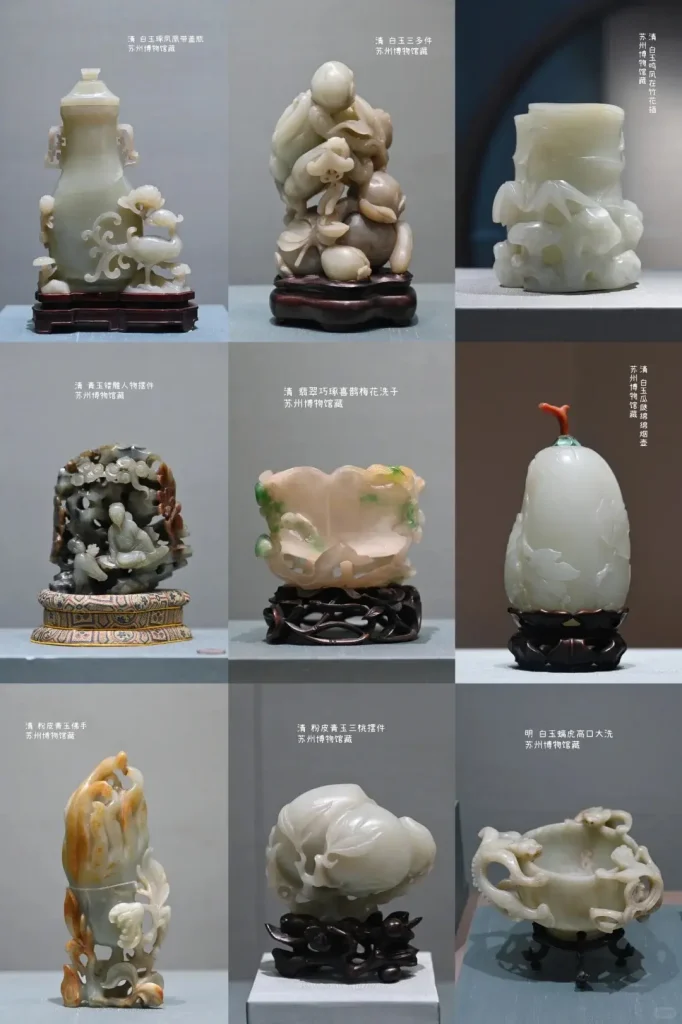
The modern jade market is flooded with imitations — dyed quartz, green glass, and plastic are frequently passed off as jade. Here are the basic methods used by experts and folk identification tips (note: folk methods are only for preliminary reference and cannot replace professional identification):
1. The temperature test: Real jade feels cool to the touch and warms slowly; glass and plastic warm quickly.
2. Hardness: Nephrite scores 6–6.5 on the Mohs scale; jadeite scores 6.5–7. A steel knife cannot scratch real jade.
3. Translucency and texture: Under strong light, nephrite shows a fibrous, almost “sugary” internal texture. Jadeite shows an interlocking granular structure, sometimes called the “orange peel” effect on polished surfaces.
4. Sound: Suspended nephrite rings with a clear, resonant musical tone when lightly struck — the Chinese court used nephrite chimes for exactly this quality. (This is a folk identification method, not a professional standard.)
5. Professional verification: For any significant purchase, a gemological certificate from a recognized laboratory is essential. Grade A jadeite is untreated; Grade B has been chemically bleached and polymer-filled; Grade C is dyed. In addition, modern jade treatment methods also include coating, baking, and oil immersion.
For those interested in Chinese traditional dress, jade is not merely background culture — it was a living, worn element of Hanfu aesthetics for millennia. In the Han Dynasty (with less evidence in the Zhou Dynasty), pei yu (佩玉, jade accessories) were considered an inseparable part of proper aristocratic dress. Sets of jade pendants would be worn hanging from the belt, and their gentle sound as the wearer moved was itself considered a mark of refined, unhurried comportment — walking too quickly would cause the jade to clatter, which was considered undignified.
In the context of modern Hanfu revival, jade accessories — pendants, hairpins, belt ornaments — serve as one of the most historically authentic finishing touches. A jade bi pendant on a Ming-style yunjian collar, or a nephrite hairpin in a traditional updo, connects the wearer not just aesthetically but symbolically to thousands of years of Chinese sartorial culture.
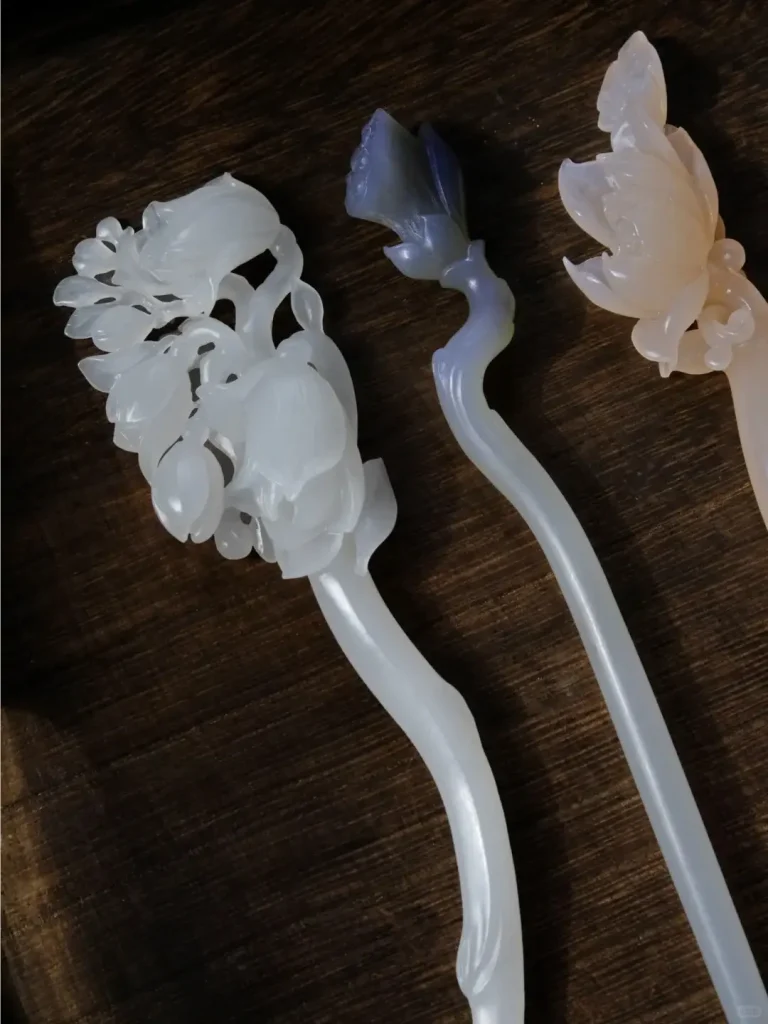
If you’re looking to purchase authentic Chinese jade, keep these points in mind:
- Know your budget: Nephrite ranges widely in price; fine Hotan mutton-fat nephrite commands premium prices. Jadeite varies even more dramatically based on color intensity, translucency, and treatment status.
- Buy from reputable sources: Major auction houses (Christie’s, Sotheby’s, Poly Auction) and established jade dealers with provenance documentation are safer than market stalls.
- Understand treatment grades: Choose Grade A jadeite only. Treated stones can look beautiful but are significantly less durable and less valuable. Modern jade treatment methods include chemical bleaching, polymer filling, dyeing, coating, baking, and oil immersion.
- Start with nephrite if budget is limited: High-quality nephrite from Xinjiang is far more accessible price-wise and has deeper historical roots in Chinese culture than jadeite.
Chinese jade is one of the most enduring symbols in human cultural history — a material that has simultaneously served as a tool, a weapon, a ritual object, a philosophical text, a status marker, and a personal talisman across more than seven millennia. Understanding jade is, in many ways, understanding a core thread of Chinese civilization itself.
Whether you’re drawn to jade for its beauty, its cultural depth, its connection to traditional dress, or simply because you’ve inherited a piece from family, you’re participating in one of the world’s oldest continuous aesthetic traditions. As Confucius observed more than 2,500 years ago — the qualities of jade are the qualities worth cultivating in a person.