
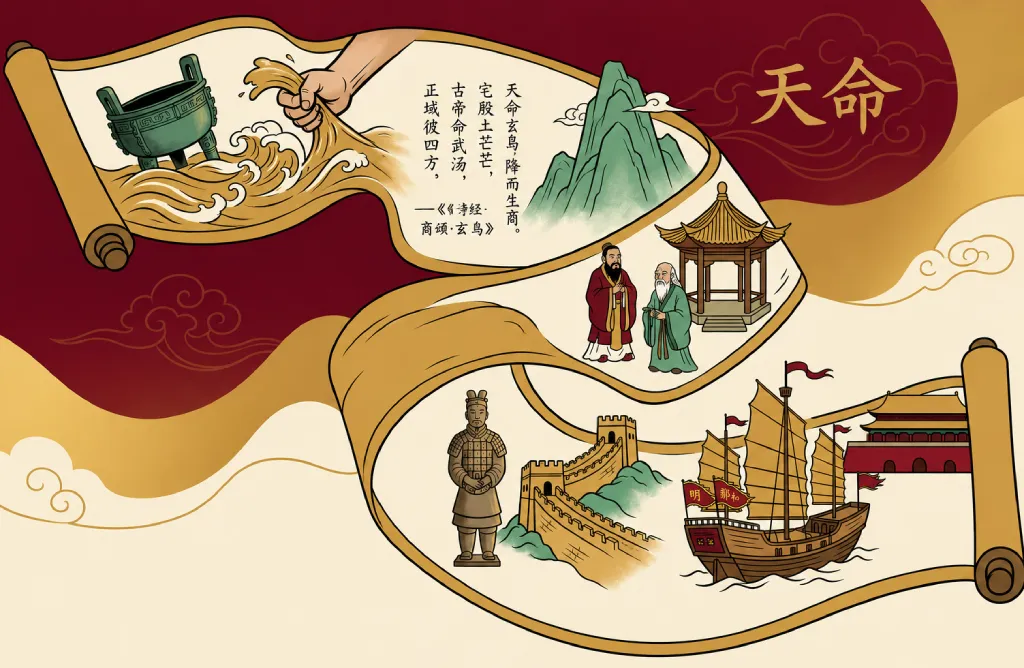
Few subjects capture the imagination quite like the sweep of Chinese dynasties — a continuous thread of civilization stretching across nearly four thousand years, from legendary flood-taming kings to the last emperor stepping down in 1912. When you explore Chinese dynastic history, you are not just reading about rulers and battles. You are tracing the origins of language, philosophy, art, cuisine, clothing, and the very identity of one of the world’s great peoples.
This guide walks through the major Chinese dynasties in order, highlighting what made each era distinctive — and why they still matter today.
A dynasty in China refers to a period during which members of the same ruling family held the imperial throne. When one dynasty fell, another rose — often after a period of civil war, rebellion, or foreign invasion. Historians generally recognize thirteen major dynastic periods, though the full count can range much higher depending on how one classifies regional kingdoms and short-lived regimes.
Central to the Chinese dynastic system is the concept of the Mandate of Heaven (天命, Tiānmìng). According to this philosophy, the right to rule was granted by heaven itself. A virtuous ruler would prosper; a corrupt or incompetent one would lose the Mandate — signaled by natural disasters, famines, or popular uprisings — and be legitimately overthrown. This cyclical view of history gave every new dynasty a moral justification for its rise and every fallen dynasty an explanation for its collapse.
Xia Dynasty (c. 2070–1600 BCE)
The Xia is considered the first dynasty in Chinese historiography, though its historicity remains debated. According to tradition, it was founded by Yu the Great, celebrated for controlling the catastrophic floods that threatened farming communities along the Yellow River. Archaeological finds at the Erlitou site suggest a Bronze Age civilization consistent with later accounts of the Xia, though a definitive link has not been established. For many Chinese, Xia is not just history — it is the origin story of civilization itself.
Shang Dynasty (c. 1600–1046 BCE)
The Shang dynasty is the first for which solid written records survive. Oracle bones — animal bones and turtle shells inscribed with early Chinese characters and used for divination — provide a direct window into Shang royal life. Bronze casting reached extraordinary artistic heights during this period, and the Simuwu Rectangular Ding, a massive bronze vessel from the Shang era, remains the largest ancient bronze object ever discovered.
Zhou Dynasty (c. 1046–256 BCE)
The longest-reigning dynasty in Chinese history at nearly 800 years, the Zhou is the period during which Chinese philosophical thought truly flourished. Confucius (551–479 BCE) lived during the Zhou’s troubled later years, as did Laozi, the founder of Daoism, and the strategist Sun Tzu. The Zhou era is divided into the Western Zhou and the Eastern Zhou — the latter further split into the Spring and Autumn Period and the Warring States Period, when seven major states competed for supremacy. It was a time of chaos and brilliance in equal measure.
Qin Dynasty (221–206 BCE)
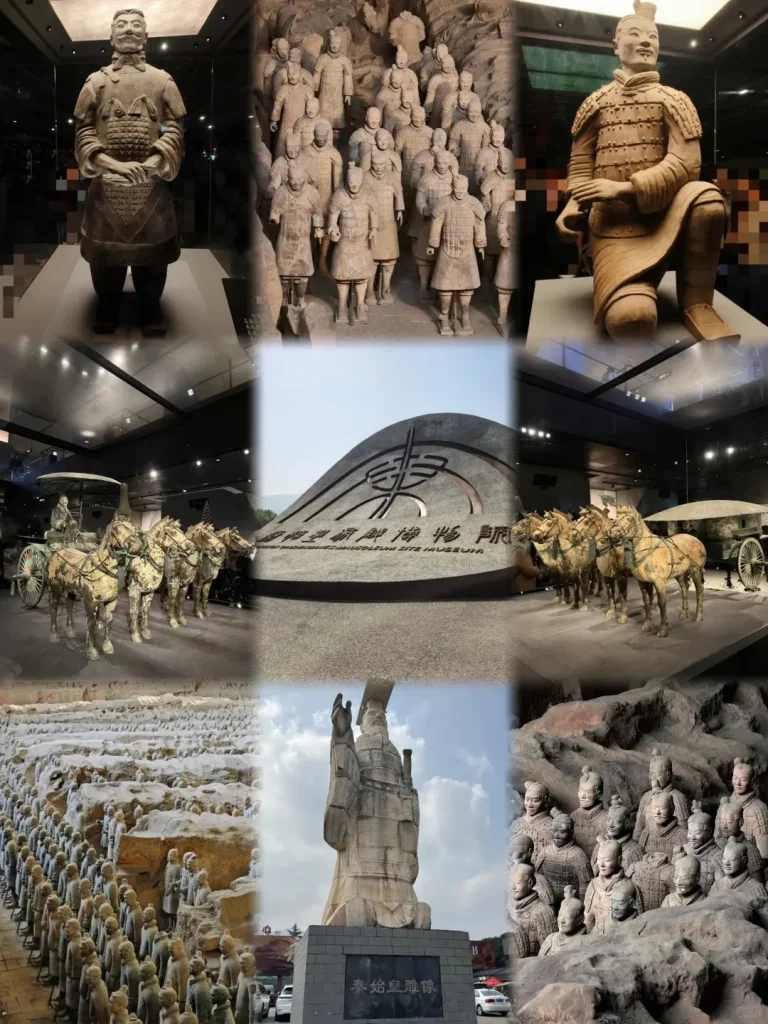
The Qin dynasty was short — just fifteen years — but its impact was enormous. Qin Shi Huang, the first emperor of a unified China, standardized weights and measures, the writing system, and the currency. He also began construction of what would eventually become the Great Wall and was buried with the extraordinary Terracotta Army, discovered by farmers in 1974 near modern-day Xi’an. The very word “China” is believed to derive from “Qin.”
Han Dynasty (206 BCE–220 CE)
If the Qin built the structure of imperial China, the Han filled it with life. The Han dynasty lasted over four centuries and is so foundational that China’s majority ethnic group still calls itself the Han people. Key achievements include:
| Achievement | Significance |
|---|---|
| Silk Road established | Connected China with Central Asia, Persia, and Rome |
| Paper invented | Transformed record-keeping and communication |
| Confucianism as state ideology | Shaped Chinese governance for two millennia |
| Civil service examinations introduced | Opened government posts to educated men of merit |
The Han existed at roughly the same time as the Roman Empire, and the two civilizations were loosely aware of each other through Silk Road trade — though they never made direct diplomatic contact.
After the Han collapsed in 220 CE, China entered a prolonged period of fragmentation. The Three Kingdoms period (220–280 CE) saw the empire split into Wei, Shu, and Wu — a dramatic era later romanticized in the classic novel Romance of the Three Kingdoms. The brief Jin dynasty that followed brought partial reunification, but China fractured again into the Northern and Southern Dynasties (420–589 CE).
Despite the political chaos, this era was culturally rich. Buddhism entered China and transformed its art and philosophy. Poetry flourished. And non-Han peoples from the northern steppes established their own dynasties, contributing new cultural strands that were gradually absorbed into the broader Chinese tradition.
The Sui Dynasty (581–618 CE) reunified China but exhausted itself through overambitious projects, most notably the Grand Canal — still the world’s longest canal — and costly military campaigns into Korea. It collapsed after just 37 years, leaving the stage for what many consider China’s greatest dynasty.
Tang Dynasty (618–907 CE)
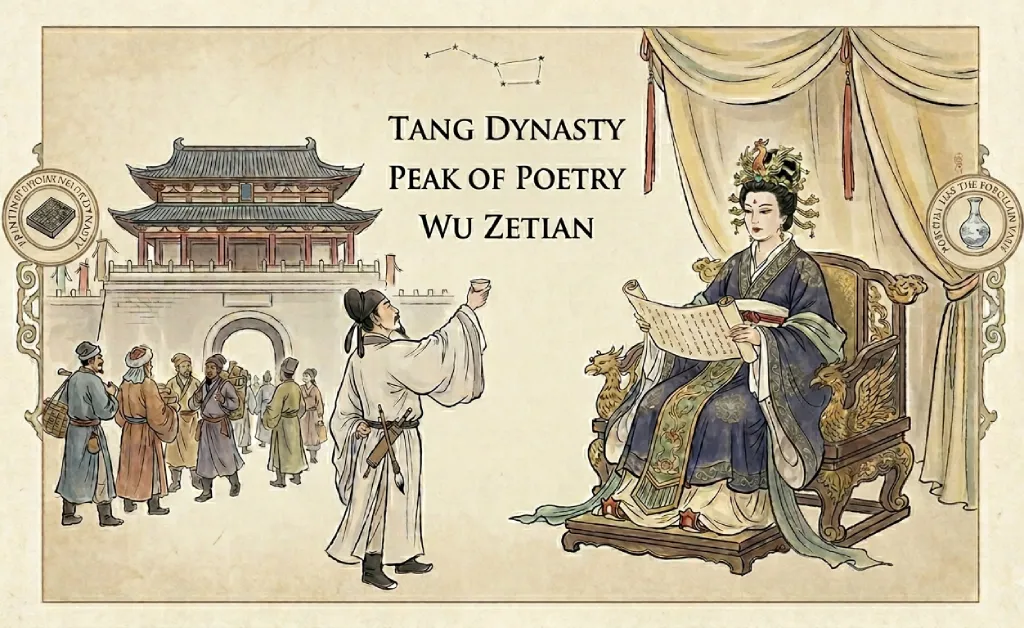
The Tang dynasty is widely regarded as the high point of Chinese civilization. Its capital, Chang’an (modern Xi’an), was the largest city in the world and a cosmopolitan hub filled with merchants, scholars, and diplomats from Persia, India, Japan, and beyond. Tang culture was confident and outward-looking.
Poetry reached its absolute peak during the Tang. Li Bai and Du Fu — the dynasty’s two greatest poets — are still memorized by schoolchildren across China and the Chinese-speaking world today. The Tang also saw woodblock printing perfected and porcelain refined to new heights. Perhaps most remarkably, the Tang produced China’s only female emperor: Wu Zetian (624–705 CE), who ruled in her own name for fifteen years and proved to be one of the most effective — if controversial — monarchs in Chinese history.
Song Dynasty (960–1279 CE)
The Song dynasty lacked the Tang’s military power — it never controlled the northern steppes and eventually lost northern China to the Jurchen Jin dynasty — but it more than compensated through economic and technological innovation. The Song invented or perfected gunpowder weapons, the magnetic compass for navigation, movable type printing, and paper money. Urban life flourished, literacy rates rose, and a sophisticated commercial culture emerged that in some ways resembles early modernity.
The Yuan Dynasty (1271–1368 CE) was established by Kublai Khan, grandson of Genghis Khan, making it the first time all of China had been conquered by a foreign power. Under the Yuan, China became the centerpiece of a vast Mongol empire stretching from Korea to the Caspian Sea. The Venetian merchant Marco Polo famously visited during this period and described the splendor of the Yuan court in accounts that Europeans found almost too incredible to believe.
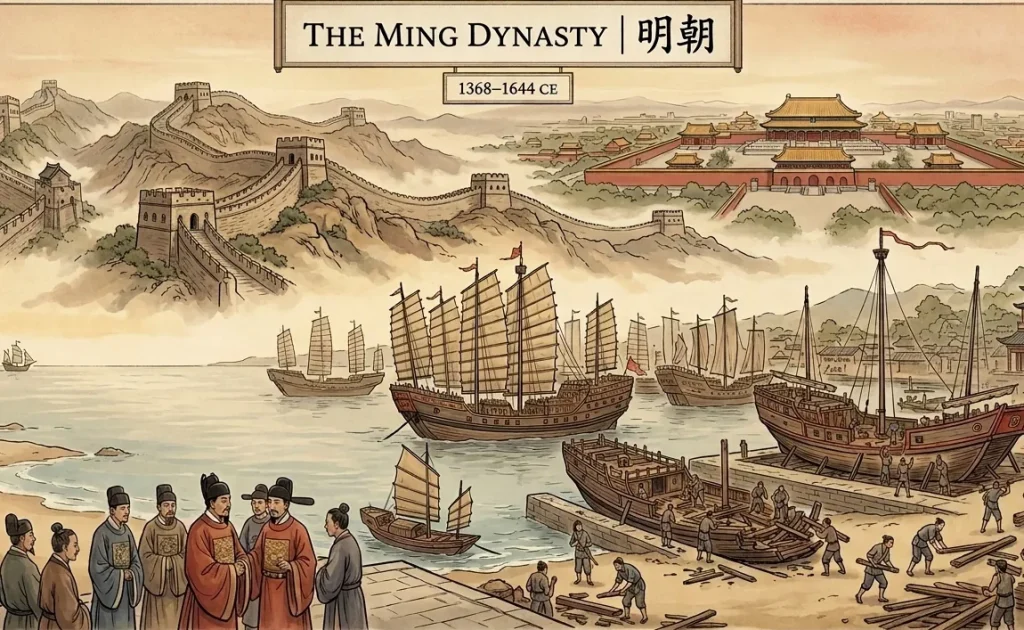
The Ming Dynasty (1368–1644 CE) restored native Han Chinese rule after nearly a century of Mongol conquest. The Ming rebuilt and extended the Great Wall into the form most visitors see today, constructed the Forbidden City in Beijing, and sponsored the extraordinary maritime expeditions of Admiral Zheng He (1371–1433 CE) — a Muslim Chinese explorer whose fleet dwarfed anything Europe was building at the time, reaching East Africa decades before Portuguese ships rounded the Cape of Good Hope.
Yet the Ming also turned inward. After Zheng He’s voyages ended, China dismantled its ocean fleet and retreated from maritime expansion — a fateful decision that allowed European powers to dominate global trade in the centuries that followed.
The Qing Dynasty (1644–1912 CE), founded by the Manchu people from northeast China, was the last of the imperial dynasties. At its height in the 18th century, the Qing presided over one of the largest empires in Chinese history, encompassing modern Tibet, Xinjiang, Mongolia, and Taiwan. The 18th century brought relative peace and prosperity — China’s population tripled during the Qing era.
The 19th century, however, brought catastrophe. The Opium Wars, the Taiping Rebellion (which killed an estimated 20–30 million people), and mounting foreign pressure exposed the dynasty’s weaknesses. The last emperor, Puyi, abdicated on February 12, 1912, ending over two thousand years of imperial rule.
| Dynasty | Period | Key Legacy |
|---|---|---|
| Xia | c. 2070–1600 BCE | Legendary founding of Chinese civilization |
| Shang | c. 1600–1046 BCE | Oracle bones, bronze casting, earliest writing |
| Zhou | c. 1046–256 BCE | Confucianism, Daoism, Mandate of Heaven |
| Qin | 221–206 BCE | First unified empire, Great Wall, Terracotta Army |
| Han | 206 BCE–220 CE | Silk Road, paper, Han ethnic identity |
| Three Kingdoms | 220–280 CE | Romantic era of military strategy and heroism |
| Sui | 581–618 CE | Reunification, Grand Canal |
| Tang | 618–907 CE | Poetry golden age, cosmopolitan culture |
| Song | 960–1279 CE | Gunpowder, compass, paper money, printing |
| Yuan | 1271–1368 CE | Mongol rule, Silk Road peak, Marco Polo era |
| Ming | 1368–1644 CE | Forbidden City, Great Wall, Zheng He voyages |
| Qing | 1644–1912 CE | Last dynasty, greatest territorial extent |
Understanding Chinese dynasties is not just an academic exercise. The dynastic era shaped virtually everything about Chinese culture that exists today — the writing system, the cuisine, the philosophical traditions, the architecture, the festivals, and the clothing. When you see someone wearing a Hanfu garment, you are seeing fabric styles that evolved across the Han, Tang, and Ming dynasties. It is worth noting, however, that the Qing dynasty’s “Queue Order” policy — which required Han Chinese men to adopt Manchu dress and hairstyles — effectively suppressed Hanfu as an official tradition for nearly three centuries. The modern Hanfu revival movement is in many ways a conscious effort to reconnect with those pre-Qing aesthetic roots. When you drink green tea, you are participating in a ritual refined over a thousand years of imperial culture. When you encounter Chinese New Year or the Dragon Boat Festival, you are engaging with celebrations that predate most Western nations by centuries.
China’s dynastic history is also a story of resilience. The country unified, fragmented, was conquered, reasserted itself, and rose again — over and over, across millennia. That pattern of endurance and renewal is as central to the Chinese identity as any specific emperor or invention.
How many dynasties did China have?
Historians generally recognize thirteen major dynasties, though the total count can reach over eighty when regional and short-lived kingdoms are included.
Which Chinese dynasty lasted the longest?
The Zhou dynasty, lasting from c. 1046 to 256 BCE, was the longest at approximately 790 years.
Which was the most powerful Chinese dynasty?
There is no single answer, but the Han, Tang, and Qing dynasties are most often cited for their military power, territorial extent, and cultural influence.
When did China’s dynastic era end?
The last Chinese emperor, Puyi of the Qing dynasty, abdicated on February 12, 1912, marking the end of over two thousand years of imperial rule and the beginning of the Republic of China.
What is the Mandate of Heaven?
The Mandate of Heaven (天命, Tiānmìng) is the philosophical doctrine that a ruler’s right to govern is granted by heaven. A virtuous ruler retains the Mandate; a corrupt or failed ruler loses it, legitimizing rebellion and a change of dynasty.
The story of Chinese dynastic history spans four millennia, dozens of ruling families, and an unbroken thread of cultural evolution that still shapes the lives of over a billion people today. From the flood-taming legends of the Xia to the cosmopolitan splendor of the Tang, from the technological brilliance of the Song to the tragic twilight of the Qing, each dynasty left its mark — on the land, the people, and the culture that continues to fascinate the world.
Whether you are drawn to the philosophy of Confucius, the poetry of Li Bai, the architecture of the Forbidden City, or the textiles of Hanfu fashion, you are exploring a living inheritance from China’s dynastic past.