
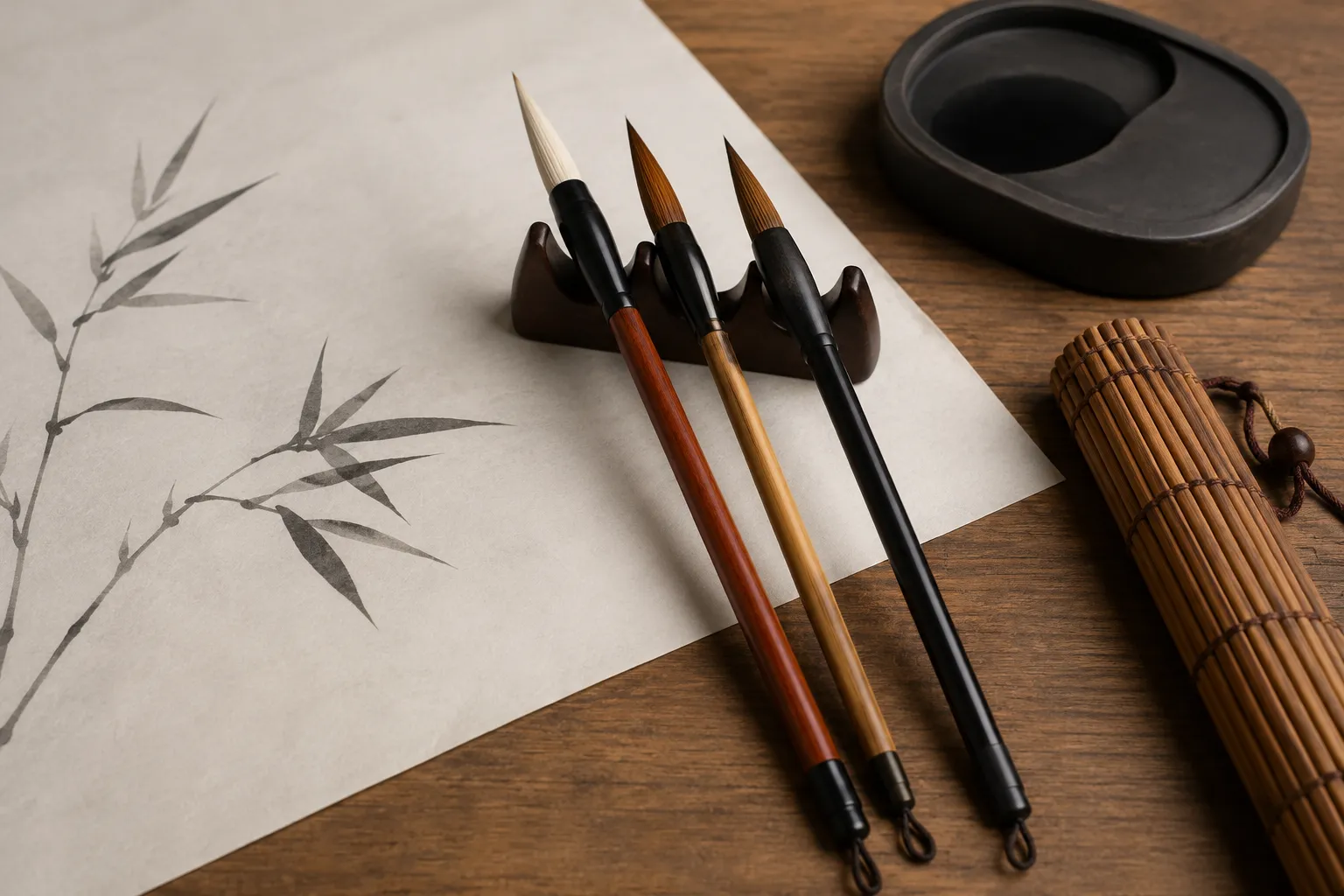
A Chinese calligraphy brush, known as máobǐ (毛笔) or “hair brush,” is the primary writing tool used to practice Chinese calligraphy and traditional ink painting. Unlike a Western pen with a fixed nib, a calligraphy brush is made from a bundle of soft animal hair set into a hollow handle, which allows it to hold ink, spread under pressure, and spring back into a fine point. This flexibility is what gives Chinese calligraphy its expressive range, from a hair-thin flick to a broad, ink-soaked stroke, all with the same tool.
The brush is considered one of the “Four Treasures of the Study” (文房四宝), alongside ink, paper, and the inkstone. For centuries it has been treated not just as a tool but as an extension of the writer’s hand, and even today, choosing and caring for a calligraphy brush is treated as part of the practice itself.
Brushes made from animal hair bound into bamboo handles date back over two thousand years, with well-documented examples from the Han dynasty (206 BC – 220 AD), when calligraphy began to be practiced as a fine art rather than purely a record-keeping tool. Early brushes were small, with heads made from rabbit hair taken from the back of the neck, and were often carried by court officials as a portable writing tool. As calligraphy matured into a respected art form among scholars, brush-making techniques diversified, producing brushes suited to different scripts, stroke widths, and ink effects. That basic construction, a hair bundle glued into a hollow handle, has changed remarkably little since.
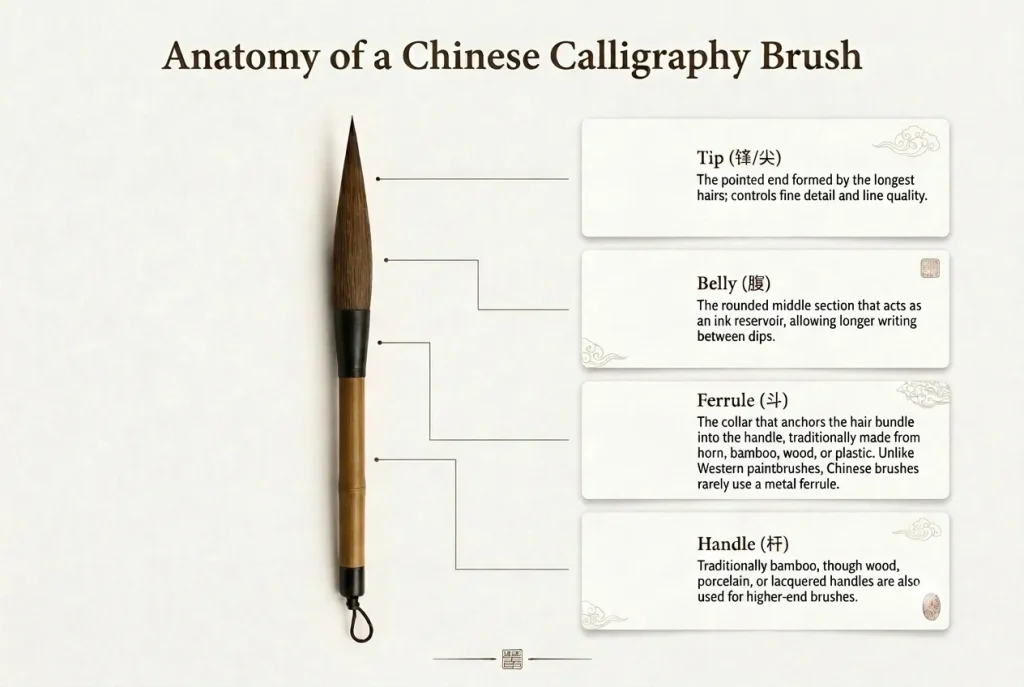
Every brush is built from the same core parts, though the materials and proportions vary by type and quality.
| Part | Function |
| Tip (锋/尖) | The pointed end formed by the longest hairs; controls fine detail and line quality. |
| Belly (腹) | The rounded middle section that acts as an ink reservoir, allowing longer writing between dips. |
| Ferrule (斗) | The collar that anchors the hair bundle into the handle, traditionally made from horn, bamboo, wood, or plastic. Unlike Western paintbrushes, Chinese brushes rarely use a metal ferrule. |
| Handle (杆) | Traditionally bamboo, though wood, porcelain, or lacquered handles are also used for higher-end brushes. |
Inside the hair bundle itself, shorter hairs form a stiff inner core or “spine,” while longer hairs are layered around it to form the point. In many brushes, the outer and core hairs are the same material, while a separate reservoir layer between them may use a different, softer hair to hold more ink.
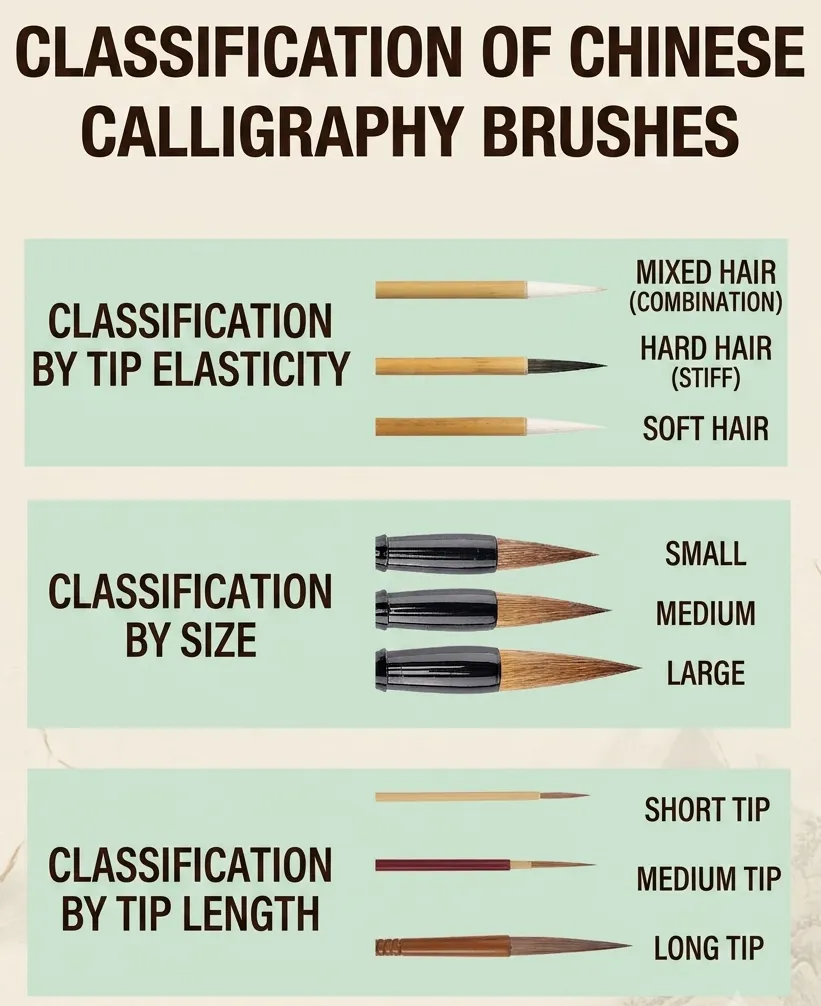
The single biggest factor in how a brush feels and writes is the hair it’s made from. Brushes are generally grouped into three categories: soft, stiff, and mixed.
Soft brushes (软毫) are most commonly made from goat or sheep hair. They are highly absorbent, hold a large amount of ink, and produce smooth, flowing lines, but their softness makes them harder to control, especially for beginners. Many advanced painters prefer goat hair precisely because its slightly unpredictable ink flow adds character to a piece.
Stiff brushes (硬毫) are usually made from weasel hair, commonly sold under the name “wolf hair” (狼毫) due to a mix-up between the Chinese words for wolf and weasel; genuine wolf hair brushes are extremely rare and expensive. Stiff brushes also come in horse hair, badger hair, and rabbit hair varieties. They snap back into shape quickly, hold their point well, and are favored for precise, angular strokes and smaller regular-script characters.
Mixed brushes (兼毫) combine a stiffer core, usually weasel hair, with a softer outer layer of goat hair, typically in roughly a 60/40 ratio. This construction balances control with ink capacity and is widely recommended as the best starting point for beginners, since it forgives minor handling mistakes while still teaching proper brush control.
| Hair Type | Feel | Best For |
| Goat/Sheep hair | Soft, absorbent, less controllable | Semi-cursive and cursive scripts, expressive painting |
| Weasel (“wolf”) hair | Stiff, springs back quickly, precise | Regular script, fine detail work |
| Mixed (goat + weasel) | Balanced control and ink flow | All-purpose, ideal for beginners |
| Horse/badger/rabbit hair | Varies from firm to very stiff | Seal script, clerical script, specialty effects |
Beyond hair material, brushes are also chosen by size and by how long the bristle tip is relative to its diameter.
Small, medium, and large brushes correspond roughly to the character size being written, from small regular script (小楷) up to large banner-style characters. As a general rule, a larger brush should not be used to write very small characters, and a small brush cannot produce large, sweeping strokes, so the character size a person plans to practice should guide the brush size they buy.
Long-tip brushes hold more ink and are suited to fluid, continuously connected strokes typical of cursive script (草书). Short-tip brushes are stiffer and better suited to the clean, structured lines needed for seal script (篆书) or clerical script (隶书).
Calligraphy brush shoppers are usually deciding between two things: their skill level and the script style they plan to practice. Both should factor into the choice.
For complete beginners, a medium-sized mixed-hair (兼毫) brush with a bamboo handle is the most commonly recommended starting point. It’s forgiving enough to learn basic strokes without fighting the brush, but still teaches proper pressure control, which is a skill that transfers to any brush later on.
For regular script (楷书), a stiffer weasel or mixed-hair brush gives the precision needed for clean, well-defined strokes.
For semi-cursive (行书) and cursive (草书) script, a softer, longer-tipped goat hair or mixed brush allows the fluid, connected strokes these styles are known for.
For seal script (篆书) or clerical script (隶书), a stiffer, shorter brush, sometimes with a mixed horse and goat hair blend, better replicates the rounded but firm quality these older scripts require.
Traditional brush buyers also judge quality using the “Four Virtues” (四德) of a good brush: the tip should be pointed (尖), the spread hairs should be even (齐), the head should be round when wet (圆), and the hair should spring back to its original shape after use (健). A new brush is coated in a thin layer of glue to protect the hairs during shipping and storage, which makes it hard to judge quality just by looking, so it’s worth wetting the tip before use to check that it comes to a clean point.

A brand-new brush needs a little preparation before its first use.
Soak and remove the glue. Gently rinse the bristles under lukewarm water until they separate freely and the tip comes to a clean point. Avoid hot water, which can damage natural hair.
Load with ink gradually. Dip the brush so ink reaches roughly two-thirds up the belly, then press off excess ink on the edge of the inkstone. Loading only the tip will cause the brush to run dry too quickly, while overloading makes strokes bleed. This applies whether the ink comes from grinding a traditional ink stick on an inkstone or from a modern bottled liquid ink; either way, the goal is the same, letting the ink soak evenly into the belly rather than sitting only on the surface of the hairs.
Hold the brush upright. Traditional grip keeps the handle roughly perpendicular to the paper, guided by the fingers and wrist rather than gripped tightly like a pen. This upright angle is part of what allows a single brush to produce both thick and thin lines.
Because the bristles are natural hair, a calligraphy brush lasts far longer with a short cleaning routine after each session.
Rinse thoroughly. After writing, rinse the brush under running water, gently working from the belly toward the tip to push out any remaining ink. Never leave ink to dry inside the bristles, as it will stiffen and break the hairs over time.
Reshape the tip. Once rinsed, gently squeeze the bristles between your fingers and draw them to a point.
Hang to dry. Store the brush hanging tip-down, either on a brush rack or a hook, so water drains away from the ferrule instead of pooling inside it and rotting the glue that holds the hair in place.
Retire it gracefully. A brush that has lost its point and no longer springs back into shape has reached the end of its working life. Many calligraphers keep old brushes rather than throwing them away, treating them as a record of practice rather than disposable tools.
For anyone buying online rather than testing brushes in person, a few details are worth checking in the product listing before ordering:
Hair material stated clearly. Reputable listings specify goat, weasel (“wolf”), or mixed hair rather than just calling it “animal hair,” since this determines how the brush will actually feel to write with.
Handle material. Bamboo is the traditional, lightweight, and most affordable option; some higher-end brushes use wood, porcelain, or lacquered handles, which add weight and cost without necessarily improving the brush’s performance.
Set vs. single brush. Beginners are often better served by a small set covering two or three hair types and sizes, since it’s difficult to know which brush will suit a personal writing style before trying a few.
Reviews mentioning tip quality. Since brush quality is hard to judge from a photo, buyer reviews that specifically mention whether the tip holds a point after use are more reliable than the product description alone.
Is goat hair or wolf hair better for beginners? Neither is strictly better; a mixed-hair (兼毫) brush combining both is usually recommended for beginners because it balances the ink capacity of goat hair with the control of weasel hair.
How long does a calligraphy brush last? With proper rinsing and drying after each use, a well-made brush can last for years of regular practice. Frequency of use, ink quality, and how well it’s dried between sessions all affect its lifespan more than age alone.
Can a Chinese calligraphy brush be used for Japanese calligraphy (shodo) too? Yes. Chinese and Japanese calligraphy brushes share the same basic construction, and many practitioners use them interchangeably, though brush size and hair stiffness conventions can differ slightly between the two traditions.
Do I need different brushes for painting and calligraphy? Not necessarily at a beginner level. Many all-purpose mixed-hair brushes are marketed for both calligraphy and Chinese ink painting, though dedicated painters often build a small collection of brushes suited to specific effects over time.