
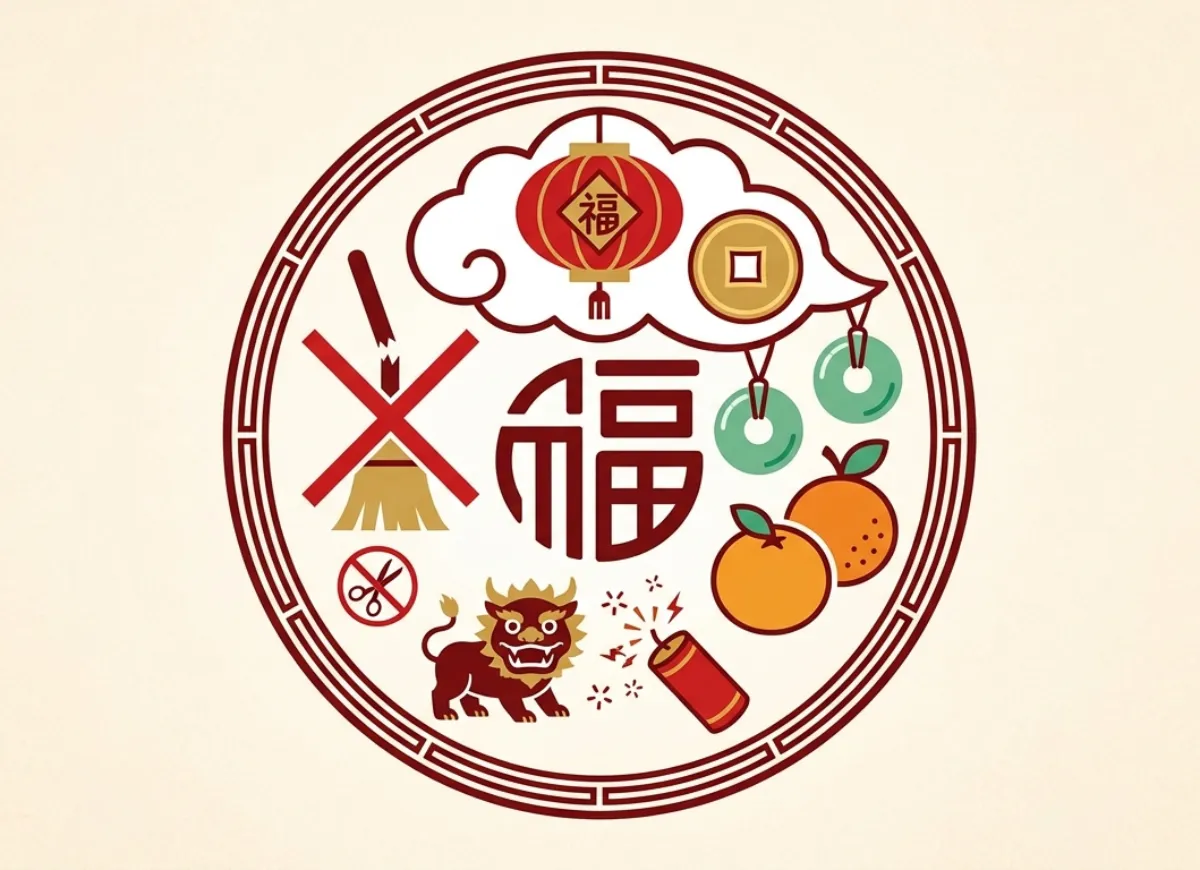
Chinese New Year is the most important holiday on the Chinese calendar, and it comes wrapped in centuries of superstition. Long before the fireworks and family reunion dinners, an entire system of beliefs grew up around how to welcome good fortune and how to avoid dragging bad luck into the new year. Some of these customs sound playful today — don’t wash your hair, don’t cry, don’t say the word “four” — but they all trace back to a deeper logic: the first days of the lunar year are believed to set the tone for the next twelve months.
Whether you’re planning your own celebration, marrying into a Chinese family, or simply curious about the superstitions of Chinese New Year, this guide walks through the most widely observed beliefs, the reasoning behind them, and how seriously modern families still take them.
A quick note on the word “superstition” itself: in English, it tends to carry a slightly dismissive tone, as if these customs were leftover folk ignorance. Within Chinese culture, most of these practices are understood differently — closer to 讲究 (jiǎngjiu), meaning a meaningful custom worth observing, or 吉祥文化, “auspicious culture,” a set of traditions built to express hope, care for family, and respect for the new year rather than fear of it. Sweeping the floor before New Year’s Eve isn’t really about dodging a curse; it’s a symbolic clean slate, similar in spirit to a New Year’s resolution. Keep that distinction in mind as you read — these are less “rules to avoid disaster” and more a shared language for wishing each other well.
Most Chinese New Year taboos share one core idea: the new year is a fresh start, and whatever happens in the opening days can shape the fortune of the entire year ahead. This belief system draws on three overlapping traditions — Taoist ideas about balancing yin and yang, folk beliefs about ghosts and spirits crossing into the human world, and a deep cultural emphasis on homophones, where words that sound alike are thought to carry each other’s meaning.
That last point explains a huge share of Chinese New Year customs. Mandarin and various Chinese dialects are full of near-identical sounding words, so a fruit, a number, or a gift can be “lucky” or “unlucky” purely because of what it sounds like, regardless of what it actually is.
The don’ts tend to get the most attention, since breaking one is thought to invite bad luck for the coming months. Below are the taboos most commonly observed across mainland China, Hong Kong, Taiwan, and overseas Chinese communities.
Don’t sweep or take out the trash on the first day. Cleaning should be finished before New Year’s Eve. This taboo specifically covers 大年初一, the first day of the new year — sweeping the floor or emptying the bin on that day is believed to sweep away the good fortune that has just entered the home. From the second day onward, normal cleaning generally resumes, and in some regions the fifth day (破五, pòwǔ) is actually set aside specifically for taking out the accumulated trash, as a way of “sending off poverty” (送穷, sòngqióng).
Don’t wash your hair. The word for “hair” (发, fà) sounds like the word for “prosperity” (发财, fācái). Washing it away on the first day is thought to rinse out the year’s prosperity right along with the shampoo. This custom is taken more seriously in some regions than others — many families simply wash their hair on New Year’s Eve instead, then avoid it for the first day or two, while it barely registers as a rule in other households.
Avoid scissors and needles on New Year’s Day. Sharp objects are believed to “cut” good luck, which is why sewing and cutting food are traditionally avoided on the first day. This is one of the softer taboos on this list — it’s mostly observed by older generations, and plenty of younger households don’t think twice about it.
Don’t get a haircut during the first lunar month. This one is often lumped in with “sharp objects are unlucky,” but it actually has its own, more specific history — and a popular explanation for it that turns out to be a mistranslation. The custom dates to the early Qing dynasty, when the new Manchu rulers issued the 剃发令 (tìfǎlìng), an order forcing Han Chinese men to shave the front of their heads and wear a queue. Many Han people quietly resisted by refusing to cut their hair during the first lunar month each year, a gesture meant to say 思旧 (sī jiù) — “missing the old,” i.e. mourning the fallen Ming dynasty. Over generations of oral retelling, “思旧” (sī jiù) was misheard and passed down as “死舅” (sǐ jiù) — “death of one’s maternal uncle” — since the two phrases sound almost identical. That mishearing is the origin of the still-common belief that cutting your hair in the first lunar month will bring harm to your mother’s brother. The saying stuck around long after most people forgot the political mourning custom it came from, which is why many families today observe “no haircuts in the first month” without knowing why.
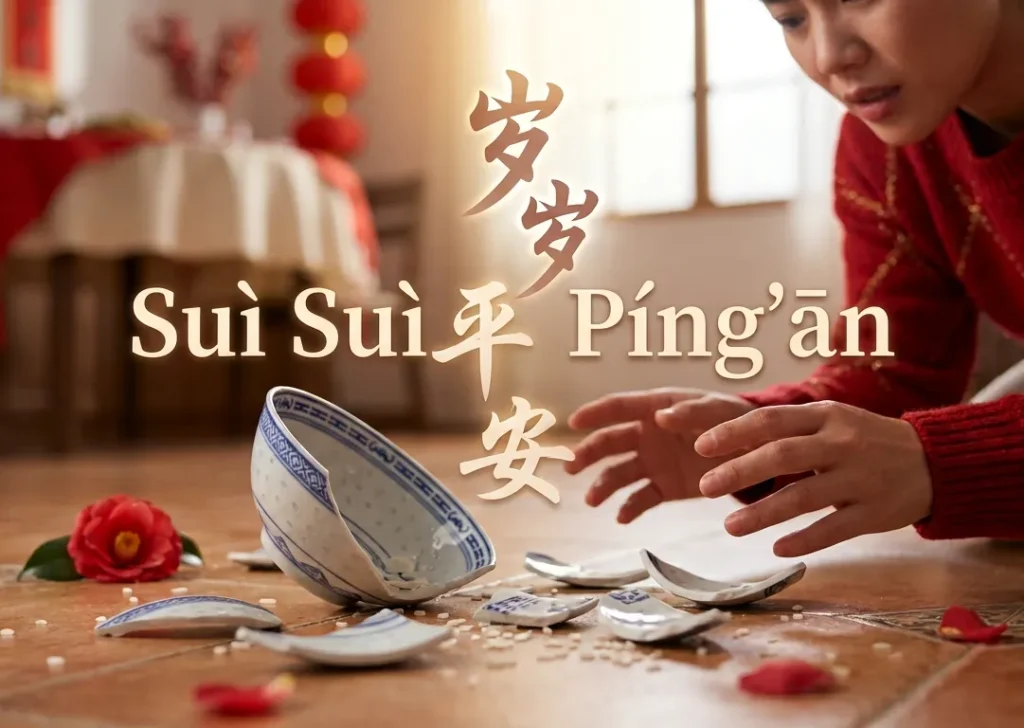
Don’t break anything. Dropping and shattering a bowl or plate is considered a bad omen, symbolizing a fractured or unlucky year ahead. If something does break, the traditional fix is to quickly say “岁岁平安” (suìsuì píng’ān), a phrase wishing for peace year after year — it works as a spoken fix because “碎” (broken) and “岁” (year) are homophones.
Don’t say unlucky words. Words associated with death, illness, poverty, or ending are avoided entirely during the New Year period. This includes words like “death,” “sick,” “poor,” and even “finished” or “gone,” since speaking them aloud is thought to invite that outcome into the year.
Don’t cry or argue. Fights, scolding children, and tears are all discouraged on New Year’s Day. The first day is meant to set an emotionally peaceful tone, so even normally strict parents tend to let small misbehavior slide.
Don’t lend or borrow money. Debts are traditionally supposed to be settled before New Year’s Eve. Lending money on New Year’s Day is believed to mean you’ll be lending money all year, while borrowing suggests a year of financial trouble.
Avoid all-black or all-white outfits for formal occasions. Both colors are strongly associated with mourning and funerals in Chinese culture. In everyday life plenty of people wear black or white without a second thought, but for New Year’s Eve dinner, temple visits, or greeting elders, an outfit built entirely around either color is still considered a poor choice — the holiday calls for red, gold, or other bright, celebratory colors instead.
Don’t give certain gifts. Clocks are never given as gifts, because “giving a clock” (送钟, sòng zhōng) sounds identical to “attending a funeral” (送终, sòng zhōng). Shoes are avoided because “shoe” (鞋, xié) sounds like “evil” (邪, xié). Umbrellas are avoided because “umbrella” (伞, sǎn) sounds like “to scatter” or “break apart” (散, sàn). Pears are avoided because “pear” (梨, lí) sounds like “to leave” or “separate” (离, lí) — each gift, in other words, is really being rejected for what it sounds like out loud, not for anything about the object itself.
Alongside the taboos, an equally large set of customs exists purely to invite good luck in. Many of these are still practiced enthusiastically even by younger, less traditional generations, simply because they’re festive and fun.
Wear red — and know where the legend comes from. Red is the defining color of Chinese New Year, and the reason traces back to the story of Nian (年), a beast said to live deep in the mountains or under the sea, emerging once a year to raid villages, devour livestock, and terrify children. Villagers eventually discovered Nian’s three weaknesses: loud noise, bright fire, and the color red. From then on, people pasted red paper on their doors, lit firecrackers, and kept lanterns burning through the night to drive the beast away — a ritual that survives today as red decorations, fireworks, and the word for “celebrating New Year” itself: 过年 (guònián), literally “surviving Nian.”
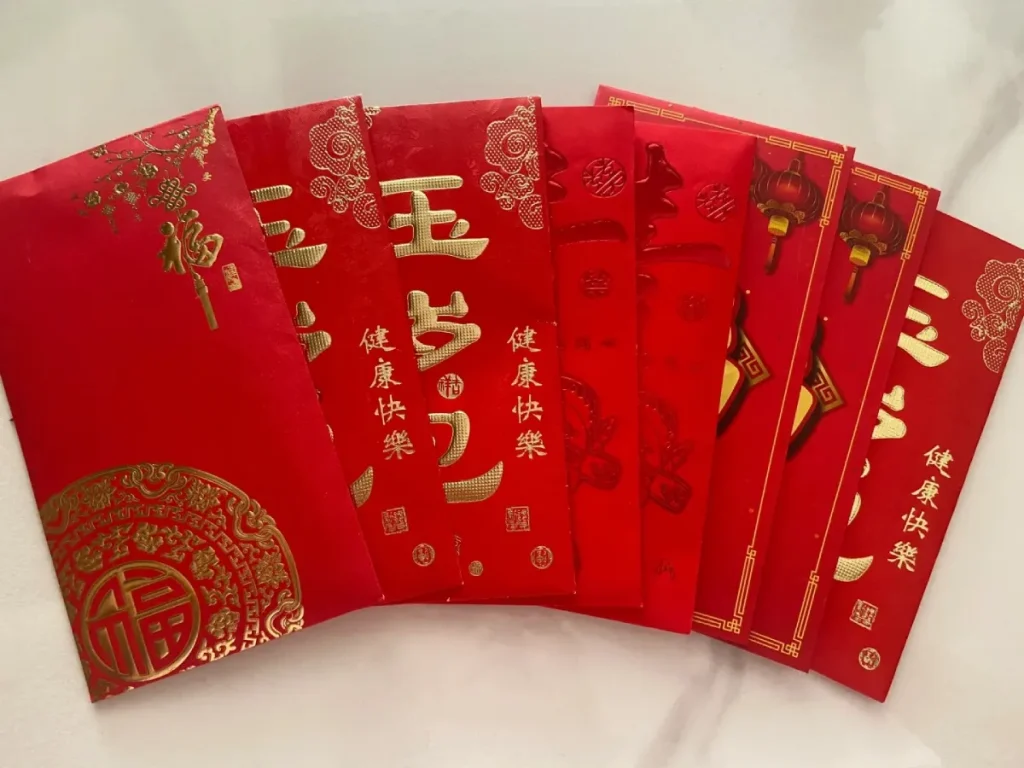
Give red envelopes (红包, hóngbāo) — a custom with its own guardian legend. Elders and married adults give red envelopes filled with money to children and unmarried younger relatives. The original version of this custom is called 压岁钱 (yāsuì qián), “money to suppress Sui” — Sui being a different demon said to sneak into children’s rooms on New Year’s Eve and touch their heads while they slept, causing illness or nightmares. Parents began giving children coins wrapped in red paper, or later strung together, to place under their pillow and ward Sui off. Over time the coins became modern paper money, but the protective intent behind the red color remains. The amount usually avoids the number four and often includes an eight, and the bills inside should ideally be new and crisp rather than worn or wrinkled.
Open doors and windows. On New Year’s Day, doors and windows are opened to let the old year’s air out and invite new fortune in.
Eat symbolic foods. Reunion dinners are built around dishes chosen for their lucky sound or shape: fish (鱼, yú) for surplus, since it sounds like “abundance” (余, yú); dumplings shaped like ancient gold ingots for wealth; long noodles left uncut for longevity; and rice cakes (年糕, niángāo) because the name sounds like “getting higher year after year.”
Set off firecrackers. Loud firecrackers and fireworks are meant to scare off Nian and other bad luck, continuing the same legend behind wearing red — the crackling sound was originally produced by burning hollow bamboo stalks, which is why the modern Chinese word for firecracker, 爆竹 (bàozhú), literally means “exploding bamboo.”
Visit family and pay respects. The first days of the new year are reserved for visiting parents, grandparents, and extended family, exchanging New Year greetings, and paying respects to ancestors.
Chinese New Year isn’t celebrated identically everywhere, and the north-south divide is one of the clearest examples. In northern China, dumplings (饺子, jiǎozi) take center stage at the New Year’s Eve meal, partly because their shape resembles old gold and silver ingots, symbolizing wealth for the coming year. In southern China, sticky rice cakes (年糕, niángāo) and glutinous rice balls (汤圆, tāngyuán) are more traditional, chosen instead for their homophones — “niángāo” sounds like “getting higher year after year,” while round tāngyuán symbolize family reunion and completeness. Northern households also tend to place more emphasis on paper-cut window decorations and door gods, while southern regions, especially in Guangdong and Fujian, put more weight on flower markets, kumquat trees, and lion dance performances. None of these differences are strict rules — they’re regional flavors layered on top of the same shared calendar and core beliefs.
Numbers carry as much superstition as words in Chinese culture, largely because of the same homophone logic.
| Number / Color | Meaning | Reason |
|---|---|---|
| 4 (四) | Unlucky | Sounds like “death” (死, sǐ) |
| 8 (八) | Very lucky | Sounds like “prosperity/wealth” (发, fā) |
| 6 (六) | Lucky | Sounds like “smooth” (流, liú) — implies things go smoothly |
| 9 (九) | Lucky | Sounds like “long-lasting” (久, jiǔ) |
| Red | Lucky | Symbolizes joy, protection, and vitality |
| Black / White | Unlucky | Associated with mourning and funerals |
| Gold | Lucky | Represents wealth and prosperity |
The taboos and lucky practices above apply every year, but the zodiac animal governing the current year adds another layer on top. Each Chinese New Year is ruled by one of the 12 zodiac animals, paired with one of five elements, and that combination shifts the spotlight onto specific people depending on their own birth sign.
Your 本命年 (běnmìngnián). Once every 12 years, the current zodiac year matches a person’s own birth sign — this is called their běnmìngnián. Counterintuitively, it’s not treated as a lucky year but as one requiring extra caution, since being “face to face” with your own zodiac animal is believed to unsettle 太岁 (Tài Suì), the guardian deity associated with that year. The standard remedy is wearing something red continuously through the year — a red string bracelet, red socks, or red underwear — as ongoing protection.
Clashing and harmonious signs. Beyond one’s own year, each of the 12 animals has fixed relationships with the others: some pairs form a “六冲” (liù chōng), a direct clash that calls for extra care with health and major decisions, while others form a “三合” (sānhé, trine) or “六合” (liùhé, secret-friend pairing), both considered favorable combinations for the year. These relationships never change — a Rat always clashes with a Horse, for instance, regardless of which year is currently running — only the specific people affected shift as the ruling animal changes each year. The six fixed clash pairs are: Rat–Horse, Ox–Goat, Tiger–Monkey, Rabbit–Rooster, Dragon–Dog, and Snake–Pig.
How long does Chinese New Year actually last? The formal celebration runs 15 days, starting on New Year’s Eve and ending with the Lantern Festival (元宵节, yuánxiāojié) on the night of the first full moon. Most workplaces only observe the first few days as public holiday, but family visits and temple events continue through the full two weeks.
Why is it called “Spring Festival” if it happens in winter? The Chinese name, 春节 (Chūnjié), literally means “Spring Festival.” The date is set by the lunisolar calendar and typically falls close to 立春 (Lìchūn), the “Start of Spring” solar term — so on the traditional calendar, the holiday really does mark the beginning of spring, even if it still feels like winter outside.
Is New Year’s Eve or New Year’s Day considered the bigger occasion? New Year’s Eve, not New Year’s Day, is arguably the most important night of the entire holiday. The reunion dinner (年夜饭, niányèfàn) that evening is the one meal almost everyone in the family is expected to attend, and many households stay up together until midnight rather than treating the following morning as the main event.
Do overseas Chinese communities still follow these customs? Yes, though observance varies by generation and location. Chinatowns and Chinese communities across Southeast Asia, North America, Europe, and Australia widely keep the red decorations, reunion dinners, and red envelope traditions, while stricter taboos — like avoiding hair washing or haircuts — tend to fade faster outside of mainland China, Hong Kong, and Taiwan.
It varies widely by generation, region, and family. Older generations and families in more traditional or rural areas tend to observe these customs closely, treating them as genuine risk-management for the year ahead. Younger, urban generations often follow the fun, food-and-décor-related customs — wearing red, eating dumplings, giving red envelopes — while treating the stricter taboos more like charming family habits than firm rules. Worth stating plainly: none of these customs are enforced or binding today. They’re rooted in centuries-old folk belief, and in most modern households they function as a shared ritual and a way of wishing loved ones well, not a set of rules anyone genuinely fears breaking.
Even skeptics tend to observe at least a few of these practices, if only because the customs are woven so tightly into what Chinese New Year feels like. Not sweeping the floor on New Year’s Day, avoiding the number four in a red envelope, or steering clear of an unlucky word at the dinner table costs nothing — and for many families, that small effort is part of what makes the holiday feel properly celebrated.