
If you’ve ever seen a small red envelope exchanged during Chinese New Year, you’ve witnessed Lucky Money in action. In Chinese, this custom is called Yasuiqian (压岁钱), literally “money that suppresses evil spirits.” What looks like a simple cash gift is actually one of the oldest and most meaningful traditions in Chinese culture, carrying centuries of folklore, family symbolism, and quiet protective magic.
This article breaks down what Lucky Money really means, where the Yasuiqian tradition came from, and how it’s practiced across Chinese families today.
Lucky Money is the English term most people use for cash given as a gift, usually during the Chinese New Year period. It is almost always presented inside a small red paper envelope known as a hongbao (红包).
Yasuiqian, the original Chinese term, is more specific and older in meaning than the modern “lucky money” label suggests. The name breaks down as:
- Ya (压) – to suppress or press down
- Sui (祟) – historically referring to evil spirits or the misfortune they bring, later personified in folklore as a demon by the same name (a homophone of 岁, meaning “age” or “year”)
- Qian (钱) – money
Put together, Yasuiqian literally means “money to ward off Sui,” referring to the folklore demon said to harm children while they sleep. Over time, as the character 祟 (misfortune/evil spirit) merged phonetically with 岁 (year/age), the meaning shifted to also represent “money for growing another year older,” which is why it’s closely tied to birthdays within the family and the Lunar New Year itself.
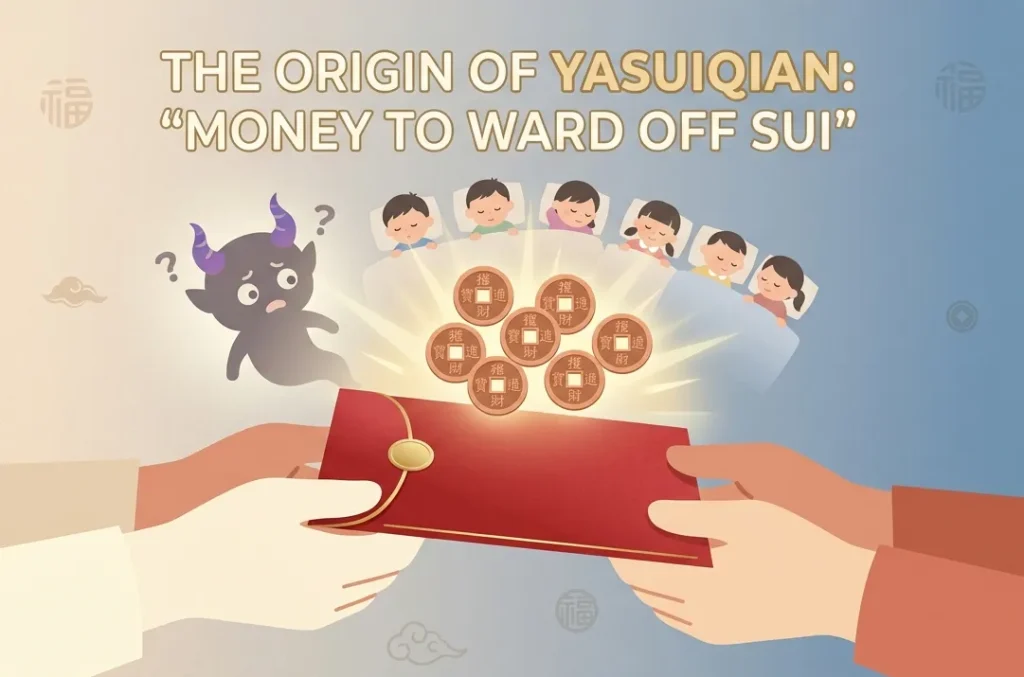
The legend of Sui. According to folklore, a demon named Sui would visit sleeping children on New Year’s Eve and touch their heads, causing them to fall ill or become frightened. Parents, desperate to protect their children, discovered that placing coins near a child’s pillow could scare Sui away — the shine of the coins was believed to reflect light that repelled the spirit.
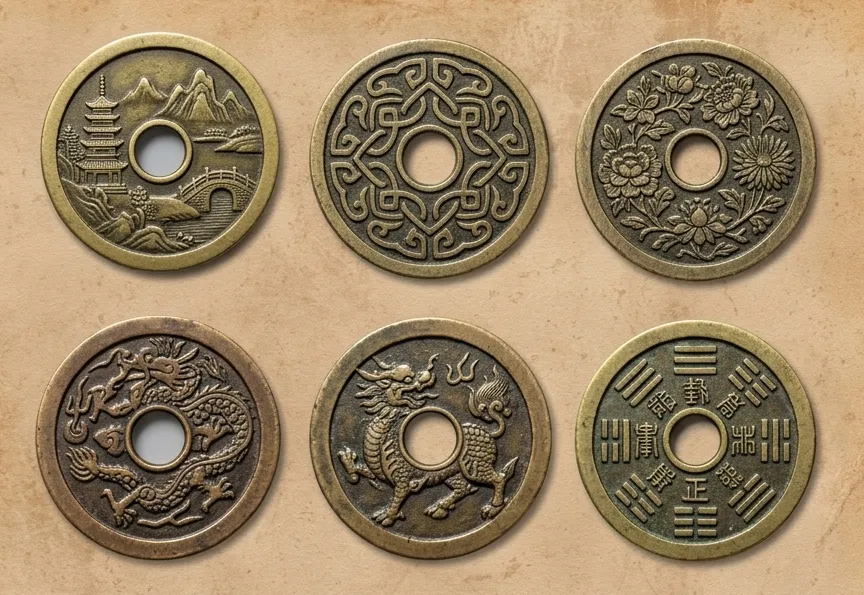
From amulet coins to red envelopes. In earlier dynasties, Yasuiqian wasn’t circulating currency at all. During the Han and Tang dynasties, people used Yansheng Qian (厌胜钱) — specially cast coins engraved with auspicious symbols like dragons, phoenixes, and protective inscriptions, made to be worn rather than spent. Children would often have these coins threaded onto multicolored silk cords and hung from their Hanfu belt (腰带), doubling as both a fashion accessory and a protective charm. As paper currency became common, the practice shifted toward wrapping money in red paper instead, since red is considered the strongest color for warding off misfortune in Chinese culture.
A tradition that outlived its myth. Even as belief in the demon Sui faded, the custom of giving money for protection and blessing remained. Today, Yasuiqian is less about superstition and more about family bonding, generosity, and marking the passage of another year.
Who gives, who receives. Traditionally, married adults and elders give Yasuiqian to unmarried younger family members — children, teenagers, and even unmarried adults in their twenties or thirties. Grandparents, parents, aunts, and uncles are the most common givers.
The red envelope matters as much as the money. The hongbao itself is treated with respect. It’s considered impolite to open the envelope in front of the giver, and the envelope is often kept sealed until the recipient returns home.
Even numbers, lucky numbers. The amount inside typically follows numerology customs. Amounts containing the number 8 (auspicious, associated with wealth) are favored, while amounts with the number 4 (a homophone for “death” in Chinese) are avoided entirely.
Timing. Money is most commonly given on Chinese New Year’s Eve or the first day of the Lunar New Year, though some families also give Yasuiqian at birthdays or weddings using the same red envelope custom.
Short answer: not really — it’s a translation, not a different custom. “Lucky Money” is simply the commonly used English phrase for Yasuiqian, popularized as the tradition became more visible outside China through Lunar New Year celebrations, media, and diaspora communities. Here’s a quick comparison for clarity:
| Term | Language | Literal Meaning | Common Usage |
|---|---|---|---|
| Yasuiqian (压岁钱) | Chinese | Money to suppress evil spirits | Original, culturally rooted term |
| Lucky Money | English | N/A (descriptive translation) | Popular international term |
| Hongbao (红包) | Chinese | Red envelope/red packet | Refers to the envelope itself, sometimes used interchangeably with the money inside |
One nuance worth knowing: Hongbao is technically the container — red envelopes are also given for weddings, graduations, and business openings, not just New Year. Yasuiqian specifically refers to the New Year and elder-to-younger context. In casual conversation, though, most people — including native speakers — use hongbao and Yasuiqian interchangeably during the New Year season.
Red envelopes aren’t just packaging. The color red is central to Chinese New Year symbolism, representing good fortune, joy, and protection from evil. Using anything other than red for Yasuiqian would be considered to strip the gift of its protective meaning.
Sealed, not stacked. Money inside a hongbao is traditionally given in crisp, new bills rather than worn currency, symbolizing a fresh start for the new year. Many people in China specifically withdraw new banknotes from the bank in the weeks before New Year just for this purpose.
Digital hongbao. In recent years, especially through platforms like WeChat, sending Yasuiqian digitally through virtual red envelopes has become just as common as physical ones, particularly for distant relatives who can’t celebrate together in person.
Yasuiqian endures not because anyone still fears a demon named Sui, but because it captures something families across generations continue to value: protection, generosity, and connection passed quietly from elder to younger. Whether it’s called Lucky Money at an international Lunar New Year event or Yasuiqian at a family dinner table in China, the gesture carries the same intention — a small red envelope wishing the recipient a safer, luckier year ahead.
If you’re wearing Hanfu for Chinese New Year celebrations, consider carrying your hongbao in a traditional embroidered pouch — a xiangbao (香囊) or hebao (荷包) — hung from your sash. It echoes the original amulet coin custom and keeps the look period-appropriate rather than reaching for a modern pocket or bag.