
If you’ve ever sipped a cup of jasmine tea and wondered whether you were actually drinking green tea, you’re not alone. The short answer: most jasmine tea is made from a green tea base, but jasmine tea is not simply “green tea with flowers.” It’s a distinct category of Chinese tea created through a centuries-old scenting process — and the base leaf isn’t always green tea at all.
Let’s break down exactly what jasmine tea is, how it relates to green tea, and how to tell the difference when you’re shopping or brewing.
What Is Jasmine Tea, Really?
Jasmine tea (茉莉花茶, mòlì huāchá) is not a tea plant variety — it’s a flavoring method. Tea leaves are layered with fresh jasmine blossoms, usually overnight, so the leaves absorb the flowers’ fragrance. The spent blossoms are then sifted out (in most commercial tea, though some high-grade versions leave a few petals in for visual appeal).
This means jasmine tea can theoretically be made from almost any base tea — green, white, oolong, or even black tea. But historically and commercially, one base dominates.
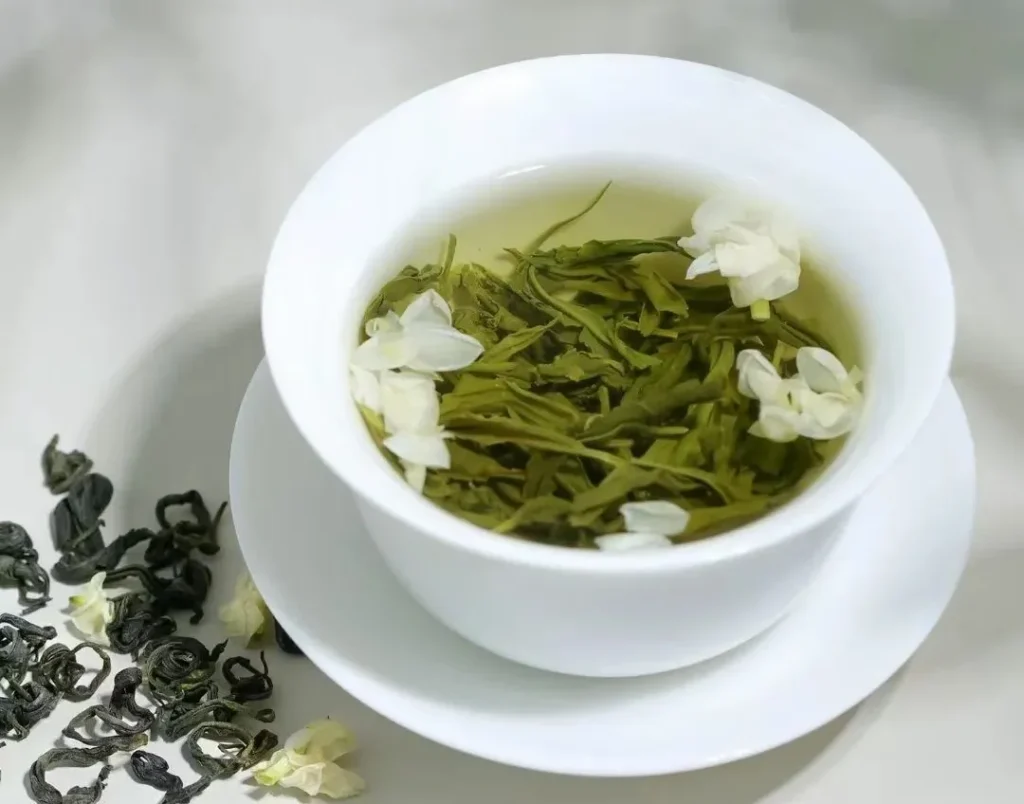
The vast majority of jasmine tea on the market — especially jasmine tea from Fuzhou in Fujian province, considered the historical home of the craft — uses green tea as its base. There are a few practical reasons for this:
1. Green tea’s delicate flavor lets jasmine shine. Green tea is lightly oxidized and has a mild, grassy, slightly sweet flavor that doesn’t compete with the floral jasmine scent. A stronger tea, like black tea, would overpower the fragrance.
2. Green tea and jasmine season together. Fresh spring green tea leaves are typically dried but not fully finished, then stored until jasmine blossoms peak in summer — allowing the scenting process to happen at the ideal time for both ingredients.
3. Tradition and market expectations. Jasmine green tea has been produced this way since at least the Song Dynasty, and refined into its modern form during the Qing Dynasty. Centuries of production have made it the default pairing.
Jasmine itself traveled a long road before it ever met tea. The flower arrived in China from the Persian Gulf region by way of the ancient Maritime Silk Road, and historical records place jasmine cultivation in Fuzhou as far back as the Western Han Dynasty. Scenting tea with the blossoms developed later, becoming a refined craft by the Song Dynasty and reaching its modern form under the Qing.
Fuzhou’s status as the birthplace of jasmine tea is now formally recognized. In 2014, the Fuzhou Jasmine and Tea Culture System was named a Globally Important Agricultural Heritage System by the UN’s Food and Agriculture Organization, and the traditional scenting technique was added to China’s National Intangible Cultural Heritage list the same year. In 2022, the broader craft of Chinese tea processing — including Fuzhou’s jasmine scenting method — was inscribed on UNESCO’s Representative List of the Intangible Cultural Heritage of Humanity. Locally, tea sellers still describe the finest grades with an old saying: the fragrance of jasmine lingers, but not a single petal remains.
This is the key nuance most people miss. While “jasmine green tea” is the most common product, other bases exist and are increasingly popular:
Jasmine white tea — uses white tea (like Bai Mudan) as the base. It’s lighter, sweeter, and less grassy than jasmine green tea, with a smoother mouthfeel.
Jasmine oolong tea — uses partially oxidized oolong leaves, often rolled into pearls. This version has more body and a slightly toasted, floral-forward taste, popular in Taiwan.
Jasmine black tea — rarer, since black tea’s bold flavor tends to mask the floral notes, but it does exist in some regional blends.
So the accurate way to think about it: green tea is the most traditional and common base for jasmine tea, but “jasmine tea” as a category is defined by the scenting process, not the base leaf. If a label just says “jasmine tea” with no other detail, it’s safe to assume green tea — but always check the packaging if you want to be sure.
| Aspect | Jasmine Tea | Plain Green Tea |
|---|---|---|
| Base leaf | Usually green tea (sometimes white or oolong) | Green tea only |
| Flavor | Floral, fragrant, slightly sweet | Grassy, vegetal, sometimes nutty |
| Processing | Green tea + jasmine flower scenting (multiple rounds) | Withered, fixed (pan-fired or steamed), dried |
| Caffeine | Similar to green tea, slightly lower on average | Moderate (roughly 20–45mg per cup) |
| Common origin | Fuzhou, Fujian province | Zhejiang, Fujian, Anhui, and other regions |
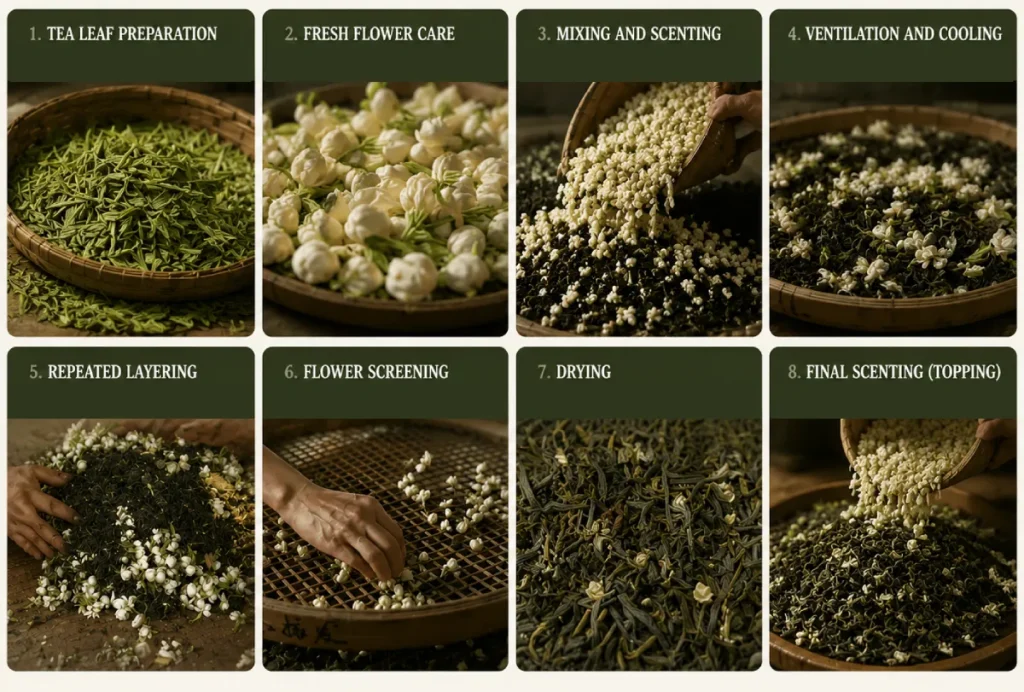
Quality jasmine tea is a far more involved process than simply “tea plus flowers overnight.” Traditional Fuzhou-style scenting follows a multi-stage cycle that’s repeated several times, which is part of why good jasmine tea costs more than plain green tea:
Step 1 — Prepare the base tea. Spring green tea is re-fired and then left to cool naturally. This step is essential: it lowers the leaf’s moisture and boosts its ability to absorb fragrance, so it’s ready to take on scent once the jasmine season arrives in summer.
Step 2 — Condition the fresh blossoms. Jasmine buds are harvested in the late afternoon while still closed, then spread out and rested — alternating between cooling and gentle heaping — so they open evenly and reach peak fragrance before use. Underripe or unevenly opened buds are sifted out at this stage.
Step 3 — Mix tea and blossoms. The conditioned blossoms are layered and mixed evenly with the tea leaves in large piles, at a carefully judged ratio — this has to happen within a narrow window after the flowers start releasing scent, or quality drops fast.
Step 4 — Vent and turn the pile. As the tea and flowers sit together, the pile naturally heats up. Workers turn and spread it out periodically to release the heat and refresh the oxygen inside — skipping this step lets the flowers overheat and turn a dull yellow, giving the tea a stale, “stewed” off-flavor instead of a clean floral one.
Step 5 — Re-pile and continue scenting. After venting, the tea and flowers are heaped back together to continue absorbing fragrance, for a combined scenting time that can run 10–14 hours for a first round.
Step 6 — Sift out the spent flowers. Once the tea has absorbed enough fragrance and the flowers have faded, the two are separated by sifting. Timing matters here too — leaving the process too long lets the spent flowers spoil and taint the tea.
Step 7 — Re-fire to dry. Because the tea has picked up moisture from the fresh flowers, it must be dried again after every single round — not just once at the very end — to bring the moisture back down before the next round or before packaging.
Step 8 — Repeat, then finish with a flower enhancement round. Higher-grade teas repeat Steps 2–7 multiple times — traditionally anywhere from one to seven or eight rounds. More rounds mean deeper, longer-lasting fragrance and higher cost. The very last round for premium teas is often a lighter “flower enhancement” pass (提花): a small amount of extra high-quality blossoms is mixed in for a short, gentle scenting with no venting and no re-firing afterward, purely to sharpen the tea’s fresh floral top-note just before it’s packed.
Not all “jasmine tea” on the shelf goes through this traditional process. Some cheaper products are sprayed with synthetic jasmine flavoring instead of scented with real flowers. A few signs can help you tell the difference:
The aroma is sharp and one-note rather than layered. Natural scenting produces a soft, evolving fragrance; artificial flavoring often smells more like perfume — strong on first opening but flat and one-dimensional in the cup.
The scent doesn’t survive re-steeping. Genuinely scented tea still carries fragrance into the second and third infusion, since the aroma has soaked into the leaf itself. Artificially flavored tea often goes nearly scentless after the first pour.
The fragrance is too loud right out of the bag. An overpowering smell before you’ve even added water is a common sign of added scent rather than natural absorption.
The packaging or listing doesn’t mention “scented” or the number of scenting rounds. Reputable sellers of traditional jasmine tea are usually happy to state how the tea was scented and how many rounds it went through.
Since most jasmine tea starts as green tea, its caffeine content is very close to that of plain green tea — typically in the range of 20–45mg per 8oz cup, though this varies by leaf grade, steeping time, and water temperature. It tends to sit slightly lower than a plain green tea of the same grade for two practical reasons: the repeated scenting-and-drying cycles subject the leaf to additional gentle heating, which causes a small amount of caffeine loss each round, and the finished tea’s weight includes a small amount of jasmine flower material rather than 100% tea leaf. Jasmine white tea and jasmine oolong versions may have slightly different caffeine profiles based on their own base tea characteristics.
Because it shares a green tea base, jasmine tea offers many of the same wellness properties associated with green tea, plus a few unique to the jasmine flower itself:
Rich in antioxidants. Green tea catechins, including EGCG, are preserved through the scenting process.
Calming aroma. Jasmine’s fragrance is often associated with relaxation and stress relief, making it a popular after-dinner tea.
Supports digestion. Traditionally consumed after meals in Chinese culture to aid digestion and cleanse the palate.
Lower caffeine than coffee. A gentler alternative for those sensitive to caffeine but still wanting a mild lift.
A couple of practical cautions worth knowing: like other tea, jasmine tea is traditionally not recommended on a completely empty stomach, since its compounds can feel harsh on some people’s digestion. Those who are pregnant, caffeine-sensitive, or taking medication that interacts with caffeine or catechins should check with a doctor about how much is appropriate for them.
| Step | Guideline |
|---|---|
| Water temperature | 75–85°C (167–185°F) — avoid boiling water, which scorches the leaves |
| Tea amount | 1 teaspoon (about 2g) per 200ml of water |
| Steeping time | 2–3 minutes for the first infusion |
| Re-steeping | Quality jasmine tea can be steeped 2–3 more times, extending time slightly each round |
A glass or white porcelain teapot works well, letting you enjoy the visual of the leaves unfurling along with the aroma. If you have a gaiwan (盖碗), it’s actually the traditional choice for jasmine tea: its wide opening releases the fragrance more fully with each pour, and the lid can be tilted to smell the aroma before drinking — a small ritual tea drinkers in Fuzhou still practice today. A clear glass cup or teapot, on the other hand, is better if you want to watch the leaves slowly open and drift through the water, which is part of the appeal of higher-grade jasmine tea.
Frequently Asked Questions
Is jasmine tea just green tea with jasmine flavoring added?
Not exactly. Real jasmine tea is scented through direct contact with fresh jasmine blossoms over multiple rounds, not flavored with extracts or oils. Lower-quality commercial versions sometimes use added scent, but traditional jasmine tea is a natural infusion process.
Can I make jasmine tea from any green tea?
At home, you can layer dried green tea with fresh jasmine flowers to create a simple version, though it won’t match the multi-round scenting process used commercially.
Is jasmine tea good before bed?
Since it typically contains caffeine from its green tea base, it’s better enjoyed earlier in the day or early evening rather than right before sleep.
What’s the difference between jasmine tea and jasmine green tea?
“Jasmine tea” is the general category. “Jasmine green tea” specifies the base leaf, which is the most common — but not the only — type available.