
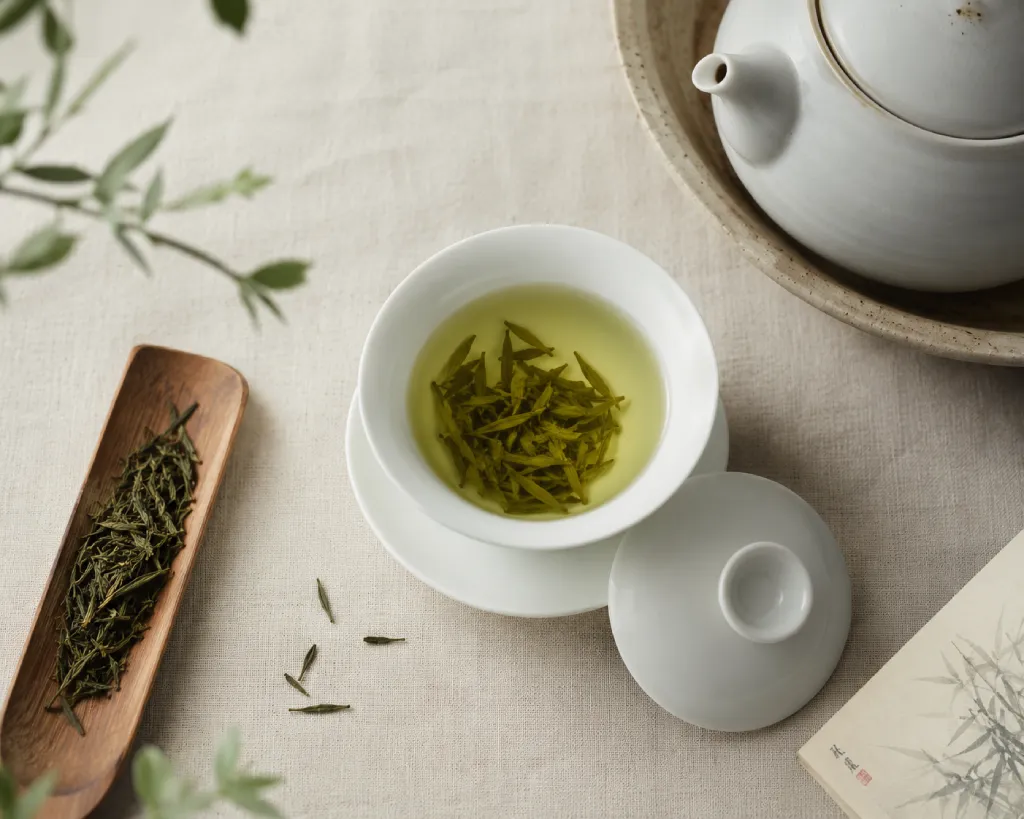
Green tea is one of China’s most treasured gifts to the world — a drink steeped in thousands of years of culture, ritual, and refinement. Whether you’re reaching for a tin of hand-picked Longjing from the hills around Hangzhou or a delicate pouch of Biluochun harvested beside Lake Taihu, knowing how to brew green tea properly is the difference between a cup that sings and one that turns bitter and flat. This guide walks you through everything you need to know, from water temperature and steeping time to vessel selection and the art of the second steep.
Green tea is the most delicate of all tea types. Unlike black or oolong teas, green tea leaves are unoxidized, which means they retain a high concentration of catechins, amino acids, and volatile aromatic compounds. These are what give a good green tea its characteristic sweetness, grassy freshness, and umami depth — but they are also what make it so easy to ruin. Boiling water, excessive steeping, and poor-quality vessels can all strip away the subtlety and leave you with a harsh, astringent brew. Understanding a few core principles before you begin will spare you countless disappointing cups.
Not all green teas are created equal, and the variety you choose will shape your entire experience. China alone produces dozens of distinct green teas, each with its own character. Longjing (Dragon Well) from Zhejiang is flat, jade-green, and famously smooth, with a lingering chestnut sweetness. Biluochun from Jiangsu is tightly rolled into tiny spirals and intensely floral. Huangshan Maofeng from Anhui is soft and misty, with a gentle orchid fragrance.Among China’s many regional varieties, Anji Baicha from Zhejiang stands out for its unusually pale, almost ivory leaves and delicate sweetness, while Enshi Yulu from Hubei is one of the few Chinese green teas still made using the steaming method — producing a clean, vegetal flavor reminiscent of fresh bamboo.
For beginners, a mid-grade Longjing or Sencha is a forgiving and rewarding starting point. As your palate develops, you can begin exploring higher-grade teas and the nuances they offer.

Before you begin, gather the following:
- High-quality loose-leaf green tea
- Filtered or spring water — tap water with heavy chlorine will dull the flavor
- A kettle — electric or stovetop
- A glass or ceramic teapot, gaiwan, or a simple glass cup
Avoid metal infusers where possible. Metal can react with the delicate compounds in green tea and introduce off-flavors. Glass and unglazed ceramic are the preferred choices among serious tea drinkers, as they are neutral in taste and allow you to observe the color and clarity of your brew as it steeps.
This is where most people go wrong. Boiling water (100°C / 212°F) is far too hot for green tea. It scorches the leaves, destroys the amino acids responsible for sweetness, and releases an excess of tannins — the source of that sharp, bitter aftertaste that puts so many people off green tea entirely.
The ideal temperature range for most green teas is 75°C to 85°C (167°F to 185°F). As a general rule:
- Delicate, high-grade teas (e.g., Longjing, Gyokuro): 70–75°C
- Standard green teas (e.g., Sencha, Maofeng): 80–85°C
If you don’t have a temperature-controlled kettle, bring water to a boil and let it rest for 3–5 minutes. This typically brings it down to around 80°C — close enough for most green teas.
Use approximately 2–3 grams of loose-leaf tea per 150–200ml of water. This works out to roughly one heaped teaspoon per cup. You can adjust to taste — more leaf produces a stronger, more intense brew; less leaf gives a lighter, more delicate cup. When brewing in a gaiwan or small teapot, you can use a higher leaf-to-water ratio and compensate with shorter steeping times, which is a method that rewards patience and yields exceptional complexity across multiple infusions.
Green tea steeps quickly. Leaving it too long is one of the most common mistakes, and one of the easiest to fix with a simple timer.
- First steep: 1 to 2 minutes
- Subsequent steeps: add 30 seconds to 1 minute each time
Quality loose-leaf green tea can typically be re-steeped 3 to 4 times. Each infusion reveals a slightly different profile — the first is often grassy and bright, the second deeper and sweeter, and later steeps mellower and more subdued. Many experienced tea drinkers find the second steep to be the most satisfying of all.
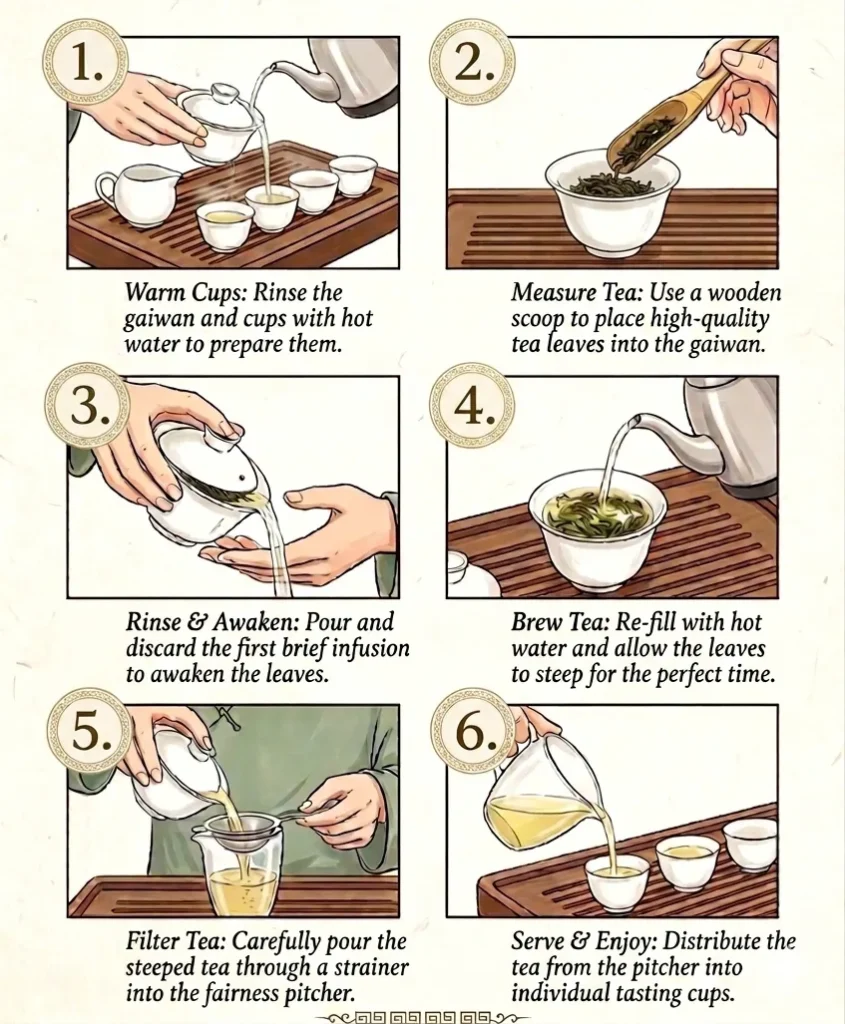
Step 1 — Warm the vessel (温杯)
Pour a small amount of hot water into your cup or teapot, swirl it gently, and discard. This brings the vessel up to temperature so it doesn’t pull heat away from your brew the moment the tea goes in.
Step 2 — Add the leaves (投茶)
Add 2–3 grams of loose-leaf green tea — roughly one heaped teaspoon — to your warmed vessel. For a glass cup, add the leaves directly. For a gaiwan or teapot, use a tea scoop if you have one.
Step 3 — Rinse the leaves (润茶, optional)
Pour a small amount of water at the correct temperature over the leaves, let it sit for just 3–5 seconds, then pour it out immediately. This softens the leaves, releases the first layer of aroma, and washes away any dust. For delicate green teas this step is optional — many people skip it entirely and lose nothing.
Step 4 — Brew (冲茶)
Pour your temperature-correct water gently over the leaves in a slow, circular motion. Fill the vessel and cover it. Steep for 1–2 minutes — set a timer until the timing becomes instinctive. Do not stir or press the leaves.
Step 5 — Decant and serve (出汤 / 分茶)
Pour the brewed tea out completely into a fairness cup (公道杯) — a small glass or ceramic pitcher that acts as an intermediate vessel. This ensures every cup gets tea of the same strength and color. From there, pour into individual cups. Getting all the liquid out of the teapot or gaiwan is important — any tea left sitting on the leaves will over-steep and turn bitter.Quality loose-leaf green tea can be re-steeped 3–4 times; add 30 seconds to each subsequent steep.
Step 6 — Drink while warm (饮茶)
Green tea is at its best within the first few minutes after pouring. As it cools the flavor shifts and bitterness becomes more noticeable. Sip slowly — the first cup is usually the brightest and most aromatic of the session.
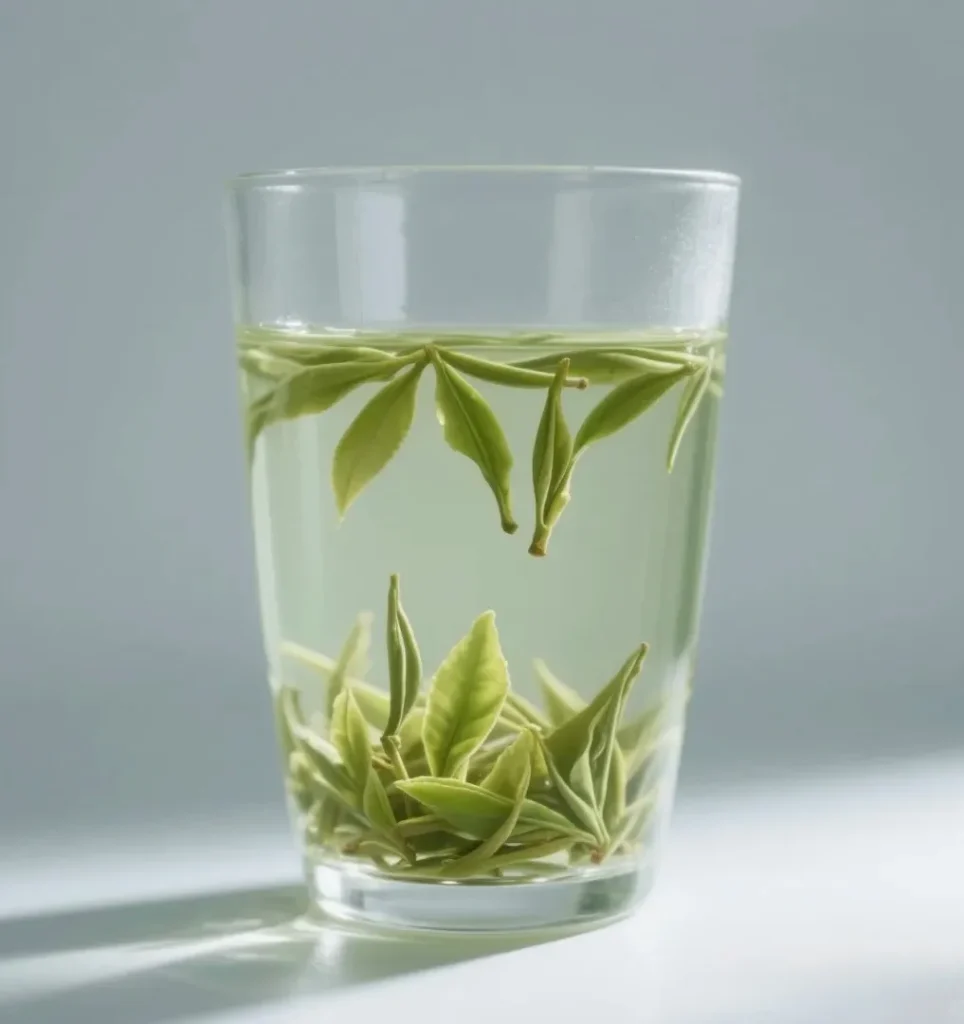
For most people, a plain drinking glass is all you need. Add your measured leaves directly to the glass, pour in water at the correct temperature, and simply wait 1–2 minutes before drinking. As the leaves sink to the bottom, tilt the glass slightly while sipping to keep them away from your lips. This is how most Chinese people drink green tea at home or at the office — no equipment, no ceremony, just good tea.
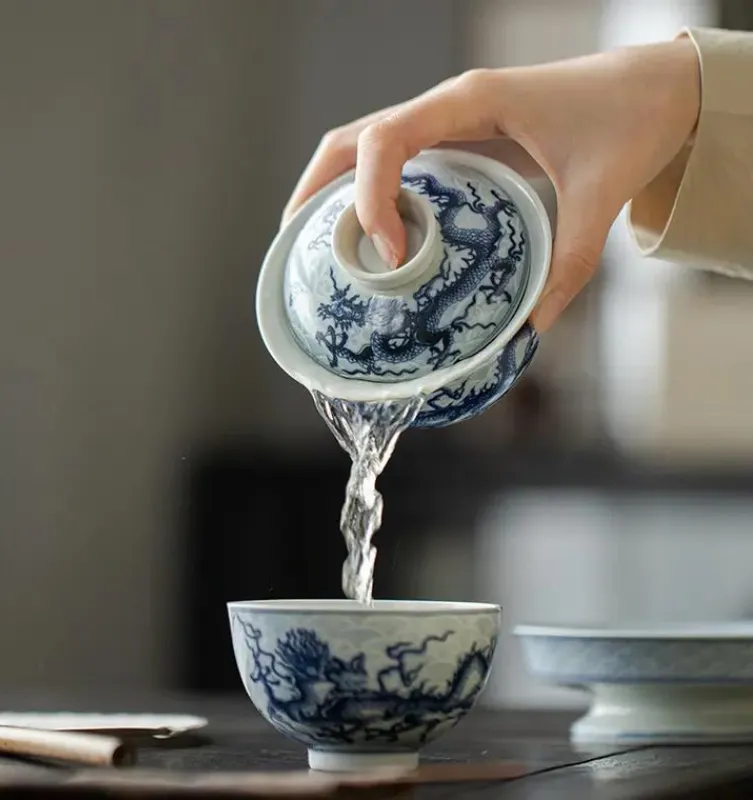
For those who want to explore traditional Chinese tea culture more deeply, the gaiwan — a lidded bowl without a handle, typically made of porcelain — is the classic vessel for brewing green tea. It gives you complete control over steeping time, allows you to observe the leaves as they unfurl, and is simple to rinse between steeps. To use a gaiwan, add leaves, pour in water at the correct temperature, place the lid slightly ajar to allow excess heat to escape, and pour out after the appropriate steeping time. The lid acts as a strainer. It takes a little practice to hold correctly without burning your fingers, but once mastered it becomes second nature — and there is a quiet elegance to the ritual that a teabag simply cannot replicate.
- Using boiling water. Always let the kettle cool before pouring.
- Steeping too long. Even 30 extra seconds can tip a delicate tea into bitterness. Set a timer until you have the timing memorized.
- Using poor-quality water. The water makes up over 99% of your cup. Spring or filtered water makes a noticeable difference.
- Discarding leaves after one steep. Good loose-leaf green tea has multiple infusions in it.
- Storing tea improperly. Green tea is sensitive to light, heat, moisture, and odors. Store it in an airtight, opaque container away from sunlight and strongly scented foods.
Green tea’s clean, vegetal character pairs beautifully with light foods. Steamed dumplings, sushi, fresh salads, mild cheeses, and simple rice dishes all complement its freshness without competing with it. It also works wonderfully as a palate cleanser between courses. Avoid pairing it with heavily spiced or deep-fried foods, which tend to overwhelm the subtlety of the brew and make any residual bitterness more pronounced.
Brewing green tea well is a small ritual that rewards patience and attention. Once you find the right temperature, ratio, and timing for your preferred variety, the process becomes effortless — and the result, a cup that is fresh, aromatic, and genuinely nourishing, is worth every second of care. Start simply, taste attentively, and let the tea teach you.