
Step into almost any restaurant in China and the server will set down a cup of steaming water before you’ve even opened the menu. Visit a Chinese household with a cold, and the first piece of advice you’ll hear is “he dian re shui” — drink some hot water. For many Western visitors, this is one of the more puzzling habits they encounter: where they expect ice water, they get a thermos. So why do Chinese people drink hot water, even in the middle of summer?
The answer isn’t a single tradition but a layering of several: an ancient medical philosophy, a 19th-century public health scare, a 20th-century government campaign, and a modern habit that has simply outlived the reasons it started. Understanding all four pieces explains why hot water became, and remains, one of China’s most distinctive everyday customs.
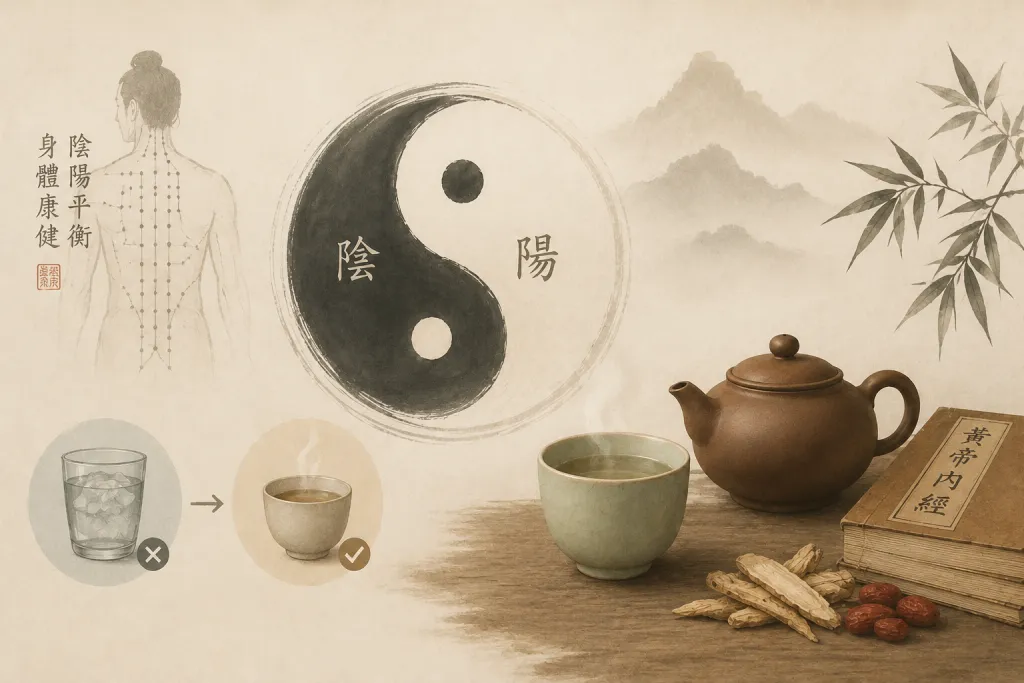
The most commonly cited explanation traces back to Traditional Chinese Medicine (TCM) and its framework of yin and yang — two opposing but complementary forces that are believed to need balance for the body to stay healthy. Cold foods and drinks are generally classified as yin, while warmth is associated with yang. According to this view, cold water can shock the digestive system, slow circulation, and disrupt the body’s internal balance, while warm water is gentler and supports digestion and circulation instead.
Interestingly, sources within TCM itself don’t fully agree on the mechanics. Some describe hot water as a way to nourish the body’s yang energy directly, which is said to power digestion and organ function. Others describe it as a mild, neutral drink that helps offset excess yang or expel dampness from the body, particularly useful in China’s humid southern climate. Either way, the underlying logic is the same: room-temperature or cold water is treated with suspicion, and warmth is treated as protective. This thinking traces back at least to the Huangdi Neijing (the Yellow Emperor’s Inner Classic), a foundational medical text often dated to around 2,000 years ago, and the broader yin-yang framework is older still, with some accounts tracing the hot water habit informally to the Zhou dynasty.
This belief explains a related, very common piece of advice: when you’re sick in China, almost everyone — doctors, parents, coworkers, taxi drivers — will tell you to drink more hot water. It’s treated as something close to a universal remedy, recommended for colds, stomachaches, cramps, and general fatigue alike.
Long before TCM theory was reinforced by government policy, there was a more immediate, practical reason to boil water: it kills the bacteria and parasites that untreated water often carried. This became especially clear in 1862, when a major cholera outbreak swept through Shanghai, reportedly killing thousands of people at its peak as refugees from the Taiping Rebellion crowded into the city. The outbreak spread north, but parts of southern China were said to have fared comparatively better — and observers at the time noted that hot water and tea drinking were already more common in the south. While modern epidemiology would point to many overlapping factors rather than hot water alone, the association stuck, and it strengthened the belief that boiling water was a matter of survival, not just comfort.
Personal habit and folk medicine are one thing; a government mandate is another. In February 1934, the Nationalist government led by Chiang Kai-shek launched the New Life Movement, a campaign of hygiene and behavioral reforms meant to modernize daily life in China. Drinking boiled water was written into its official guidelines alongside rules on cleanliness, manners, and public conduct, turning what had been a regional habit into something promoted nationwide.
What’s striking is that the practice survived the political upheaval that followed. During the 1930s and 1940s, the Communist movement that opposed Chiang Kai-shek rejected most of what the New Life Movement stood for — but not the hot water. The Red Army actively encouraged its troops to drink boiled water during long marches through difficult terrain, partly to prevent dysentery and other waterborne illness. Two rival political movements that agreed on almost nothing both ended up promoting the same drink.
In the following decades, as China industrialized and tap water infrastructure expanded unevenly, boiling water at home (often in a thermos, to keep it hot through the day) remained a practical necessity in many areas where water safety wasn’t guaranteed. That practical need is largely gone in most Chinese cities today, but the habit it created was not.

Modern Chinese tap water in most cities is generally safe when boiled, and bottled and filtered water are widely available, so the original public health urgency behind drinking hot water has eased considerably. Yet the custom hasn’t faded — if anything, it has become a marker of everyday hospitality and care. Offering a guest hot water (or hot tea) rather than something cold is simply considered the polite, comfortable thing to do, in the same way offering a cold drink is the default elsewhere.
There are smaller, more practical habits layered on top of the medical and historical reasons too. Many people grow up being told that drinking cold liquids with a hot meal is hard on the stomach, or that cold drinks can make period cramps worse — folk beliefs that, true or not scientifically, are passed down the same way many food customs are. A hot foot soak before bed, a flask of hot water carried through winter and summer alike, a bowl of soup before the main dishes — these are all expressions of the same underlying idea: warmth, in food and drink, is treated as something the body wants and deserves.
| Reason | Origin |
| Yin-yang balance, supports digestion and circulation | Traditional Chinese Medicine |
| Boiling kills bacteria and parasites in untreated water | 1862 Shanghai cholera outbreak |
| Nationwide hygiene policy | 1934 New Life Movement |
| Wartime health measure for troops | Red Army practice, 1930s–40s |
| Hospitality and comfort custom | Modern everyday habit |
Like a lot of long-running customs, the Chinese preference for hot water isn’t really about any one explanation — it’s about all of them stacking up over more than a century. What started as medical theory was reinforced by a genuine public health crisis, formalized by a government campaign, carried forward by two opposing armies, and eventually settled into something closer to comfort and habit than necessity. The next time you’re handed a cup of hot water in China, on a winter day or a summer one, it’s worth remembering: you’re not just being served a drink, you’re being handed a small piece of a very long story.