
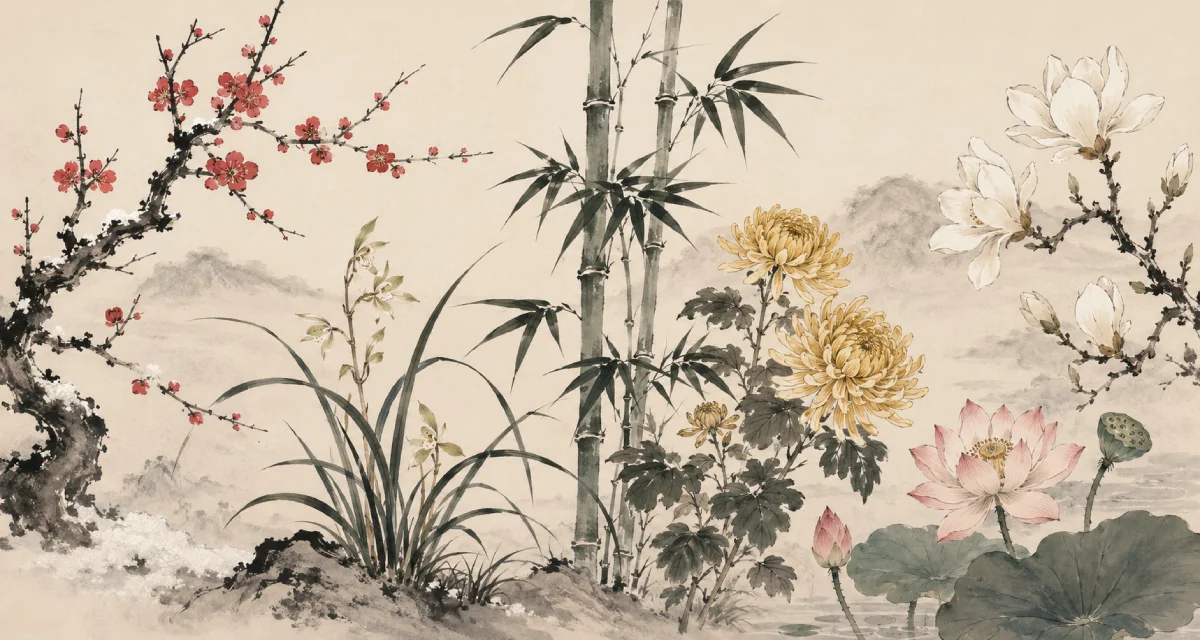
Flowers have held a central place in Chinese visual culture for more than two thousand years. Unlike in Western decorative traditions, where flowers are often painted for their beauty alone, flowers depicted in Chinese art carry layers of meaning — moral, philosophical, seasonal, and spiritual. A single peony on a ceramic vase is not merely decorative; it communicates wealth, femininity, and imperial splendor. A spray of plum blossom in ink wash speaks of resilience, integrity, and the cold promise of spring.
Understanding which flowers appear in Chinese art — and why — opens a window into how Chinese civilization has long understood virtue, nature, and the passage of time.
The story of flowers in Chinese art begins in the Han dynasty (206 BCE–220 CE), when floral motifs first appeared on silk banners, lacquerware, and tomb murals. These early representations were largely decorative, used as ornamental borders or to suggest paradise. However, even at this early stage, certain flowers were acquiring symbolic weight. As Buddhism spread into China along the Silk Road, the lotus began to carry new meanings drawn from Indian and Hellenistic visual traditions.
By the Tang dynasty (618–907 CE), flowers had become a serious subject of painting in their own right. The peony was elevated to near-national status during this period — its lush, full blossoms perfectly suited to the Tang aesthetic of opulence and confidence. Court painters rendered peonies in rich mineral pigments, establishing a tradition of technically virtuosic flower painting that would influence Chinese art for centuries.
The Song dynasty (960–1279 CE) marks the pivotal turning point. Two parallel traditions emerged: the meticulous court style associated with Emperor Huizong, who painted birds and flowers with extraordinary precision; and the literati tradition, championed by scholar-artists like Su Shi and Mi Fu, who used spare ink-wash brushwork to invest flowers with moral and philosophical meaning. It was during the Song dynasty that the famous grouping known as the Four Gentlemen crystallized into a unified concept.
The Yuan (1271–1368 CE) and Ming (1368–1644 CE) dynasties saw flower painting become institutionalized within literati culture. Scholar-artists used flower subjects as a form of self-expression and political commentary — painting orchids in remote valleys to signal their own withdrawal from corrupt official life, or rendering plum blossoms to declare their unbroken integrity under foreign rule.
By the Qing dynasty (1644–1912 CE), floral imagery had saturated every medium: painting, embroidery, porcelain, jade carving, furniture inlay, and textile design. The symbolic vocabulary established in the Song and Ming periods had become a shared cultural language spoken across all decorative arts.
The most iconic grouping in Chinese flower art is the Four Gentlemen (sì jūnzi, 四君子) — the plum blossom, the orchid, the bamboo, and the chrysanthemum. The term “gentleman” here does not refer to social rank but to the Confucian concept of the junzi: the cultivated, morally upright person whose character provides stability to society. Each plant in the group corresponds to a season, and each embodies a set of virtues that Chinese literati aspired to.
The Four Gentlemen have been depicted in ink and wash painting for more than a thousand years, and remain one of the most practiced subjects in traditional Chinese brush painting today.
The plum blossom is perhaps the most beloved flower in all of Chinese culture. It blooms in the dead of winter — after most other plants have shed their leaves, before any other flower appears — often pushing through snow to open its pale, fragrant petals. This singular behavior made it a natural symbol of perseverance, resilience, and the courage to stand against adversity.
In painting, the plum blossom presents a compelling visual challenge: the tension between the gnarled darkness of old winter branches and the fragile delicacy of blossoms opening in the cold. Song dynasty artists developed specialized techniques to capture this contrast, using varied ink tones to suggest three-dimensional branches while rendering flowers through careful negative space. The painter Wang Mian (1287–1359) became so celebrated for his plum blossom paintings that the subject is still associated with his name.
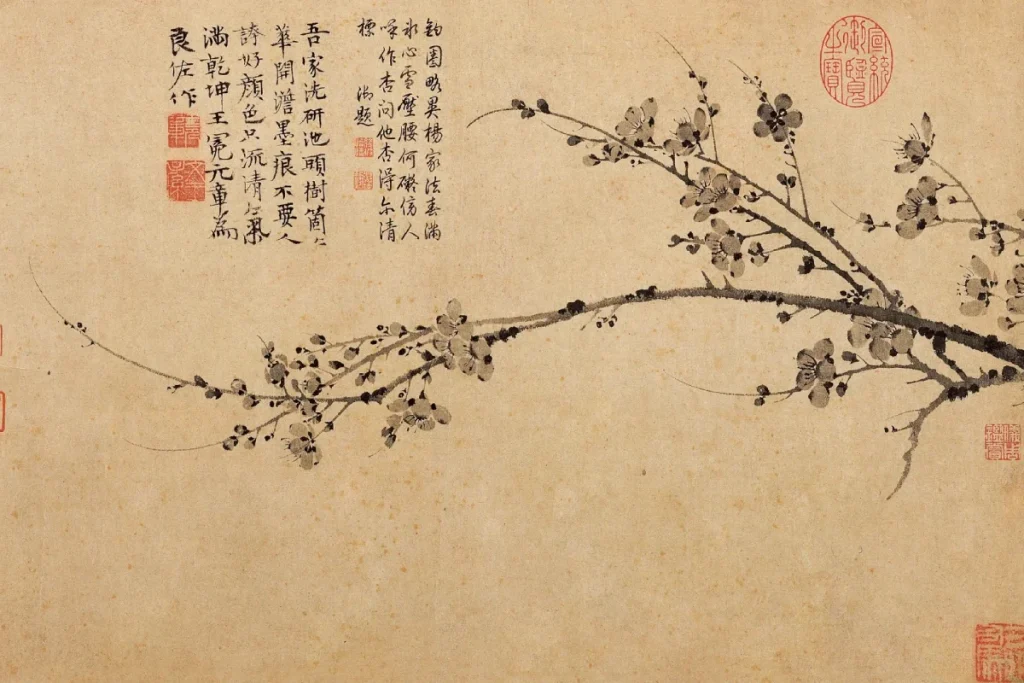
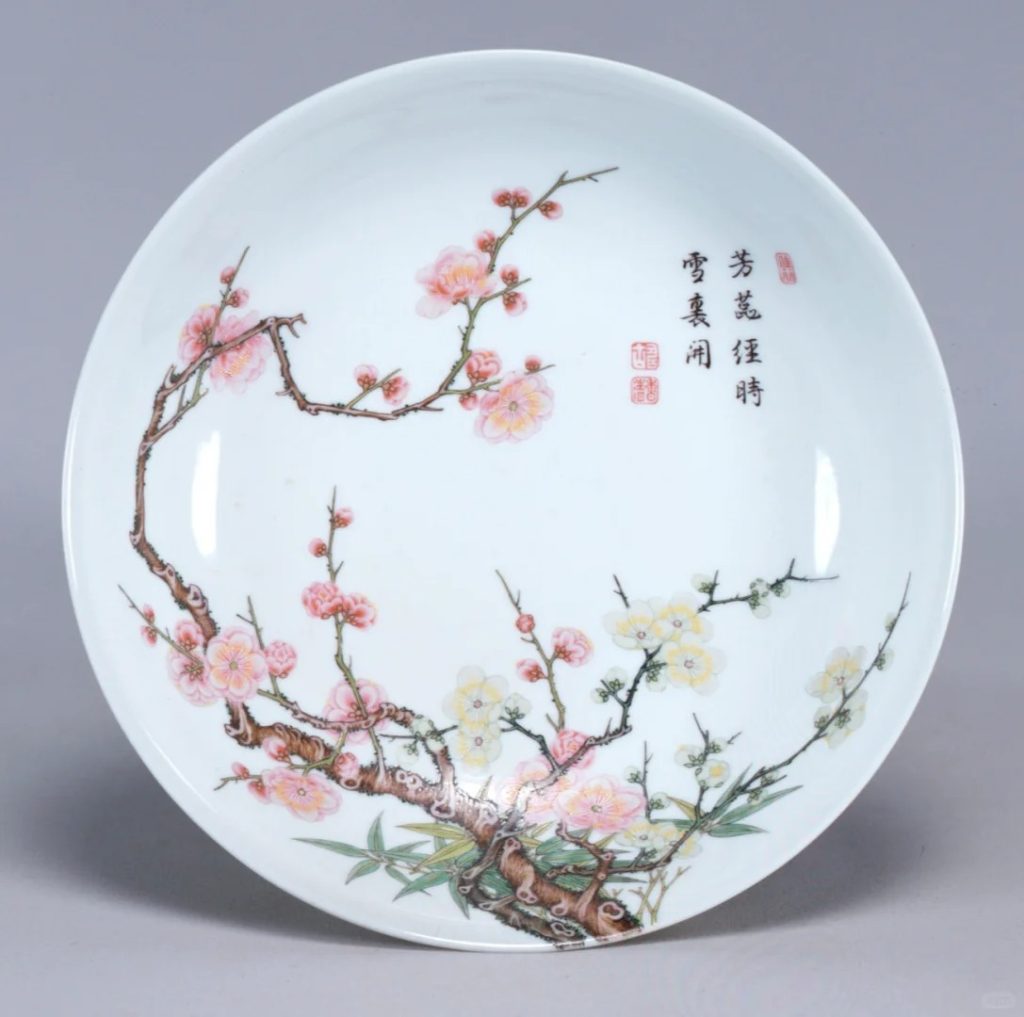
Plum blossom imagery also carries seasonal hope — it is simultaneously a symbol of winter’s harshness and spring’s promise. A branch of red plum blossoms against white snow is one of the most enduring images in Chinese visual culture, appearing on paintings, porcelain, furniture, and textile designs across the centuries.
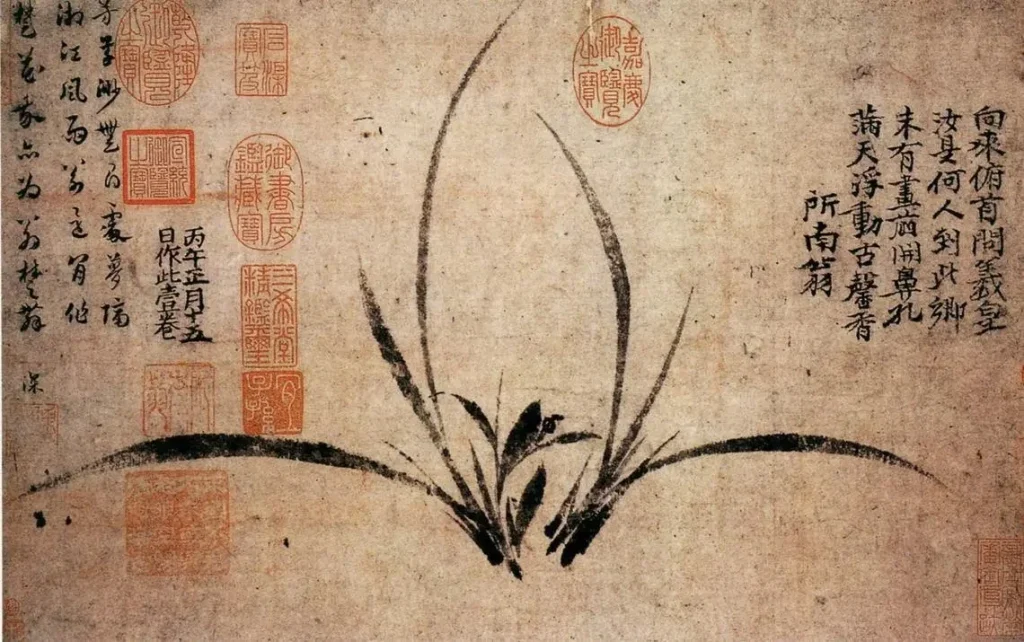
The orchid in the Four Gentlemen tradition refers primarily to wild grass orchids (Cymbidium) rather than the showy tropical varieties familiar in Western floristry. These modest plants grow in remote valleys and mountain slopes, blooming with quiet elegance far from human attention.
Confucius himself is said to have used the orchid as a metaphor for the virtuous person who maintains their integrity even when no one is watching. The orchid’s fragrance — subtle and unassuming — became a symbol of genuine virtue as opposed to performative display. Its graceful, linear leaves were particularly admired by Chinese artists for the way they could be rendered in single, confident brushstrokes, making the orchid a test of the painter’s technical mastery and spiritual composure.
In literati painting, the orchid became a vehicle for self-expression. Scholar-artists who had withdrawn from official life would paint orchids growing alone in rocky, inaccessible landscapes — a self-portrait in botanical form.
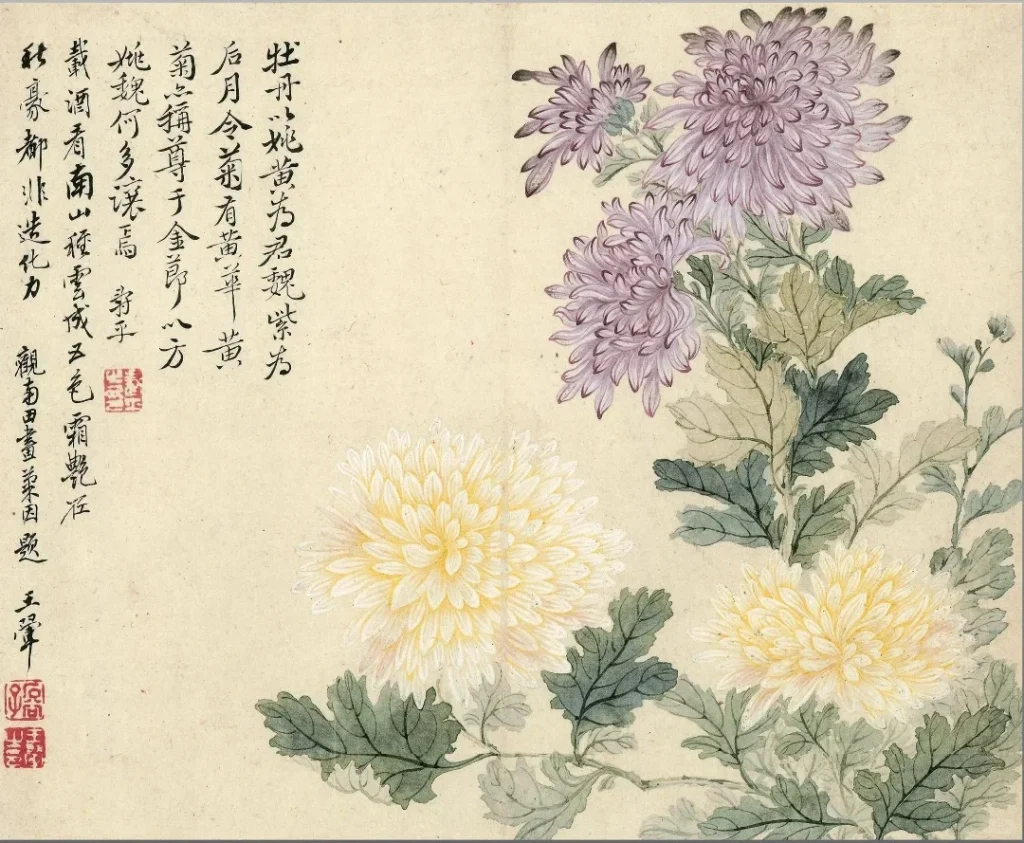
The chrysanthemum blooms in late autumn, when most other flowers have already faded. This quality — persisting and even thriving as temperatures drop and frost approaches — made it a symbol of endurance, longevity, and the ability to face adversity with composure.
The chrysanthemum is inseparable from the poet Tao Yuanming (365–427 CE), who famously retired from official corruption to grow chrysanthemums in peaceful seclusion. His poems celebrating the flower established it as the emblem of the scholar who refuses to compromise his integrity for political advancement. To paint chrysanthemums, or to give them as a gift, carried the implicit message: I value integrity over ambition.
In Taoist thought, chrysanthemums are also associated with immortality — an elixir made from chrysanthemum petals was believed to promote longevity, and the flower appears frequently in paintings depicting the landscapes of immortals and hermit-scholars.
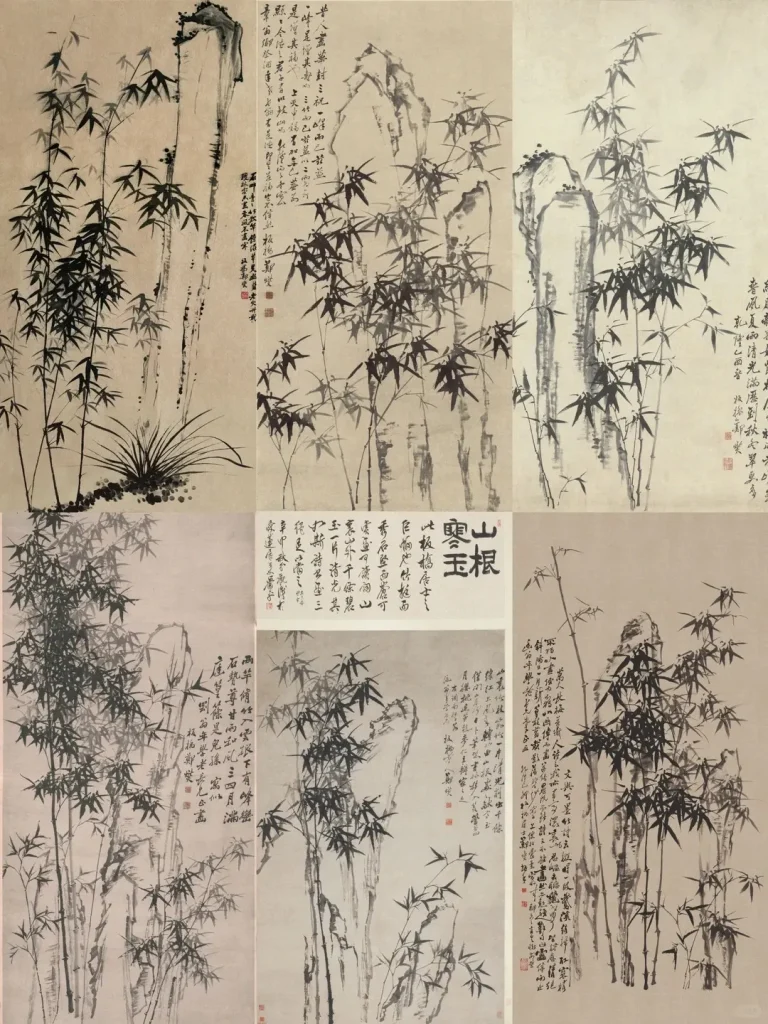
Though technically a grass rather than a flowering plant, bamboo holds its place in the Four Gentlemen by virtue of its extraordinary symbolic weight. The hollow stalk represents open-mindedness and the willingness to receive wisdom. The upright, unbending cane — flexible enough to bend in the wind without breaking — represents moral strength and integrity under pressure.
Bamboo was the favorite subject of the calligrapher-painter Zheng Xie (1693–1765), known as Zheng Banqiao, who spent decades studying the way bamboo moves in wind and rain. His paintings treat bamboo almost as a philosophical statement — each stalk a model of how a person of character should move through adversity.
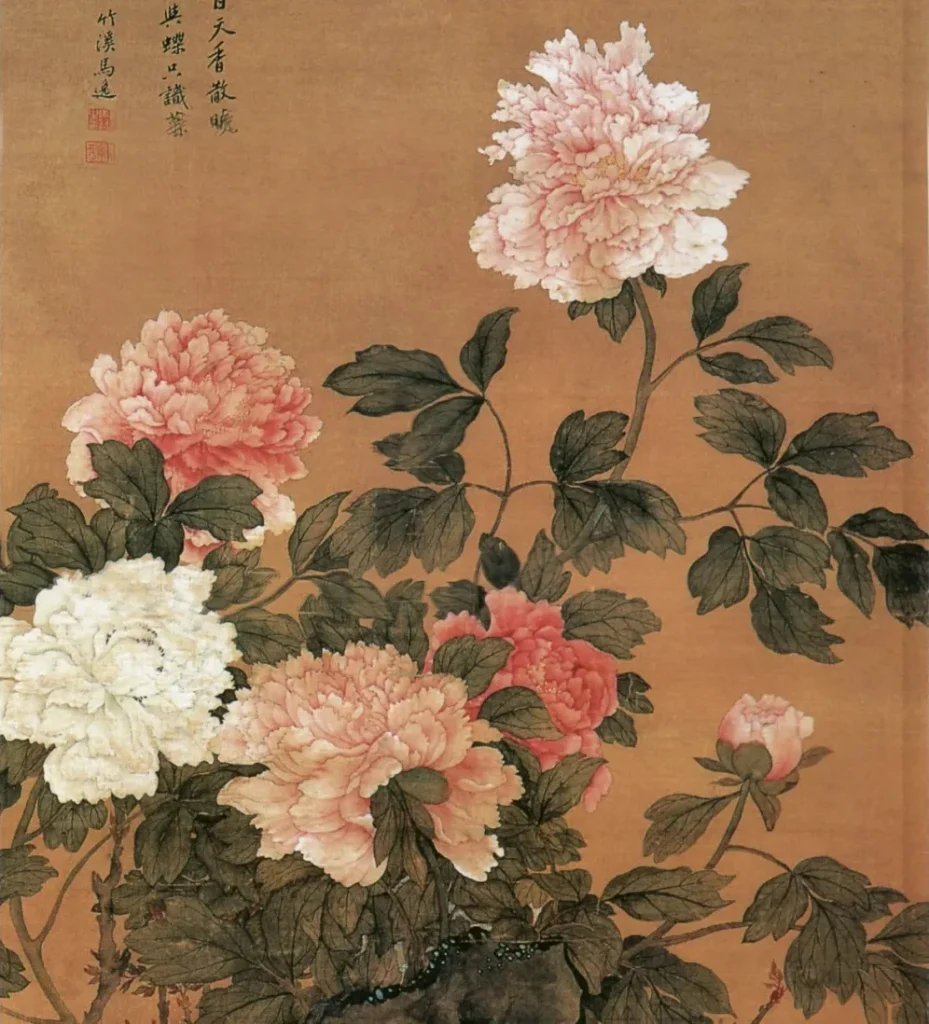
No flower is more associated with opulence and celebration in Chinese art than the peony. Called mǔdān (牡丹), its name is sometimes rendered as “the most beautiful,” and it has been considered China’s most magnificent flower since at least the Tang dynasty, when it was cultivated in imperial gardens and became the unofficial national flower.
Peonies in Chinese art symbolize feminine beauty, romantic love, wealth, honor, and prosperity. Their full, layered blossoms lend themselves to the decorative arts — peonies appear on Tang and Song ceramics, Ming dynasty blue-and-white porcelain, Qing silk embroideries, and carved lacquerware. Painted in the meticulous gongbi (工笔) style with mineral pigments, a peony can take days to complete — each petal layered with multiple washes of color to achieve that characteristic depth and luminosity.
The peony also carries cultural memory of the Tang dynasty’s golden age. When later artists painted peonies, they were invoking not just the flower but an entire era of Chinese confidence, cosmopolitanism, and aesthetic ambition.
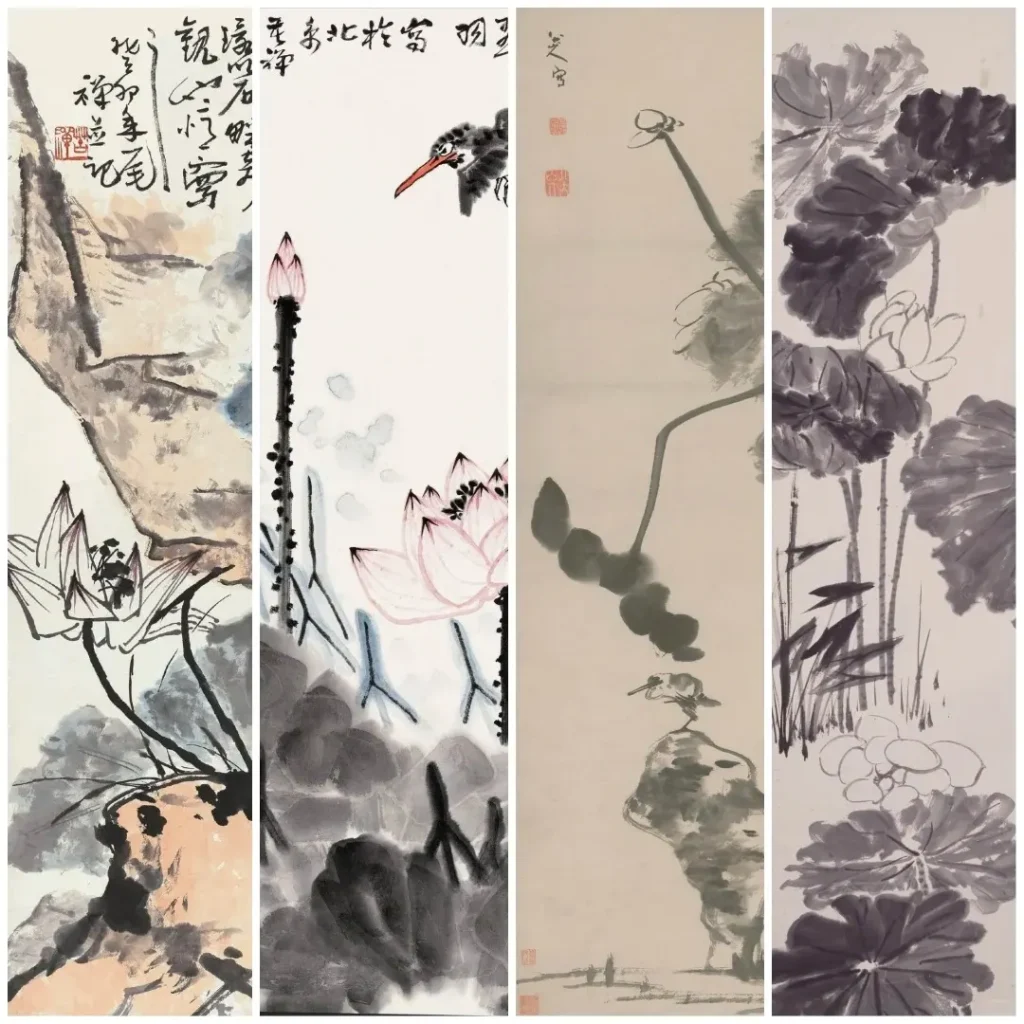
The lotus is one of the most symbolically rich flowers in all of Asian visual culture. Rooted in muddy, murky water, it rises to bloom in pure air above the surface — a natural metaphor for spiritual transcendence, purity, and enlightenment. The image resonated deeply with both Buddhist and Confucian traditions.
In Buddhist art, the lotus is the seat of the Buddha and the emblem of Guanyin, the goddess of mercy, who is frequently depicted holding a lotus blossom. The open lotus became one of the most ubiquitous decorative motifs in Chinese Buddhist architecture, metalwork, and textile design.
In Confucian literary tradition, the Song dynasty scholar Zhou Dunyi wrote the most celebrated meditation on the lotus — praising it for emerging from mud without becoming soiled, passing through clean water without becoming seductive. This reading transformed the lotus from a Buddhist symbol into a universal emblem of moral integrity, quoted and painted ever since.
In visual art, the lotus is often depicted with its full range of forms simultaneously: closed bud, open flower, and seed pod. This compression of a plant’s life cycle into a single composition reflects the Chinese aesthetic preference for suggesting the full arc of natural processes within a single image.
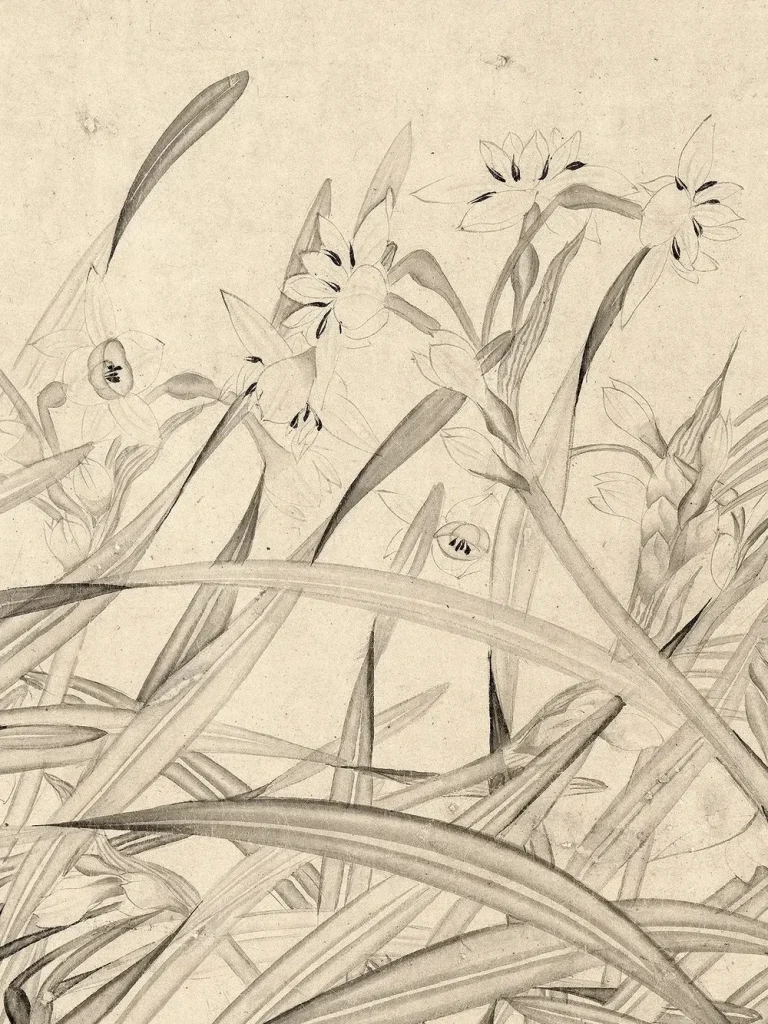
The narcissus — whose Chinese name shuǐxiān literally means “water immortal” — carries associations with purity, good fortune, and the New Year. It blooms in winter and early spring, making it a symbol of renewal and auspicious beginnings. Narcissus bulbs were (and still are) cultivated to bloom precisely at the Spring Festival, filling homes with their delicate fragrance.
In paintings, the narcissus is typically rendered with spare, elegant brushwork — clusters of white flowers and slender green leaves emerging from pale bulbs. The subject appealed particularly to artists working in the xieyi (写意) freehand tradition, for whom its simple forms offered both a technical challenge and a meditation on purity.
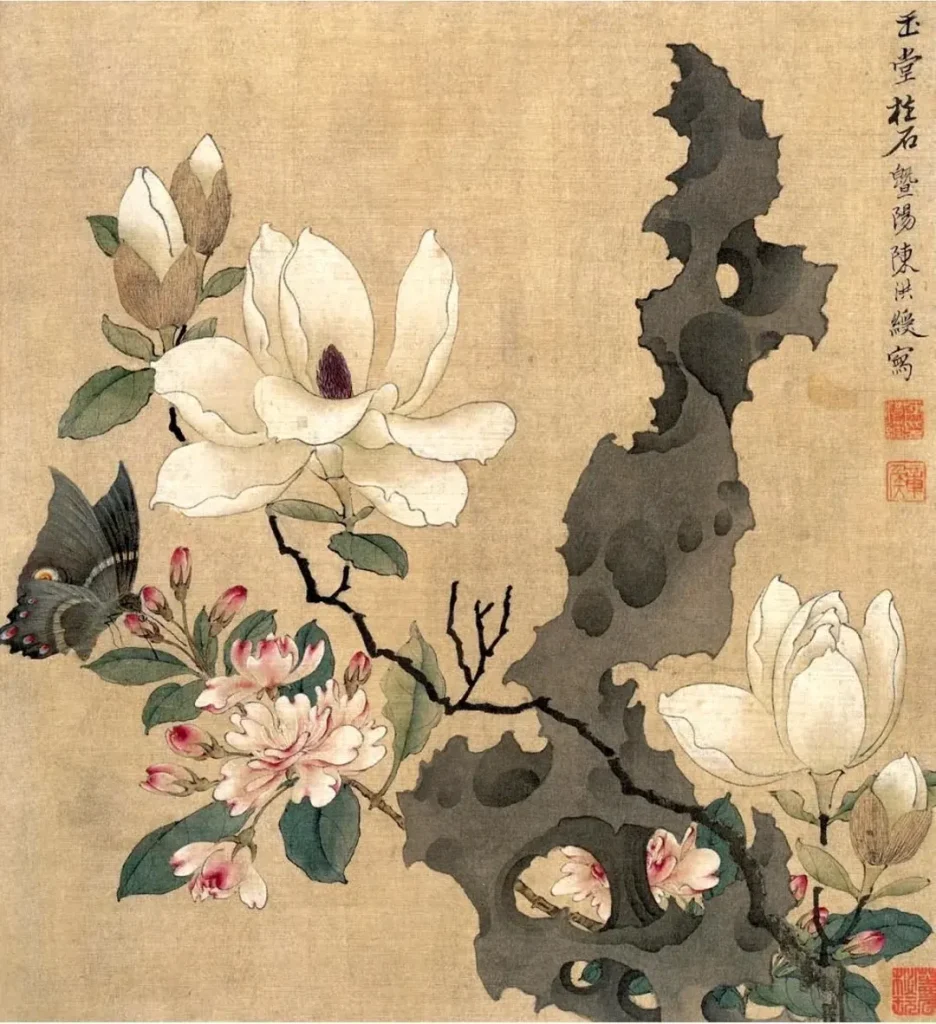
The white magnolia (yùlán, literally “jade orchid”) is one of the earliest-flowering trees in the Chinese garden calendar, its flowers appearing before any leaves — white and pristine against bare branches. It was historically so prized that, according to tradition, only the emperor and his closest favorites were permitted to cultivate it.
In flower-and-bird painting, magnolias frequently appear alongside birds in huāniǎo huà compositions, their large, luminous blossoms offering a visual counterpoint to the dynamic movement of birds in flight. The magnolia represents feminine beauty, nobility, and the transient glory of early spring.
Flowers in Chinese art are rendered through two fundamental approaches, which reflect very different philosophical attitudes toward representation:
Gongbi (工笔) — “Meticulous Brush” uses fine, controlled outlines filled with carefully layered mineral pigments. It demands extraordinary patience and technical precision — a single peony painted in gongbi style might require dozens of individual wash layers over several days. This style is associated with court painters and was the dominant mode of the Northern Song academy. The result is jewel-like images of almost photographic clarity, yet saturated with decorative intensity.
Xieyi (写意) — “Freehand Expression” prioritizes spirit over accuracy. A chrysanthemum may be suggested with just a few swift, confident brushstrokes. An orchid leaf rendered in a single fluid motion with a well-loaded brush carries more expressive force than any amount of meticulous rendering. This style is associated with the literati painting tradition and reflects the Confucian and Daoist belief that the goal of painting is not to capture appearances but to express inner truth.
The tension between these two modes — precision versus spontaneity, description versus expression — runs through the entire history of Chinese flower painting and remains a central concern of artists working in traditional styles today.
The symbolic vocabulary of flower painting permeated every medium of Chinese material culture. The same meanings that governed brush painting also informed the decoration of silk textiles, embroidered garments, porcelain vessels, carved jade, lacquerware, and architectural detail.
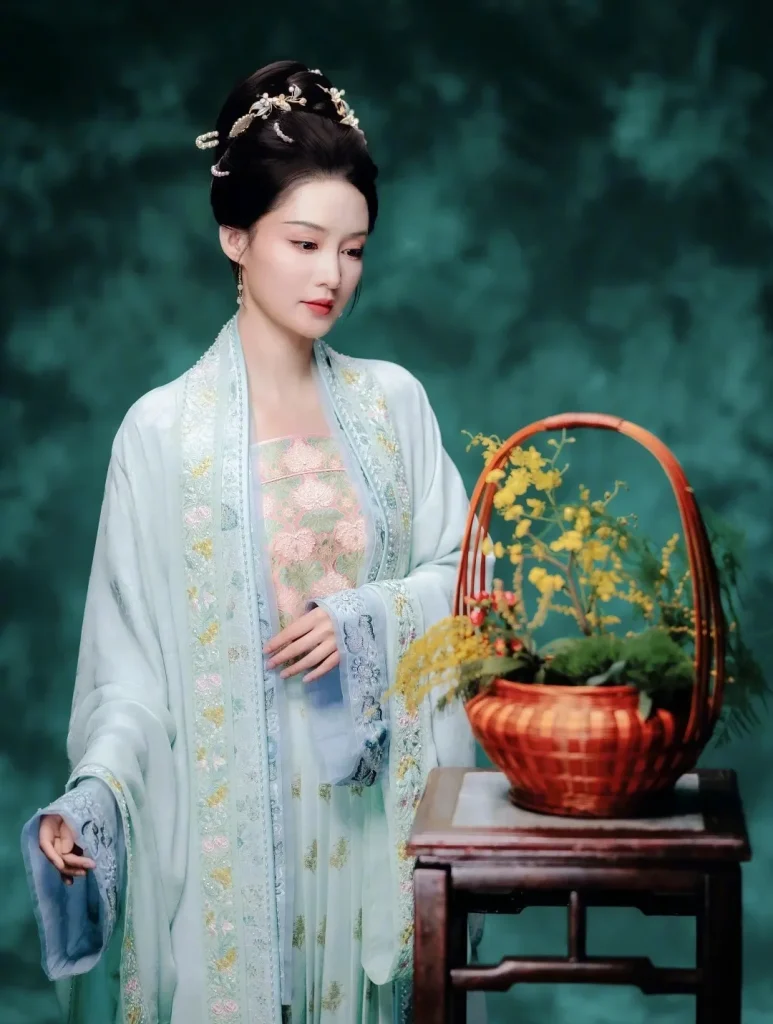
In traditional Chinese dress (Hanfu), floral motifs are among the most important design elements, carrying precise cultural meanings. A court robe embroidered with peonies declared imperial status and feminine grace. A scholar’s informal robe featuring orchids or bamboo signaled literary refinement and moral integrity. Chrysanthemum patterns on autumn garments placed the wearer in seasonal and philosophical alignment with the natural world.
The lotus was a particularly important motif in Buddhist ceremonial textiles, appearing on altar cloths, monks’ robes, and the regalia of devout lay patrons. On silk and brocade, the lotus was rendered with the same symbolic layering as in painting — bud, bloom, and seed pod often depicted together to suggest the complete cycle of spiritual development.
For anyone interested in Hanfu or traditional Chinese dress, recognizing the flowers that appear in textile designs is essential to understanding what those garments communicated — not just aesthetically, but socially, spiritually, and philosophically.
One of the most important functions of flowers in Chinese art is marking time. The Four Gentlemen map directly onto the four seasons: plum blossom for winter, orchid for spring, bamboo for summer, chrysanthemum for autumn. This seasonal vocabulary gave painters an efficient symbolic shorthand — a chrysanthemum instantly signals autumn without any landscape context.
The twelve months of the lunar calendar each have their own flower associations, from the plum blossom of the first month to the poppy of the eighth. This flower calendar appears across Chinese decorative arts — on porcelain sets where each piece depicts a different monthly flower, on folding screens arranged by season, on textile borders where a complete circuit of flowers marks the passage of a full year.
The second day of the second lunar month is a minor but enduring festival celebrating the goddess of flowers (Bǎi huā shén), marking the arrival of spring growth. Early spring blossoms — particularly plum, narcissus, and magnolia — were used to decorate homes for the Spring Festival, filling rooms with both fragrance and auspicious symbolism.
Flowers in Chinese art are never simply decorative. Every flower carries meaning accumulated over centuries of poetry, philosophy, painting theory, and cultural practice. A lotus motif on a silk garment speaks of purity and spiritual aspiration. A sprig of plum blossom on a ceramic vase declares resilience and the promise of new beginnings. Peonies on a wedding gift invoke wealth, beauty, and romantic love. Chrysanthemums on an autumn scroll recall Tao Yuanming’s retirement from corruption and his choice of integrity over ambition.
Learning to read the flowers depicted in Chinese art is, in many ways, learning to read Chinese culture itself — its values, its seasonal rhythms, its aesthetic ideals, and its long conversation between the natural world and the human moral imagination.
Whether you encounter these flowers in a museum gallery, on a piece of antique porcelain, or woven into the embroidered hem of a Hanfu garment, the symbolic language remains consistent: beauty and meaning, inseparable, speaking across the centuries.