

Few symbols in world culture carry as much power, depth, and beauty as the Chinese dragon. Unlike the fire-breathing monsters of Western folklore, the Chinese dragon — known as lóng (龙) — is a divine, benevolent creature that has shaped Chinese art, mythology, and identity for over 7,000 years. Whether you’ve spotted it on a temple wall, a festival parade, or a piece of silk embroidery, the Chinese dragon deserves a closer look.
In this guide, we’ll explore what the Chinese dragon truly means, why it looks the way it does, the different types you’ll encounter, and how this legendary creature continues to live on in Chinese culture and fashion today.
The Chinese dragon is a mythical creature deeply rooted in East Asian culture. It is typically depicted as a long, serpentine body with four clawed legs, a scaled body, antler-like horns, and a flowing mane. Unlike Western dragons that fly on bat-like wings, Chinese dragons are often shown soaring through clouds or swimming through rivers and seas — commanding water, weather, and the forces of nature.
The Chinese word for dragon, lóng (龙), appears in the earliest Chinese written records. Archaeological evidence of dragon imagery dates back to the Hongshan culture (4700–2900 BCE), suggesting this symbol has been central to Chinese civilization for millennia.
Most importantly, the Chinese dragon is a symbol of good fortune, power, and prosperity — not danger or destruction. It is considered the highest of all divine animals in the Chinese zodiac and mythological tradition.
The symbolism of the Chinese dragon is layered and complex. Here are the core meanings associated with this legendary creature:
1. Imperial Power and Authority
For thousands of years, the Chinese dragon was the exclusive symbol of the emperor. The emperor was called the “True Dragon, Son of Heaven” (真龙天子), and his throne was known as the Dragon Throne. Imperial robes were embroidered with five-clawed dragons — a motif forbidden to common people. The dragon throne, the dragon robe, the dragon seal — every aspect of imperial life was intertwined with this creature.
2. Good Luck and Prosperity
In Chinese culture, encountering a dragon — in art, dreams, or the zodiac — is considered an extremely auspicious sign. Dragons are believed to bring rain for crops, good harvests, and financial fortune. This is why you’ll see dragon imagery everywhere during Chinese New Year celebrations.
3. Strength and Wisdom
The Chinese dragon represents not brute force, but wise, measured power. It is associated with the yang principle in Taoist philosophy — active, creative, and heavenly energy. Chinese parents traditionally hope to give birth during the Year of the Dragon, believing their children will inherit the dragon’s strength, ambition, and intelligence.
4. Water and Nature
Dragons are closely linked to rivers, seas, and rainfall in Chinese mythology. The Dragon Kings (龙王, Lóng Wáng) were divine rulers of the four seas — north, south, east, and west — responsible for controlling rain and weather. Farmers prayed to dragon deities during droughts, and rivers were often believed to be inhabited by powerful dragon spirits.
5. Chinese National Identity
Even today, Chinese people sometimes refer to themselves as “Descendants of the Dragon” (龙的传人). The dragon is a profound symbol of Chinese cultural pride and national identity, representing the resilience, creativity, and continuity of Chinese civilization.
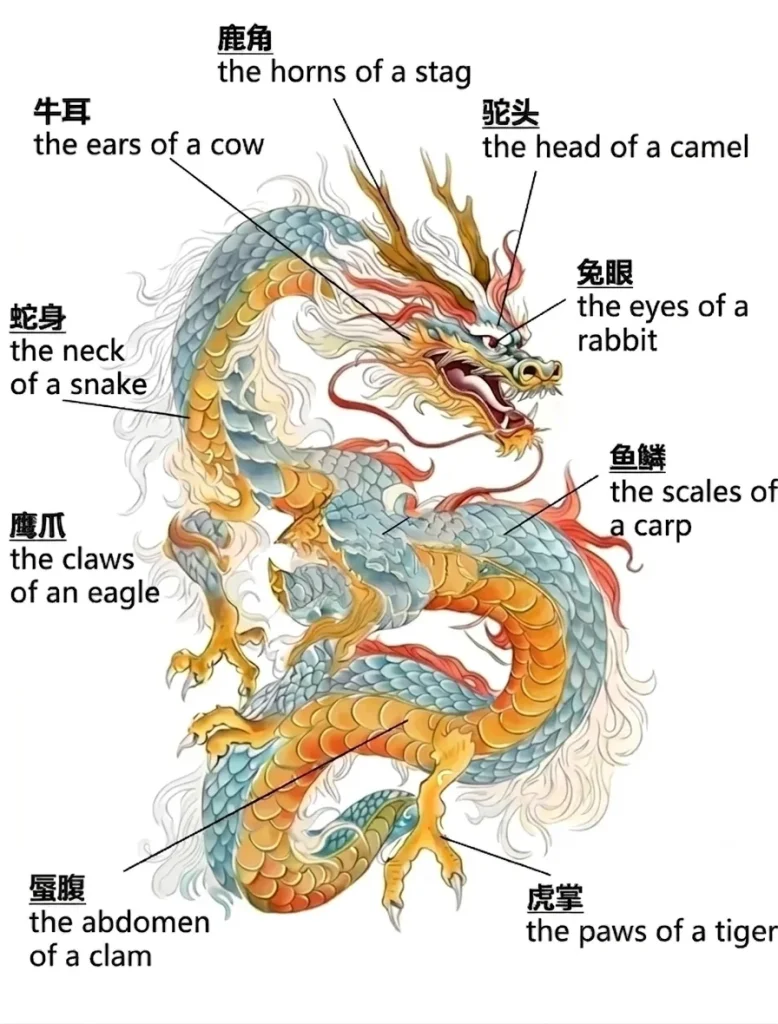
The appearance of the Chinese dragon is far from random. Each feature carries specific symbolism:
- Head of a camel — wisdom and age
- Horns of a deer — longevity
- Eyes of a rabbit — kindness
- Ears of a cow — strength
- Neck of a snake — flexibility
- Belly of a clam — abundance and fertility
- Scales of a fish (typically 117) — prosperity
- Claws of a hawk — swiftness
- Paws of a tiger — power
This composite design, borrowing features from nine different animals, reflects the dragon’s role as the ultimate synthesis of natural power and cosmic authority.
The number of claws on a Chinese dragon was also highly significant:
- Five claws — reserved for the emperor and the Son of Heaven
- Four claws — for nobility and senior officials
- Three claws — common in earlier dynasties such as the Tang and Song, and the standard form after dragon imagery spread to Japan
Chinese mythology recognizes many distinct types of dragons, each with specific roles and characteristics:
Tianlong (天龙) — Celestial Dragon
The heavenly dragon that guards the gods and supports the celestial palaces. This is the most exalted type, associated with the sky and divine protection.
Shenlong (神龙) — Spiritual Dragon
The master of weather and storms. Shenlong controls rain and wind, making it vital to agricultural societies. Failing to respect the Shenlong was said to bring drought and famine.
Fucanglong (伏藏龙) — Treasure Dragon
The dragon of hidden wealth. It guards buried treasure underground and is associated with volcanic eruptions when it finally emerges to report to heaven.
Dilong (地龙) — Earth Dragon
The controller of rivers and seas on earth. The Dilong is associated with earthly waters and is believed to rule the rivers from beneath.
Yinglong (应龙) — Winged Dragon
One of the few Chinese dragons depicted with wings. The Yinglong is an ancient, powerful dragon that assisted the Yellow Emperor in battle, making it a symbol of military prowess.
Jiaolong (蛟龙) — Sea Dragon
A water dragon that rules the deep seas. Often depicted rising from ocean waves, the Jiaolong is associated with the power and mystery of the deep ocean.
Panlong (蟠龙) — Coiled Dragon
A dragon that has not yet ascended to heaven. Often depicted in a coiled, resting position, the Panlong is a common motif in Chinese decorative art and architecture.
Many Westerners are surprised to learn just how different the Chinese dragon is from the dragons of European mythology. Here’s a quick comparison:
| Chinese Dragon (Lóng) | Western Dragon |
|---|---|
| ✅ Benevolent, divine, auspicious | ❌ Malevolent, fearsome, destructive |
| Rarely depicted with wings | Almost always winged |
| No fire — associated with water and clouds | Breathes fire |
| Long, serpentine body | Stocky, lizard-like body |
| National symbol, imperial emblem, protector | Monster to be slain by heroes |
| Water, rain, fertility, prosperity | Fire, destruction, greed |
This fundamental difference in perception means that when Chinese people say they are “Descendants of the Dragon,” it carries enormous pride — something that gets lost in translation for those unfamiliar with Chinese culture.
Dragon imagery appears throughout every art form in Chinese history:
- Architecture: Dragon carvings guard the staircases and rooftops of the Forbidden City in Beijing. The famous Nine-Dragon Wall (九龙壁) in the Forbidden City features nine coiled dragons in vibrant glazed tile.
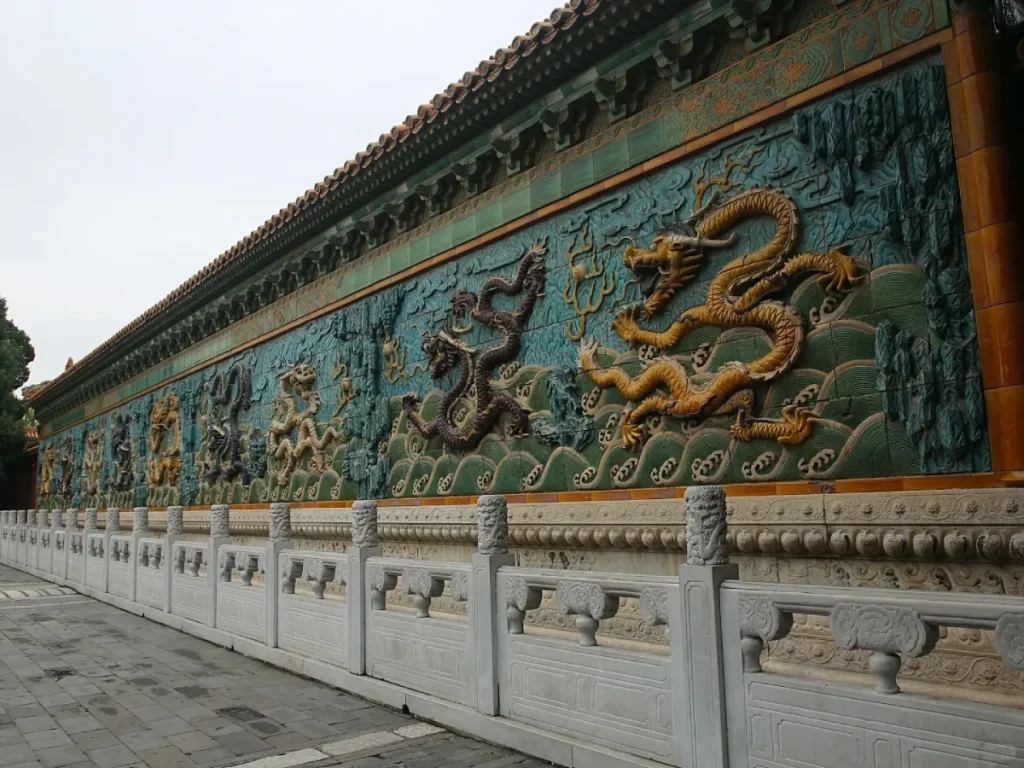
- Ceramics: Five-clawed imperial dragons appear on some of the most prized Chinese porcelain pieces, including Ming dynasty vases and Qing dynasty bowls.
- Painting: Dragons are a central subject of Chinese ink painting, often depicted emerging from clouds or water.
- Embroidery and Textiles: Some of the most intricate embroidery in Chinese history depicts dragons winding across silk robes and wall hangings.
The Chinese dragon is most visibly alive during festivals and celebrations:
Dragon Boat Festival (端午节, Duānwǔ Jié)
Held on the fifth day of the fifth lunar month, the Dragon Boat Festival features spectacular races in long, dragon-headed boats. The festival honors the poet Qu Yuan and channels the dragon’s power over water.
Chinese New Year Celebrations
During Spring Festival parades, teams of performers carry giant dragon puppets through the streets in what’s called the Dragon Dance (舞龙, Wǔ Lóng). The dragon weaves and undulates to the sound of drums and firecrackers, chasing away evil spirits and inviting good fortune for the new year.
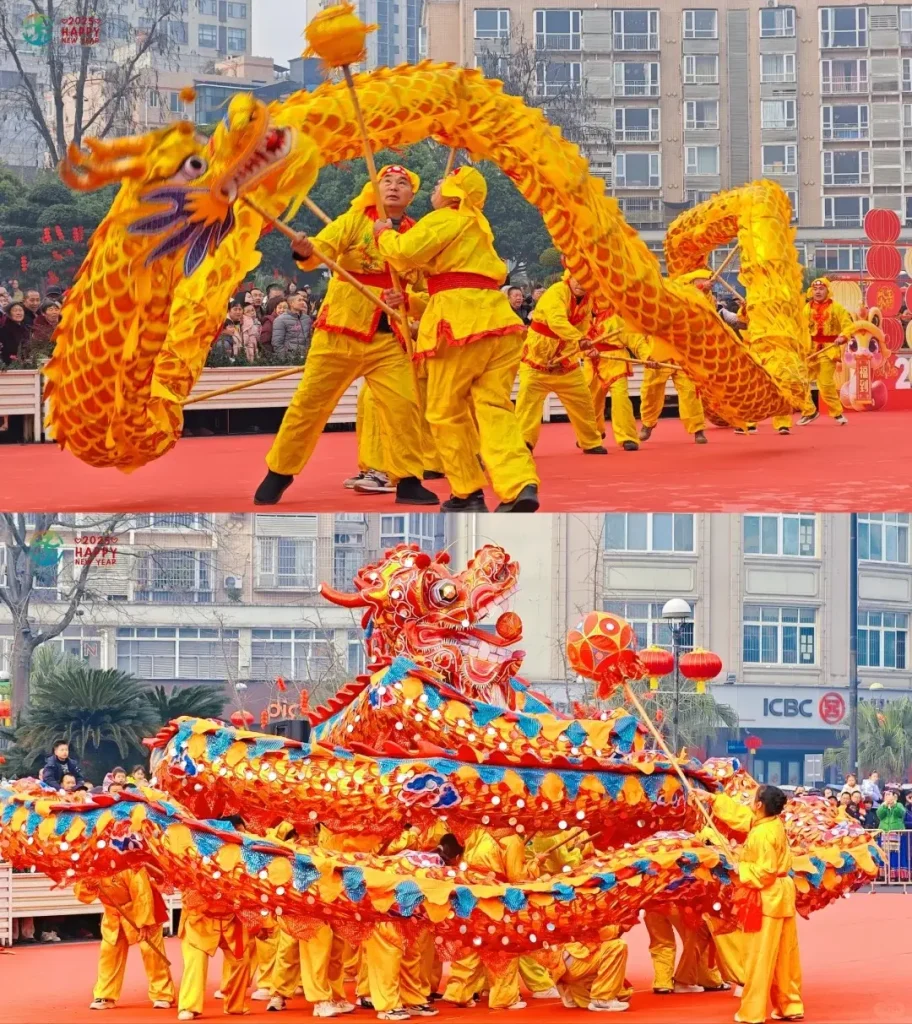
Lantern Festival
Dragon-shaped lanterns are a beloved feature of the Lantern Festival, glowing with hundreds of lights in spectacular nighttime processions.
The dragon is the fifth animal in the Chinese zodiac and the only mythical creature among the twelve. People born in the Year of the Dragon are considered especially blessed — traditionally seen as natural leaders who are confident, ambitious, enthusiastic, and charismatic.
Dragon years include: 1952, 1964, 1976, 1988, 2000, 2012, and 2024. The Year of the Dragon 2024 saw a notable spike in births in China and across the Chinese diaspora, as many families planned to have children during this auspicious year.
One of the most stunning expressions of dragon symbolism in Chinese culture is found in traditional clothing. The dragon robe — known as lóngpáo (龙袍) — was the ultimate garment of imperial power, worn exclusively by emperors and high-ranking members of the royal family.
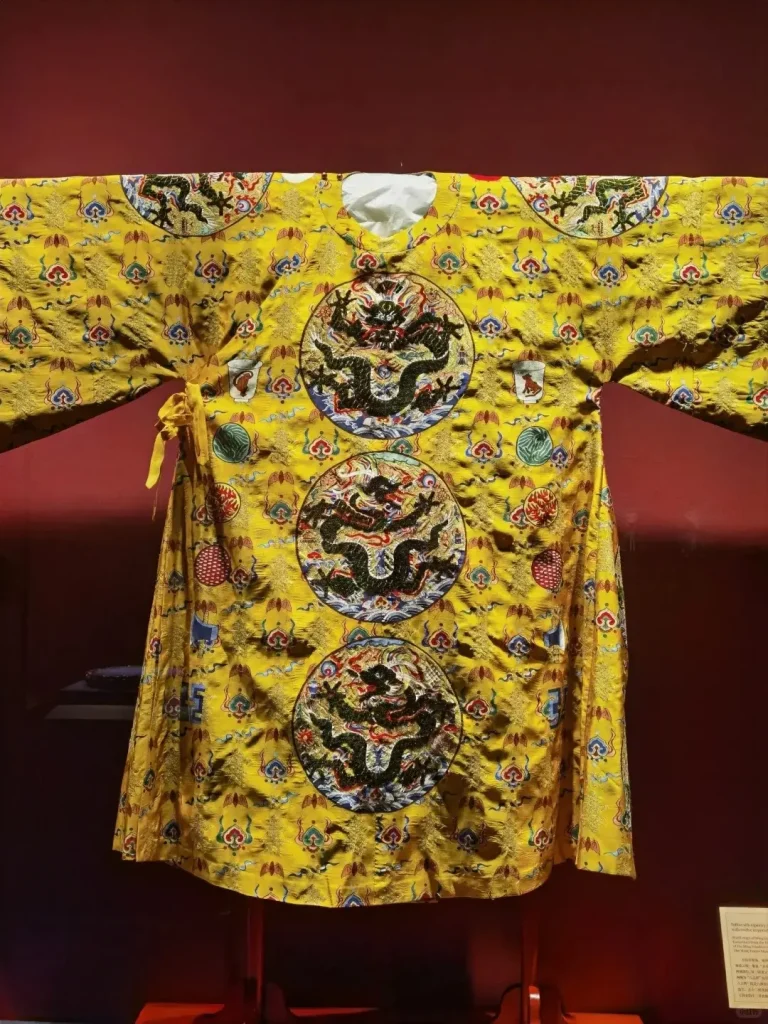
These robes were painstakingly embroidered with golden five-clawed dragons on rich yellow silk — a color itself reserved for the emperor. The craftsmanship involved could take months or years of skilled labor, with stitches so fine they resembled painting.
Today, dragon motifs continue to be celebrated in Hanfu (汉服) — the traditional clothing of the Han Chinese. While everyday Hanfu tends to feature nature patterns like plum blossoms, phoenixes, and clouds, more formal Ming Dynasty styles — such as the Yesa (曳撒) and the straight-collared Zhiju (直裾) — often incorporate elegant dragon embroidery that echoes this ancient imperial heritage.
Wearing Hanfu embroidered with dragon motifs isn’t just about fashion. It’s a way of connecting with thousands of years of Chinese history, artistry, and the enduring spirit of the dragon itself.
Is the Chinese dragon a real creature?
No — the Chinese dragon is a mythological creature. However, some scholars have theorized that ancient Chinese people may have assembled dragon imagery from the fossils of dinosaurs and large ancient reptiles, which were abundant in Chinese soil.
Why is the Chinese dragon associated with water?
In ancient agrarian China, rainfall was essential for survival. The dragon, as a divine controller of weather and water, represented the life-giving power of rain and rivers. Dragon imagery was used in rain rituals and prayers during droughts.
What is the difference between a Chinese dragon and a Japanese dragon?
Japanese dragons (ryū or tatsu) were heavily influenced by Chinese dragon mythology. The main visual difference is that Japanese dragons typically have three claws, while classical Chinese imperial dragons have five. Japanese dragon mythology also incorporates local Shinto traditions alongside Chinese Buddhist and Taoist influences.
What colors do Chinese dragons come in?
Different colors carry different meanings: golden dragons represent wealth and prosperity; red dragons symbolize good luck and celebration; black dragons are associated with water and the north in the Five Elements system; green/blue dragons represent the east and nature; white dragons are linked to purity, mourning, and the west; yellow dragons are among the most sacred, associated with the center, the earth, and imperial power.
Is the Chinese dragon male or female?
In Chinese mythology, the dragon is typically associated with yang (masculine, active, celestial) energy, while the phoenix represents yin (feminine) energy. The pairing of dragon and phoenix is one of the most iconic symbols in Chinese culture, representing the union of husband and wife, and the perfect balance of cosmic forces.
The Chinese dragon is far more than a mythical beast — it is a living symbol that has guided Chinese civilization for thousands of years. From the imperial courts of the Forbidden City to the vibrant dragon dances of modern Chinese New Year celebrations, the lóng continues to represent the best of what Chinese culture values: strength, wisdom, prosperity, and a deep connection to the natural and cosmic world.