
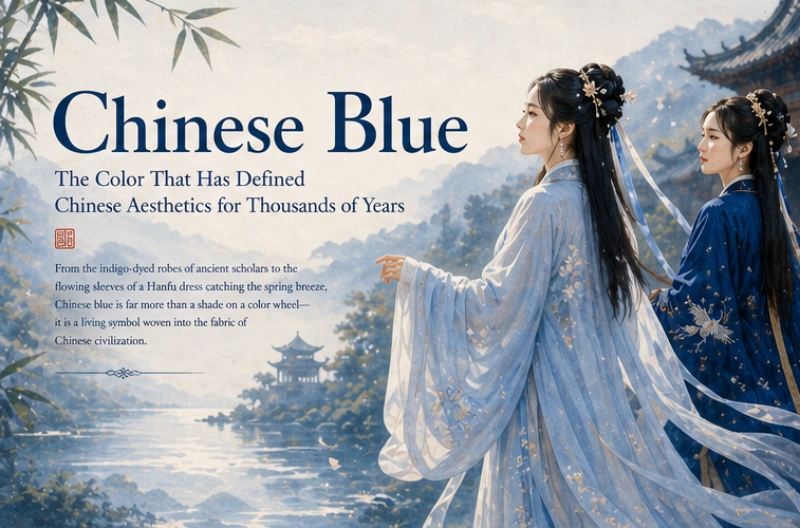
Few colors carry as much cultural weight as blue in the Chinese tradition. From the indigo-dyed robes of ancient scholars to the flowing sleeves of a Hanfu dress catching the spring breeze, Chinese blue is far more than a shade on a color wheel — it is a living symbol woven into the fabric of Chinese civilization.
Whether you are a Hanfu enthusiast looking for your next outfit or simply curious about the deep meaning behind this iconic color, understanding Chinese blue will transform how you see traditional Chinese clothing forever.
In the West, blue is a single, relatively straightforward concept. In classical China, the world of blue was far richer and more nuanced.
The most culturally significant blue in Chinese history is captured by the character 青 (qīng) — a word that has no perfect English equivalent. Sitting somewhere between blue and green, qīng evokes the color of a clear mountain river, young bamboo, or a twilight sky. It is the blue of nature in motion: alive, shifting, and impossible to pin down.
The more familiar modern word for blue, 蓝 (lán), entered wider usage later and refers to the deeper, richer blues more recognizable to contemporary eyes — the color of a cobalt bowl, a midnight robe, or an ocean horizon.
Together, qīng and lán form the soul of what we call Chinese blue: a spectrum running from delicate sky blue and celadon through treasure blue and deep navy, each shade carrying its own mood, story, and symbolic weight.

In Chinese cultural tradition, blue has long been associated with the sky and water — two of the most powerful forces in the natural world. This connection to the infinite gave blue its association with immortality and wisdom, qualities prized above almost all others in classical Chinese thought.
Blue is also linked to the Wood element in the Five Elements Theory (五行, Wǔ Xíng), the ancient framework that organizes the natural world into five interconnected forces: Wood, Fire, Earth, Metal, and Water. As a Wood-element color, blue represents growth, healing, new beginnings, and the energy of spring — the season when the earth renews itself after winter.
This is why blue carries almost entirely positive associations in Chinese culture. Unlike in some Western traditions where blue can signify sadness, in Chinese thought blue signals forward momentum, life force, and the calm confidence of deep water.
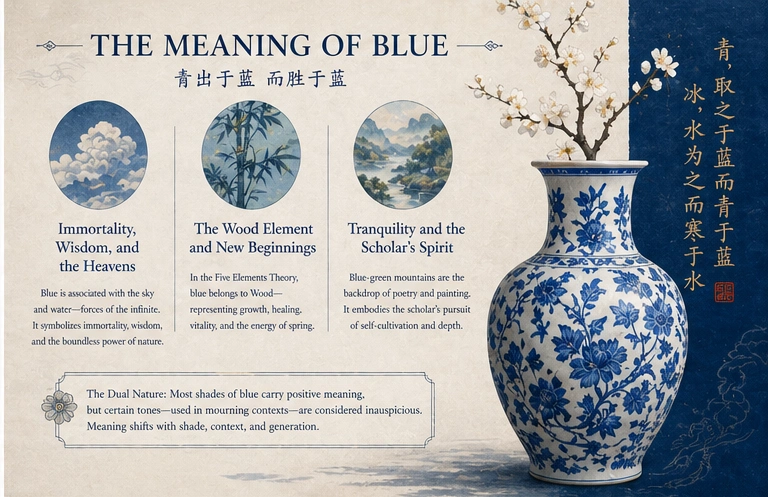
In classical Chinese painting and poetry, blue-green mountain landscapes (青山, qīng shān) appear again and again as the ideal setting for contemplation and self-cultivation. The scholar-gentleman who retreated to such landscapes to read, write poetry, and commune with nature was the cultural hero of the age — and the blue-green world he inhabited became a color of intellectual elegance, simplicity, and depth.
This scholarly association is one reason blue Hanfu carries such a distinctive aura today: wearing it connects the wearer to a long tradition of refined, introspective elegance.
No discussion of Chinese blue would be complete without acknowledging its complexity. While most shades of blue carry positive meaning, certain specific tones — sometimes called “funeral blue” in colloquial usage — are associated with mourning rituals and considered inauspicious in some contexts, particularly among older generations. This nuance is a reminder that color in Chinese culture is never one-dimensional: meaning shifts with shade, context, and generation.
For Hanfu and fashion purposes, the vast majority of blues — from sky blue and powder blue through cobalt and navy — are entirely celebratory and stylistically powerful.
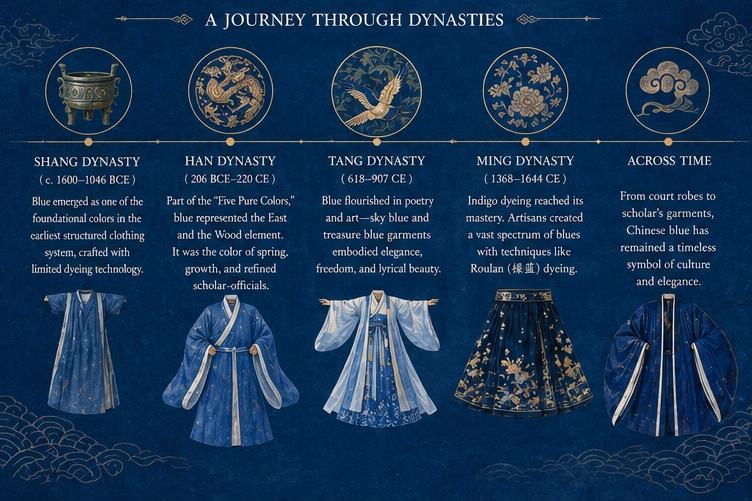
Blue’s story in Chinese clothing stretches back over three thousand years. During the Shang Dynasty, the earliest structured clothing system in Chinese history was established. Artisans of this era worked with a limited palette of primary colors — red, blue, yellow — along with green, constrained by the dyeing technology of the time. Even then, blue claimed its place as one of the foundational colors of Han Chinese dress.
By the Han Dynasty, color in clothing had become deeply political and philosophical. The “Five Pure Colors” (五色, wǔ sè) — blue, red, yellow, white, and black — were considered the noblest hues, each corresponding to a direction, an element, and a season. Colors derived from mixing two primaries were considered secondary and less prestigious.
Blue, associated with the East and the Wood element, was the color of spring, of new growth, of the scholar-official class at their most refined. Emperors and empresses changed their ceremonial robes with the seasons, and spring — blue’s season — was a time of renewal and optimism.
The Tang Dynasty is often considered the golden age of Chinese aesthetics, and blue flourished during this era. Tang poets celebrated the contrast between red and blue as one of nature’s most harmonious tensions — fire meeting water, passion meeting calm. The poet Bai Juyi, one of the dynasty’s greatest voices, wrote about color pairings that still resonate in Hanfu styling today.
Tang-era blue Hanfu, particularly flowing big-sleeved dresses (大袖衫, dà xiù shān) in sky blue or treasure blue, embroidered with cranes and cloud motifs, represent one of the high-water marks of Chinese blue in clothing.
The Ming Dynasty saw indigo dyeing reach new heights of sophistication. Craftspeople had developed a mastery of extracting and fixing blue from plants — particularly the polygonum plant (蓼蓝, liǎo lán) — that allowed for an extraordinary range of blues, from the palest whisper of sky to the deepest midnight navy.
The technique known as Roulan (揉蓝), in which artisans hand-kneaded fresh bluegrass to release its pigment for dyeing, produced colors of great subtlety and depth. Ming-era blue Hanfu, including the famous Ma Mian skirt (马面裙) in deep blue embroidered with cranes and blossoming flowers, exemplifies how Chinese blue at its peak was not simply a color but a complete aesthetic statement.
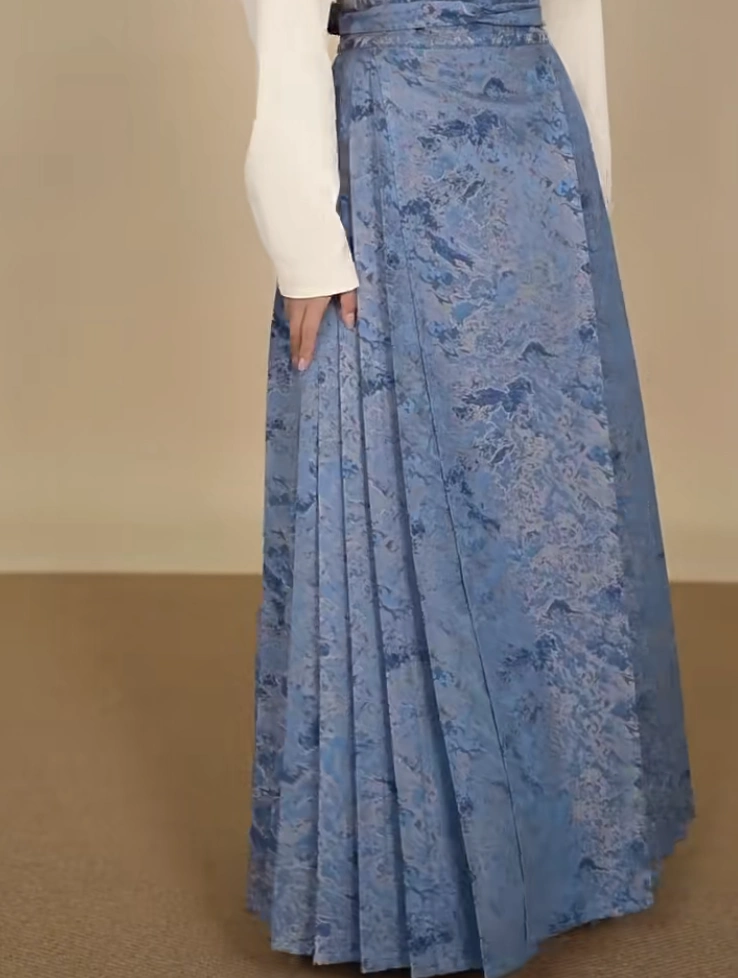
Understanding the cultural depth of Chinese blue makes styling it far more intuitive. Blue Hanfu does not demand to be loud — its power is in the layering of shade, texture, and pairing.
Different blues speak different languages in Hanfu aesthetics:
Light blue and sky blue evoke freshness, youth, and a fairy-tale delicacy. Paired with white or soft pink, light blue Hanfu creates a gentle, luminous effect — perfect for outdoor photography, spring festivals, and anyone who wants to channel the airy elegance of a Tang-era court lady.
Treasure blue and cobalt sit at the heart of Chinese blue tradition. Rich enough to command attention but not aggressive, these mid-tones have the versatility to work across Han, Tang, and Song dynasty styles. Paired with gold embroidery or white accents, cobalt blue Hanfu radiates a quiet nobility.
Ink blue and deep navy carry the weight of the scholar tradition. These darker shades suggest depth, restraint, and intellectual seriousness. In Wei-Jin dynasty inspired Hanfu — known for its flowing silhouettes and philosophical aesthetic — ink blue is the definitive choice for conveying effortless refinement.
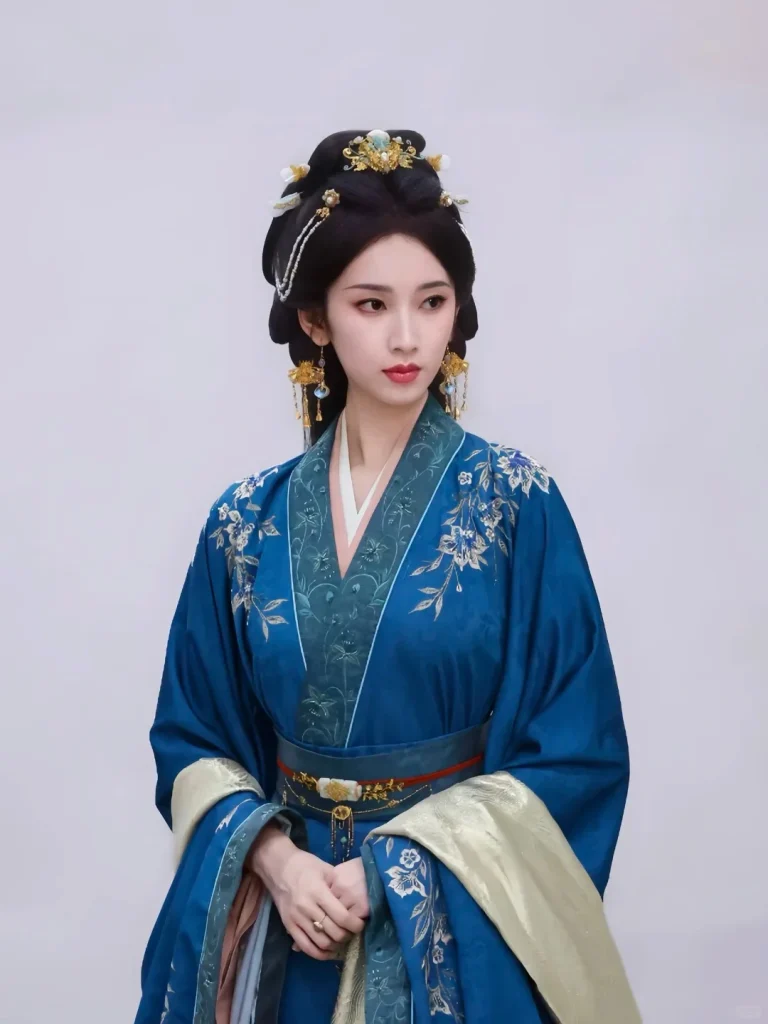
One of the joys of blue Hanfu is how generously it pairs with other colors:
- Blue + White: The most iconic combination in Chinese aesthetics, evoking blue-and-white porcelain. Clean, elegant, and universally flattering.
- Blue + Pink: A pairing that brings out a soft, lively quality — playful without being childish, romantic without being overly sweet.
- Blue + Same-family blues (tonal dressing): Layering different shades of blue — a light sky blue ruqun (襦裙) over a deeper blue lining, for example — creates depth and visual sophistication that rewards close attention.
- Blue + Gray/White: The literati combination. Simple, restrained, and utterly elegant. This pairing embodies the scholarly simplicity at the heart of Chinese blue’s cultural identity.
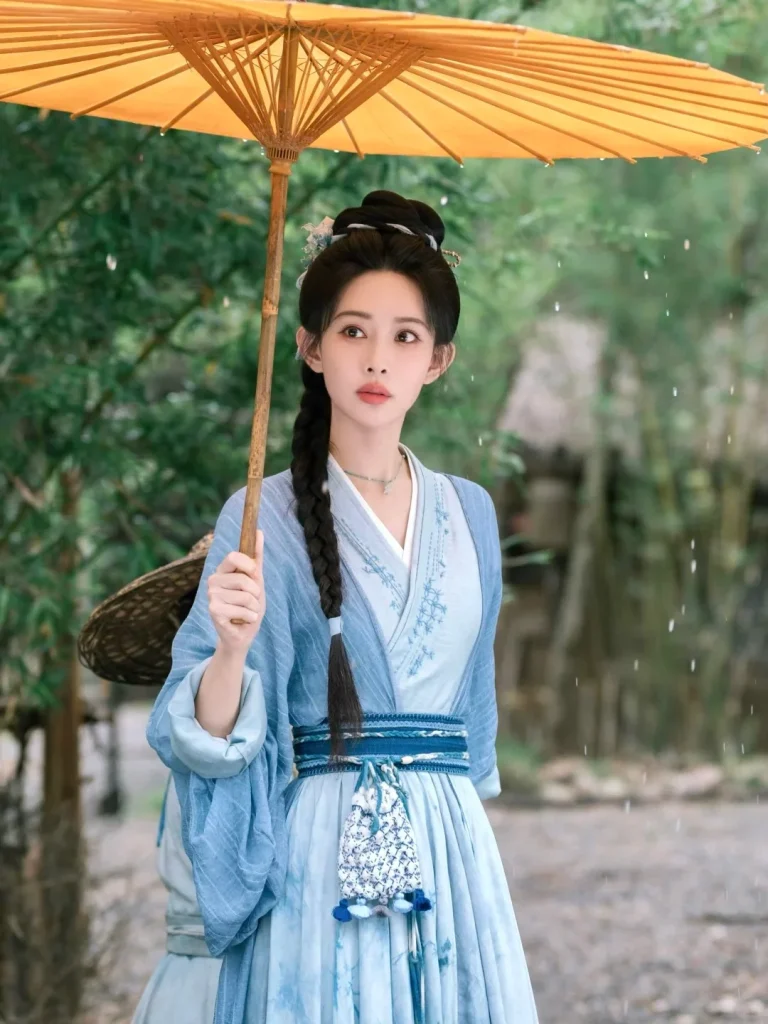
One reason blue Hanfu has always been beloved is its flattering quality across a wide range of skin tones. The Chinese aesthetic tradition observes that blue — particularly lighter and mid-range blues — creates a brightening effect that enhances the complexion. Deep navy and ink blue, meanwhile, provide a striking contrast that highlights facial features with confidence.
The beauty of Chinese blue in Hanfu is inseparable from the craft that produces it. Indigo dyeing in China is a tradition spanning thousands of years — one so influential that it traveled across Asia, contributing to the development of over twenty distinct dyeing techniques in Japan alone.
Traditional blue dyeing begins with plant-based pigments, most commonly from the polygonum plant or woad. The fabric is submerged in a dyeing bath, where the indigo penetrates every thread of the warp and weft, building color through repeated dipping and oxidation. Each submersion deepens the shade; the dyer’s skill lies in knowing exactly when to stop.
This process means that traditional Chinese blue is never flat or uniform. It has depth, variation, and a living quality that synthetic dyes struggle to replicate. When you see a beautifully dyed piece of blue Hanfu, you are looking at a color that carries the touch of the craftsperson who made it.
The Hanfu revival movement has brought Chinese blue back to the center of contemporary Chinese fashion. Among young Hanfu wearers in China and across the diaspora, blue remains one of the most popular and aspirational color choices — and the reasons run deep.
Blue Hanfu occupies a unique aesthetic space: it is neither the ceremonial gravity of imperial yellow nor the festive heat of traditional red. Instead, it offers something rarer — a color that is both culturally rooted and quietly modern, both historically specific and universally appealing.
In an age when traditional Chinese clothing is being rediscovered and reimagined, Chinese blue provides a thread of continuity: the same color that clothed Tang scholars and Ming court ladies now flows through the sleeves of a modern ruqun at a spring festival, a Ma Mian skirt photographed against ancient architecture, a simple everyday Hanfu worn with contemporary confidence.
That continuity — across dynasties, across centuries, across cultures — is what makes Chinese blue so enduring.
Chinese blue is not a single color. It is a conversation between sky and water, between the philosopher and the craftsperson, between ancient symbolism and living fashion. In Hanfu, it finds one of its most beautiful expressions: a color that carries thousands of years of meaning in its folds, worn anew with every generation.
Whether you choose the delicate pale of a spring morning, the confident richness of cobalt, or the quiet depth of midnight navy, you are participating in one of the oldest and most beautiful aesthetic traditions in the world.
And that is the enduring power of Chinese blue.