
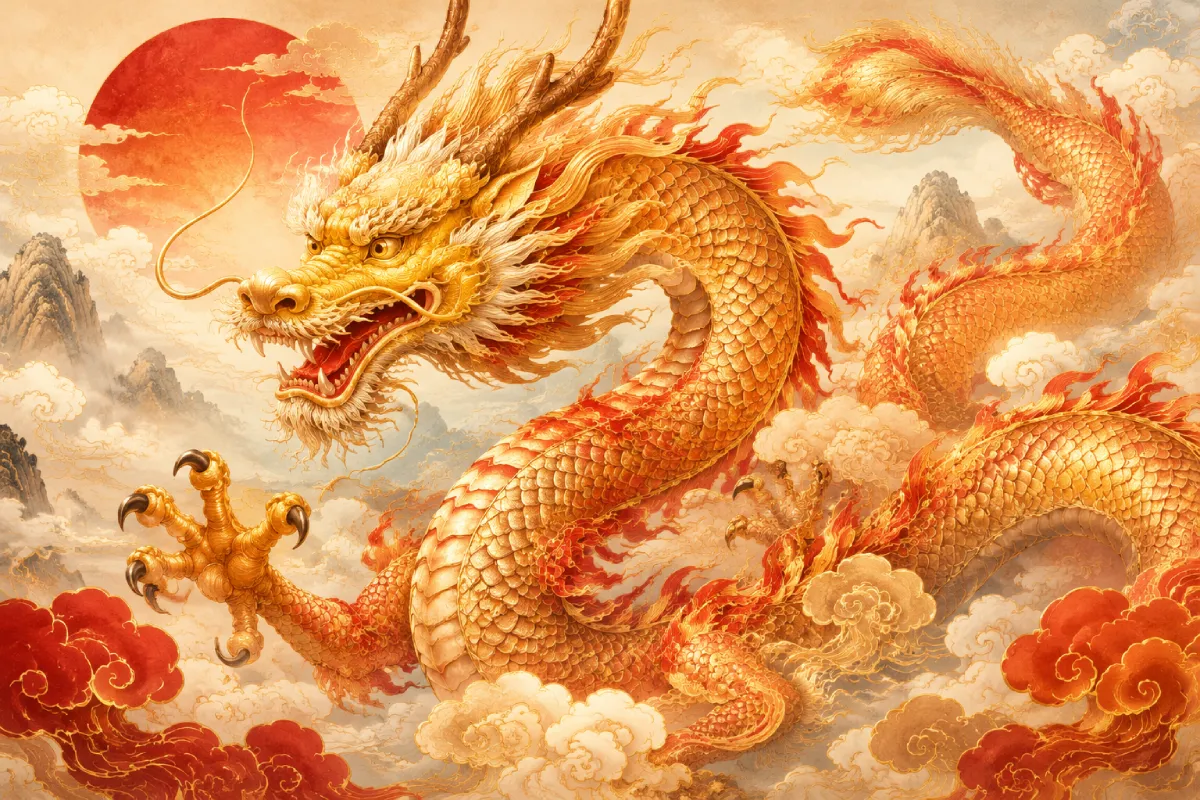
The Dragon holds the 5th position in the 12-animal Chinese zodiac cycle, following the Rat, Ox, Tiger, and Rabbit, and coming before the Snake, Horse, Goat, Monkey, Rooster, Dog, and Pig. It is the only mythical creature among the twelve zodiac animals, and despite being widely regarded as the most powerful and auspicious sign, it does not occupy the top spot in the ranking.
This often surprises people outside Chinese culture. If the Dragon symbolizes imperial power, strength, and good fortune, why isn’t it first? The answer lies in one of the most beloved origin stories in Chinese folklore — though it’s worth noting several regional variations of this legend exist, and the version below is the most widely told.
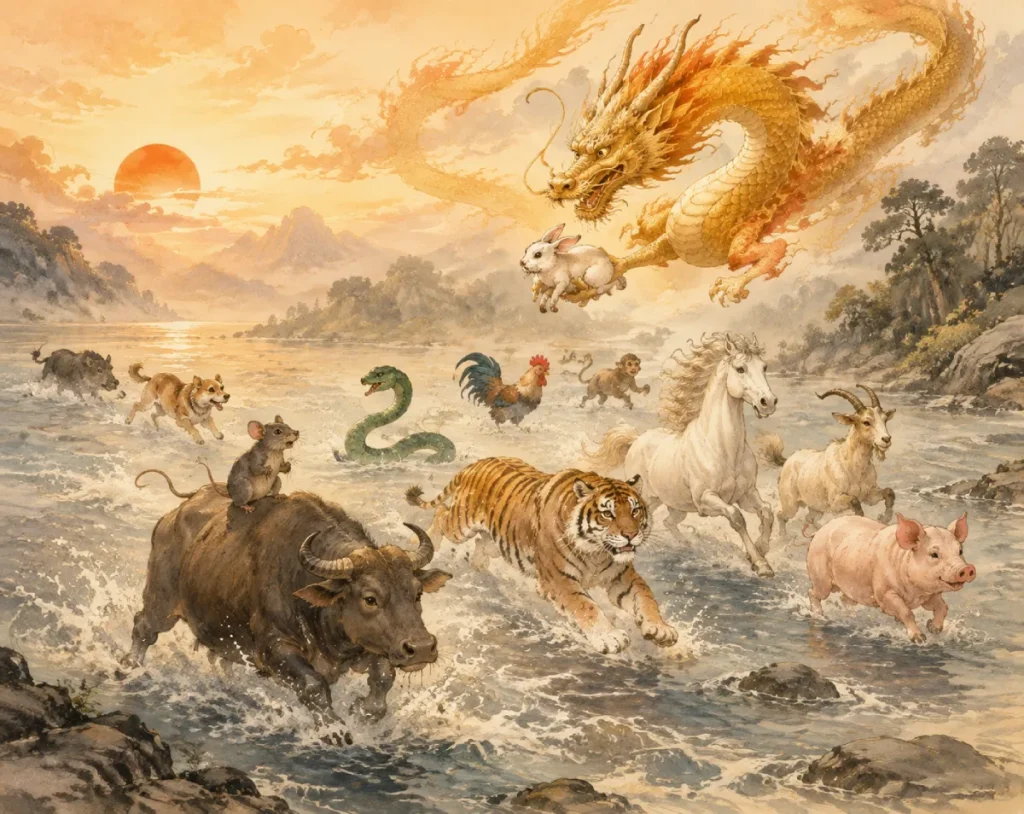
According to traditional folklore, the Jade Emperor held a race to determine the order of the zodiac animals. Whoever crossed the river first would claim the top rank, and so on down the line. The Dragon, despite having the ability to fly and command wind and rain, arrived only 5th.
Why the Dragon didn’t finish first: The story explains that the Dragon stopped mid-race to bring rain to a village suffering from drought, and later paused again to help blow the Rabbit safely across the water. These acts of generosity cost the Dragon precious time, allowing the cunning Rat to reach the finish line first by riding on the Ox’s back, followed by the Ox, the Tiger, and the Rabbit.
What this reveals about the Dragon’s character: Rather than diminishing the Dragon’s status, this legend reinforces why the Dragon is so deeply respected. Its rank was earned not through speed or self-interest, but through benevolence — a quality highly valued in Chinese cultural values.
| Rank | Animal |
|---|---|
| 1 | Rat |
| 2 | Ox |
| 3 | Tiger |
| 4 | Rabbit |
| 5 | Dragon |
| 6 | Snake |
| 7 | Horse |
| 8 | Goat |
| 9 | Monkey |
| 10 | Rooster |
| 11 | Dog |
| 12 | Pig |
Numerical rank and cultural prestige are two different things in the Chinese zodiac system. While the Rat ranks 1st, the Dragon is widely seen as the most desirable sign to be born under. Dragon years consistently see spikes in birth rates across China and other East Asian countries, with so-called “Dragon Babies” born in these years often perceived by parents as more likely to enjoy good fortune and success — a social and psychological phenomenon rooted in cultural belief rather than any official doctrine.
Imperial symbolism: For centuries, the Dragon was the exclusive emblem of the Chinese emperor, representing supreme authority, strength, and the mandate of heaven. No other zodiac animal carries this level of historical political weight.
The only mythical animal: All eleven other zodiac signs are real-world animals. The Dragon alone is a legendary creature, associated with control over rivers, rain, and the natural forces that sustained agricultural life in ancient China.
Association with success: People born in the Year of the Dragon are traditionally believed to be ambitious, charismatic, and destined for achievement, which contributes to the sign’s enduring popularity despite its 5th-place rank in the race legend.
| Year | Element |
|---|---|
| 1976 | Fire Dragon |
| 1988 | Earth Dragon |
| 2000 | Metal Dragon |
| 2012 | Water Dragon |
| 2024 | Wood Dragon |
| 2036 | Fire Dragon |
Each Dragon year is paired with one of the five Chinese elements — Wood, Fire, Earth, Metal, or Water — creating a 60-year cycle before the same combination repeats. This happens because the 12 zodiac animals and 5 elements combine on a rotating basis (12 × 5 = 60), so it takes a full 60 years for any given animal-element pairing, such as the Wood Dragon, to come around again. This is why 2024’s Wood Dragon and 1964’s earlier Wood Dragon share the same elemental pairing, sixty years apart.
Strong compatibility: In traditional Chinese astrology, the Dragon, Rat, and Monkey are said to form a “San He” (三合, Three Harmonies) trine, one of the most favorable alliances in the zodiac system, built on mutual ambition and shared energy. The Rooster is also frequently listed as a strong secondary match.
Challenging pairings: The Dog is traditionally identified as the Dragon’s “Liu Chong” (六冲, Six Clashes) opposite, sitting directly across the zodiac wheel. Folk belief holds that these two signs clash in temperament and values, though modern practitioners note this reflects traditional astrology rather than a fixed rule for real relationships.
Neighboring signs: Sitting between the gentle Rabbit and the wise Snake, the Dragon’s position in the cycle is sometimes interpreted as a bridge between quiet diplomacy and deep intuition — though the Dragon itself is known for boldness rather than either trait.
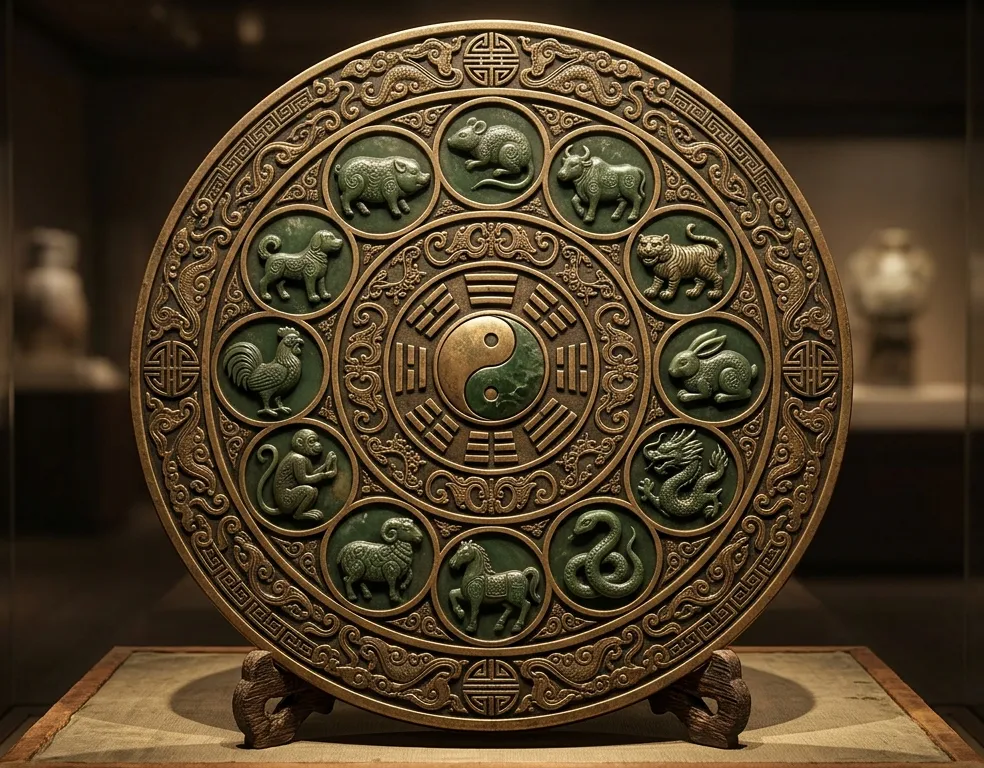
The Dragon’s 5th-place rank in the Chinese zodiac race is a matter of folklore sequencing, not a measure of cultural importance. In practice, the Dragon remains the most revered and sought-after sign in the entire cycle, carrying connotations of imperial power, good fortune, and extraordinary destiny that far outweigh its numerical position. Understanding both the story and the symbolism gives a fuller picture of why this single animal continues to hold such a central place in Chinese culture.
Want to know if you’re a Water Dragon, Wood Dragon, or another element entirely? Use our Chinese Zodiac Calculator to find your exact sign and element in seconds.