
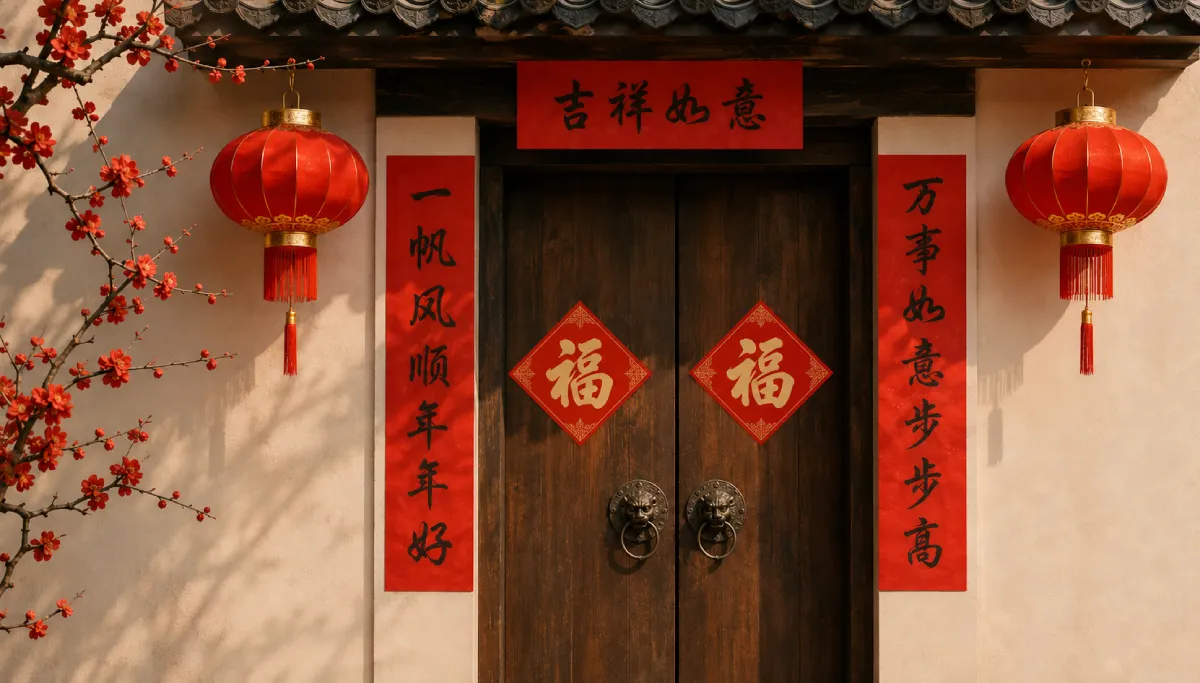
Chinese Spring Festival couplets, known as chunlian (春联), are pairs of poetic phrases written in black or gold ink on red paper and pasted on either side of a doorway during Chinese New Year. Together with a horizontal scroll placed above the door, a complete set forms a short, rhymed message that expresses hopes for good fortune, health, prosperity, and family harmony in the year ahead.
So what is a spring festival couplet, exactly? It is not a single line of text but a matched pair: one line pasted on the right side of the door and one on the left, chosen so that the number of characters, grammatical structure, and tone pattern of each line mirror the other. This balance is the defining feature that separates a true couplet from an ordinary New Year greeting.
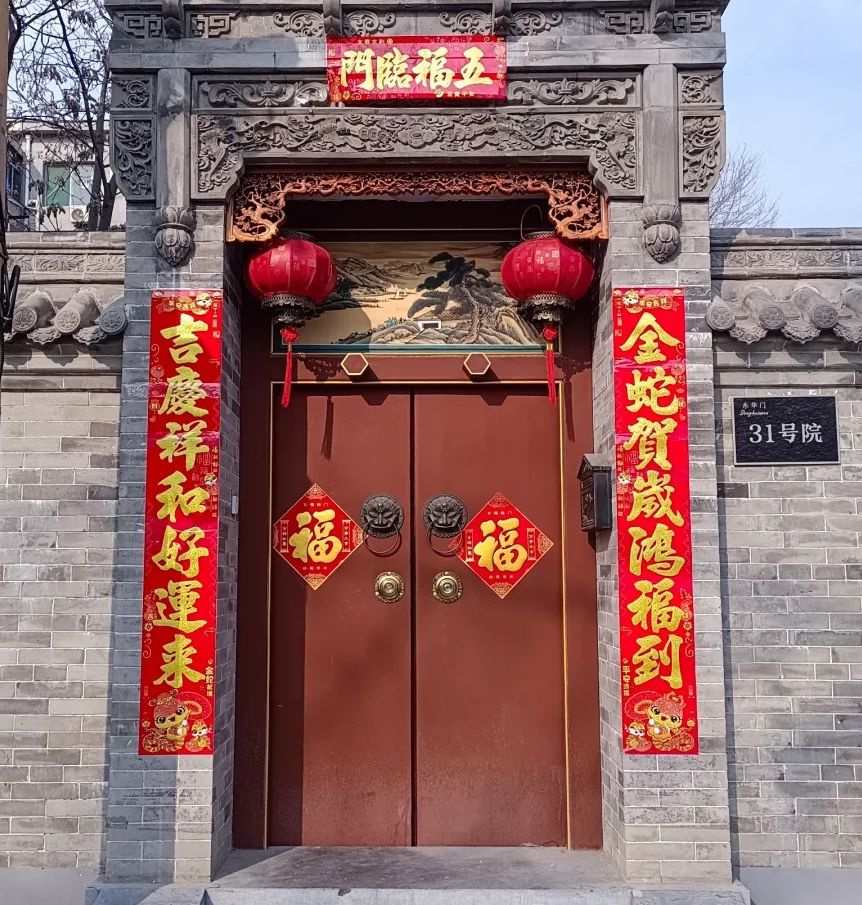
The practice of hanging protective charms on doors is much older than the couplet itself. As early as the Han Dynasty, households hung peachwood boards (桃符) carved with the names of door gods to ward off evil spirits. The first written couplet on record, however, dates to the Five Dynasties period, when Meng Chang, ruler of the Later Shu kingdom, is said to have brushed a pair of lines onto peachwood himself — generally credited as the earliest known chunlian. By the Ming Dynasty, red paper had replaced peachwood as the standard material, giving couplets the bright red appearance still used today.
Red became the standard color partly because of the legend of Nian, a beast said to terrorize villages at the turn of the year, which folklore describes as fearing the color red along with firelight and loud noise — the same belief behind firecrackers and lanterns during the festival. Pasting chinese spring festival couplets on the door each New Year’s Eve therefore carries a double meaning: celebrating the arrival of spring and protecting the household for the year to come.
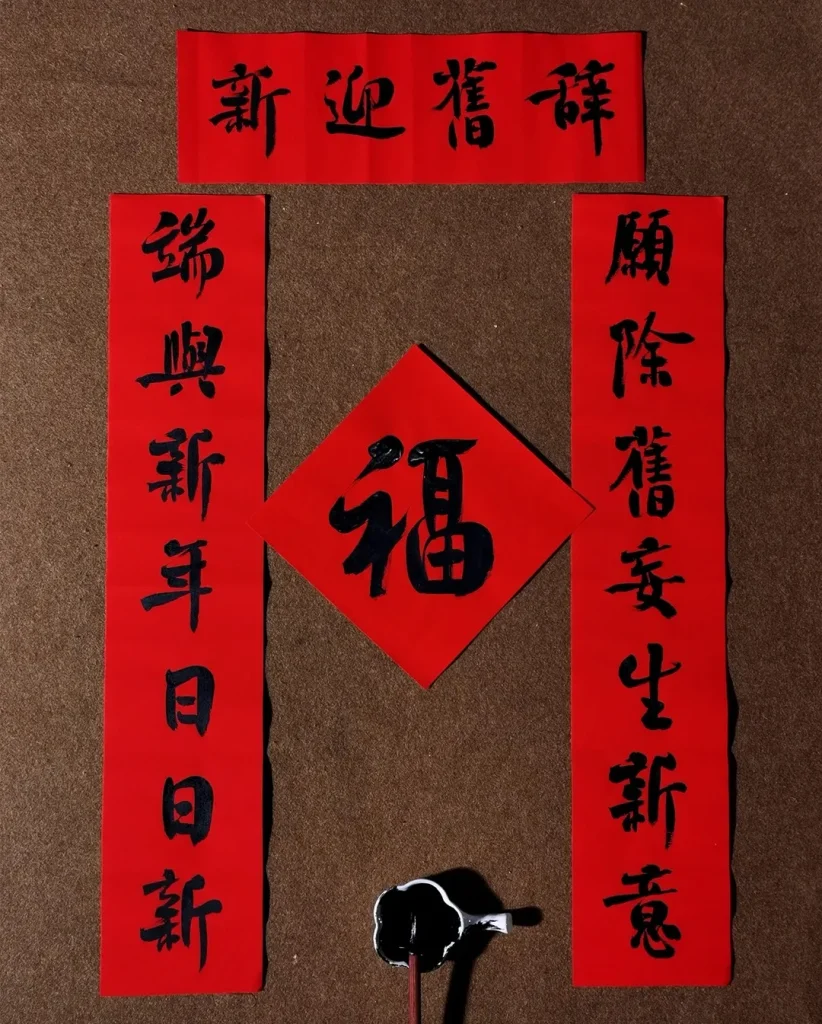
A complete set of spring festival couplets is made up of three parts, each with its own placement and purpose:
1. The Upper Line (上联) — Traditionally pasted on the right side of the door as one faces it. It usually sets up the first half of the idea and traditionally ends on a falling (仄) tone.
2. The Lower Line (下联) — Traditionally pasted on the left side of the door. It completes or responds to the upper line and traditionally ends on a level (平) tone, creating a sense of resolution.
3. The Horizontal Scroll (横批) — A short four-character phrase pasted above the doorway that summarizes the theme of the two vertical lines, such as “Wan Shi Ru Yi” (万事如意), meaning “may everything go as you wish.”
Whether buying pre-printed couplets or writing them by hand, a few conventions guide the selection of a good spring festival couplet:
- Equal length. The upper and lower lines must contain exactly the same number of characters, typically between five and nine.
- Matching grammar. If the upper line uses a noun in a certain position, the lower line should use a noun in the same position; the same applies to verbs and adjectives.
- Tonal contrast. Classical couplets follow the level-and-oblique tone rule, so the final characters of the two lines sound different when read aloud, giving the pair a natural rhythm.
- Positive, forward-looking themes. Good couplets reference spring, renewal, wealth, longevity, or family reunion rather than anything associated with loss or decline.
Pasting spring festival couplets in the wrong order is a common mistake, and the correct layout actually depends on one detail people often overlook: the direction the horizontal scroll is written in.
- Step 1: Identify the upper line. The upper line is the one ending in an oblique (仄) tone — usually the third or fourth tone in modern Mandarin.
- Step 2: Check the horizontal scroll’s direction. Classic scrolls read right to left, but many printed couplets sold today use a horizontal scroll written left to right in the modern style.
- Step 3: Match the vertical lines to that direction. If the scroll reads right to left, the upper line goes on your right as you face the door and the lower line on your left. If the scroll reads left to right, the placement is reversed — upper line on the left, lower line on the right — so that reading order stays consistent across all three pieces.
- Step 4: Add the horizontal scroll above the doorway last, once the two vertical lines are positioned to match its reading direction.
Couplets are traditionally pasted on New Year’s Eve or a day or two before, using wheat-flour paste or double-sided tape. In practice, most households simply peel off the old pair and paste on the new one at that time, rather than waiting for the previous year’s couplets to fade.
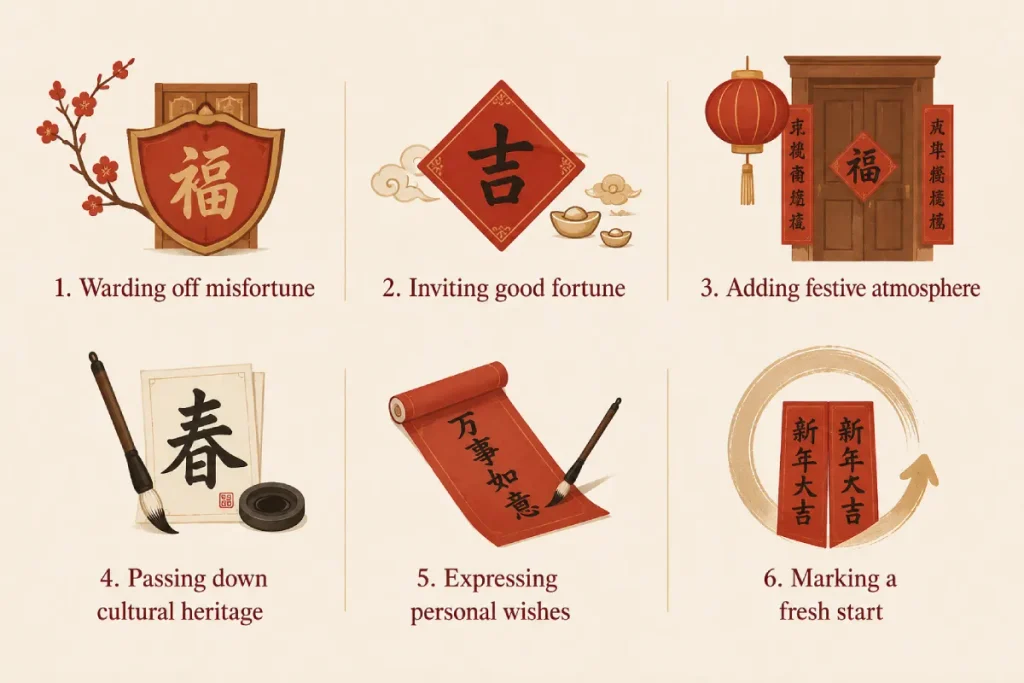
Beyond decoration, the act of pasting couplets carries several layers of meaning that have kept the custom alive for over a thousand years:
- Warding off misfortune. The custom traces back to the peachwood boards once used to drive away evil spirits, and red couplets are still seen as a symbol of protection for the household in the year ahead.
- Inviting good fortune. The auspicious phrases in a couplet are chosen to express hopes for the coming year, acting as a written wish that blessings will find their way through the door.
- Adding festive atmosphere. The bright red paper and lucky wording instantly signal that a household is celebrating, filling the neighborhood with the visual energy of the New Year.
- Passing down cultural heritage. Writing and selecting couplets is itself a living tradition, connecting each generation to classical Chinese language, calligraphy, and literary skill.
- Expressing personal wishes. Many families choose or write couplets that reflect their own hopes for the year, whether about health, career, study, or family reunion.
- Marking a fresh start. Replacing last year’s couplets with a new pair symbolizes leaving the old year behind and stepping into the new one with renewed hope.
Below are a few well-known spring festival couplets examples still pasted on doors across China today, shown with the original Chinese, pinyin, and general meaning.
1. A general New Year greeting
Upper: 天增岁月人增寿 (Tiān zēng suì yuè rén zēng shòu)
Lower: 春满乾坤福满门 (Chūn mǎn qián kūn fú mǎn mén)
Horizontal scroll: 喜迎新春 (Xǐ yíng xīn chūn)
Meaning: “As heaven adds another year, people add another year of life; as spring fills the world, fortune fills the home” — a broad wish for longevity and household blessing.
2. A prosperity couplet for businesses
Upper: 生意兴隆通四海 (Shēng yì xīng lóng tōng sì hǎi)
Lower: 财源广进达三江 (Cái yuán guǎng jìn dá sān jiāng)
Horizontal scroll: 恭喜发财 (Gōng xǐ fā cái)
Meaning: “May business flourish across all lands; may wealth flow in from every river” — commonly seen on shop and restaurant doors.
3. A couplet celebrating spring itself
Upper: 一年四季春常在 (Yī nián sì jì chūn cháng zài)
Lower: 万紫千红永开花 (Wàn zǐ qiān hóng yǒng kāi huā)
Horizontal scroll: 万象更新 (Wàn xiàng gēng xīn)
Meaning: “Spring lasts through all four seasons; a thousand colors bloom forever” — a general wish for renewal, often paired with any household’s theme.
What are Spring Festival couplets?
They are paired red paper banners with matching poetic lines pasted on both sides of a doorway during Chinese New Year, expressing wishes for luck, health, and prosperity.
What is a Spring Festival couplet used for?
It is used as a New Year decoration and a form of blessing for the household, believed to invite good fortune while warding off misfortune for the coming year.
Do Spring Festival couplets have to rhyme?
They don’t need to rhyme in the Western sense, but the two lines must match in length, grammar, and tonal pattern, which gives them a natural rhythm when read aloud.
Can Spring Festival couplets be reused each year?
Traditionally no. New couplets are pasted fresh each New Year to symbolize a clean start, and old ones are removed even if they haven’t faded.