
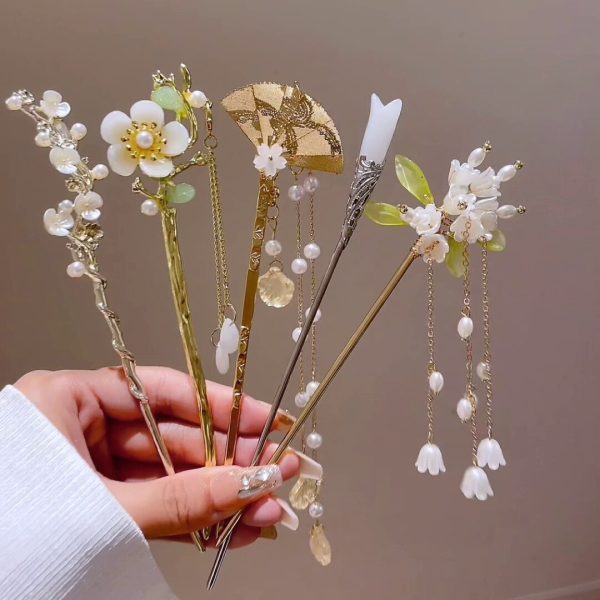
A single slender stick. No clips, no elastic, no complicated tools — just one elegant pin that has held up Chinese hairstyles for over two thousand years.
The hair chinese stick (发簪 fāzān) looks deceptively simple. And once you learn the technique, it is. But most beginners make the same few mistakes that cause the stick to slip out within minutes. This guide will walk you through everything: the right technique for different hair types, multiple styling methods, and the small adjustments that make all the difference.
Before diving into technique, a quick note on what makes the hair stick different from other accessories.
Unlike Western hairpins that clip or grip, a Chinese hair stick works through twisting and tension — the hair’s own weight and coil hold the stick in place. This means the technique matters more than the stick itself. A beautifully crafted jade pin will fall out immediately if inserted incorrectly; a simple wooden stick will hold all day when used right.
Traditional sticks come in two main forms:
- 单簪 (dān zān) — single pin, minimal and versatile, suits most hair types
- 双钗 (shuāng chāi) — double pin (forked), grips more securely, better for thick or heavy hair
For beginners, start with a single pin around 18–20cm long. Too short and it won’t catch enough hair; too long and it becomes unwieldy.
This is the foundational technique. Master this and everything else follows naturally.
Step 1 — Gather your hair Pull all your hair into a ponytail at the back of your head, roughly level with your ears. Hold it loosely with one hand — don’t tie it.
Step 2 — Twist the ponytail With your free hand, twist the ponytail in one direction (clockwise or counterclockwise, whichever feels natural) until it begins to coil on itself.
Step 3 — Wrap into a bun Continue twisting while guiding the hair into a coiled bun shape against your head. The twist is what creates the internal tension that locks the stick in place — don’t skip it.
Step 4 — Hold and insert Hold the bun firmly against your head with your non-dominant hand. With your dominant hand, hold the stick horizontally and push the pointed tip through one side of the bun at a slight downward angle.
Step 5 — Catch the hair underneath As the tip passes through the center of the bun, angle it to scoop a small section of your natural hair (beneath the bun, against your scalp). Then push the stick through until the tip exits the other side.
Step 6 — Secure Give the stick a gentle tug. If it feels loose, rotate it slightly — sometimes just a 10–15 degree turn locks it in completely. The stick should feel snug without pulling.
The key: The stick isn’t just piercing the bun — it’s threading under a layer of hair to create a lock. If you skip the scooping motion in Step 5, the stick will slide out.
Better for shorter hair or a more relaxed everyday look.
Step 1 — Take the top half of your hair (from temples up) and gather it loosely.
Step 2 — Twist this section two or three times to create a small rope of hair.
Step 3 — Fold the twisted section back on itself to create a loose loop or small knot.
Step 4 — Insert the stick horizontally through the loop, catching your natural hair underneath as you push through.
This method works especially well with hair around 20–30cm (shoulder to collarbone length) and gives a casual, effortless look that pairs beautifully with everyday Hanfu.
For a more elaborate look — or for thick hair that one stick can’t hold.
Step 1 — Create a bun using Method 1, but use a hair tie to secure the base first.
Step 2 — Insert the first stick from left to right through the upper portion of the bun.
Step 3 — Insert the second stick from right to left through the lower portion, crossing slightly beneath the first.
The two sticks form an X pattern inside the bun, distributing the weight and creating a much more secure hold. This is also the traditional method for wearing buyao (步摇) — ornamental sticks with hanging pendants — where extra security is essential.
“My stick keeps sliding out” You’re likely not catching enough hair in the scooping motion. Try inserting at a steeper downward angle, or twist your bun tighter before inserting.
“The bun falls apart after an hour” The twist isn’t tight enough. Before coiling into a bun, twist the ponytail until you can feel real tension — it should want to coil on its own.
“It works but feels uncomfortable” The stick is probably pressing against your scalp. Re-insert with a slightly shallower angle so the tip exits cleanly through the other side of the bun without digging in.
“My hair is too slippery / too fine” Lightly backcomb the bun section before inserting, or mist with a tiny amount of texturizing spray. Fine hair can also benefit from starting with a small elastic at the base of the ponytail before twisting.
“My hair is too thick / too heavy” Switch to a double-pin stick (钗) or use the double-stick method. Single pins struggle with very dense hair regardless of technique.
| Hair Type | Recommended Style | Length |
|---|---|---|
| Fine / straight | Single pin, smooth shaft | 18–20cm |
| Wavy / medium | Single pin or double pin | 18–22cm |
| Thick / coarse | Double pin (钗) | 20–25cm |
| Short (above shoulders) | Single pin, lighter weight | 15–18cm |
| Very long | Double-stick method | 22–25cm |
The hair chinese stick has been a constant presence in Chinese culture for more than two millennia — from the jade hairpins of Han Dynasty noblewomen to the elaborate buyao of Tang court ladies, whose ornaments swayed with every step. For much of Chinese history, a woman’s hairstyle and hairpin were not merely aesthetic choices; they marked her age, status, and life stage.
Today, as Hanfu culture grows around the world, the hair stick is being rediscovered by a new generation — not as a museum piece, but as a living accessory. Learning to use one is a small act of cultural connection, and with a little practice, a surprisingly satisfying skill.
Start with Method 1. Give yourself ten minutes. By the third try, it will click.