

Laba Festival (腊八节, Làbā Jié) is a traditional Chinese folk holiday observed on the eighth day of the twelfth lunar month, known as La Month (腊月). It isn’t a public holiday in modern China, but it carries real cultural weight. There’s an old saying that captures its role perfectly: “After Laba, it’s the New Year” (过了腊八就是年). Once Laba arrives, households across China begin shifting into festive mode ahead of Chinese New Year.
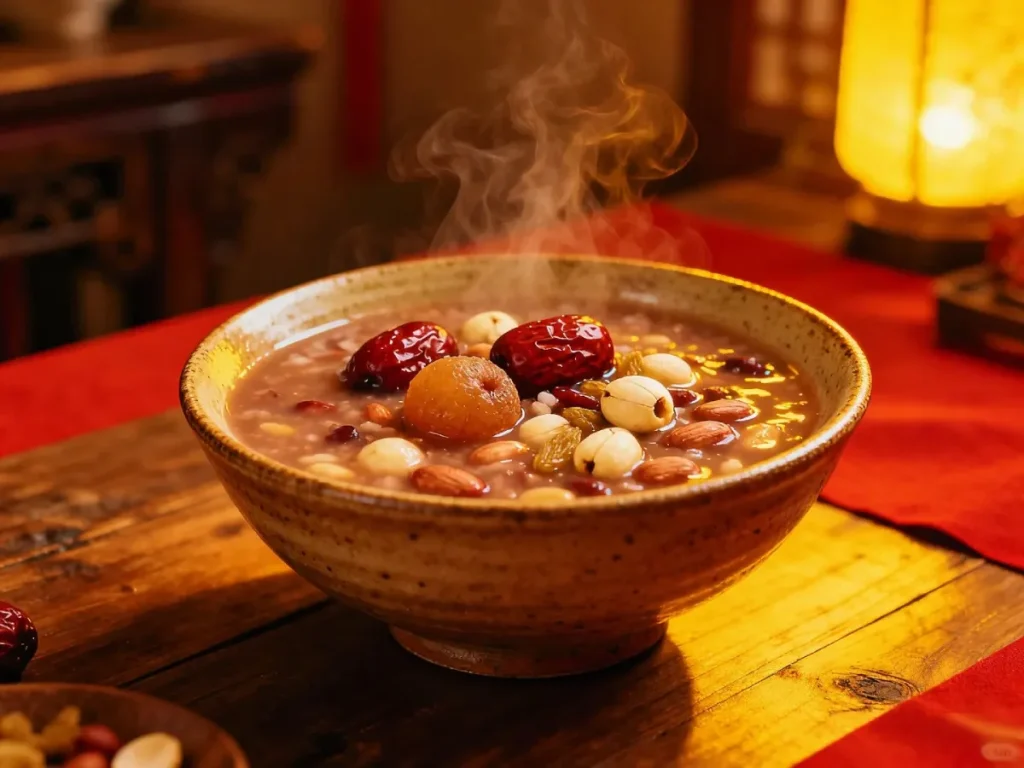
The centerpiece of the day is a warm bowl of Laba porridge, a mix of grains, beans, nuts, and dried fruit that has been part of Chinese winter tradition for close to a thousand years.
The name breaks down into two parts. “La” (腊) refers to the twelfth lunar month, which in ancient China was closely tied to year-end sacrifices and harvest celebrations. “Ba” (八) simply means “eight.” Put together, Laba literally means “the eighth day of La,” a direct reference to the date on which the festival falls. Over time, the name also became attached to the festival’s signature dish, giving us “Laba porridge” and “Laba garlic,” both named for the day rather than for their ingredients.
Because the date follows the lunar calendar, Laba Festival lands on a different day each year on the Gregorian calendar, though it always falls in the depths of winter, generally between late December and late January.
| Lunar Year | Gregorian Date |
|---|---|
| 2025 (Yi Si Year) | January 26, 2026 |
| 2026 (Bing Wu Year) | January 15, 2027 |
| 2027 (Ding Wei Year) | January 4, 2028 |
| 2028 (Wu Shen Year) | January 22, 2029 |
Notice that Laba Festival in a given lunar year falls in January of the following Gregorian year, since the twelfth lunar month sits right at the end of the lunar calendar, just before Chinese New Year begins.
Laba Festival’s origins are generally traced to two traditions that developed separately and, over time, grew closely intertwined.
Ancient sacrificial rites. In pre-Qin China, the twelfth lunar month was associated with “La” ceremonies, seasonal sacrifices offered to ancestors and to the gods of heaven, earth, and harvest. Farmers gave thanks for the year’s crops and prayed for good fortune and an abundant harvest in the year ahead. These rites did not originally fall on a fixed date; they simply took place sometime during the twelfth month.
Buddhist influence. As Buddhism spread through China during the Northern and Southern Dynasties, the holiday took on an additional layer of meaning. Buddhist tradition holds that the eighth day of the twelfth month marks the anniversary of Shakyamuni Buddha’s enlightenment. According to the story, after years of extreme fasting had left him weak, the Buddha collapsed near a river. A shepherdess, sometimes referred to as Sujata (also transliterated as 苏阇陀 in Chinese Buddhist texts), found him and offered a nourishing porridge made from rice, beans, and wild fruit. Restored by the meal, he is said to have reached enlightenment soon after.
Buddhist temples began marking the occasion by cooking large batches of porridge and distributing it to worshippers and the poor on the eighth day of the last lunar month. This tradition is widely believed to have helped popularize the porridge and strengthen its association with the date, alongside the older harvest and ancestor-worship customs. Historical records place written mentions of Laba porridge as far back as the Song Dynasty (960–1279), and the custom became firmly established in folk life by the Qing Dynasty (1644–1912).
Laba porridge is the dish most associated with the holiday. Tradition calls for eight ingredients, in keeping with the “ba” (eight) in the festival’s name, though most modern households treat this as a loose guideline and mix in whatever grains, beans, and dried fruits they have on hand.
The most commonly used ingredients include:
| Category | Common Ingredients |
|---|---|
| Grains | Glutinous rice, regular rice, millet, corn, barley |
| Beans | Red beans (adzuki), mung beans, black beans, kidney beans |
| Nuts and Seeds | Peanuts, lotus seeds, walnuts, coix seed |
| Dried Fruit | Red dates (jujubes), longan, raisins |
Many of these ingredients carry symbolic meaning in folk tradition: rice and glutinous rice are associated with abundance and family unity, red beans and red dates with good luck, and lotus seeds with peace and harmony in the household. In northern China, the porridge tends to be sweeter and grain-heavy, while some regions in the southwest prepare savory versions with meat and vegetables mixed in.
Beans and dried grains are usually soaked overnight so they cook evenly, then simmered slowly for an hour or more until the mixture thickens into a warm, sticky bowl, well suited to the coldest stretch of the Chinese winter.
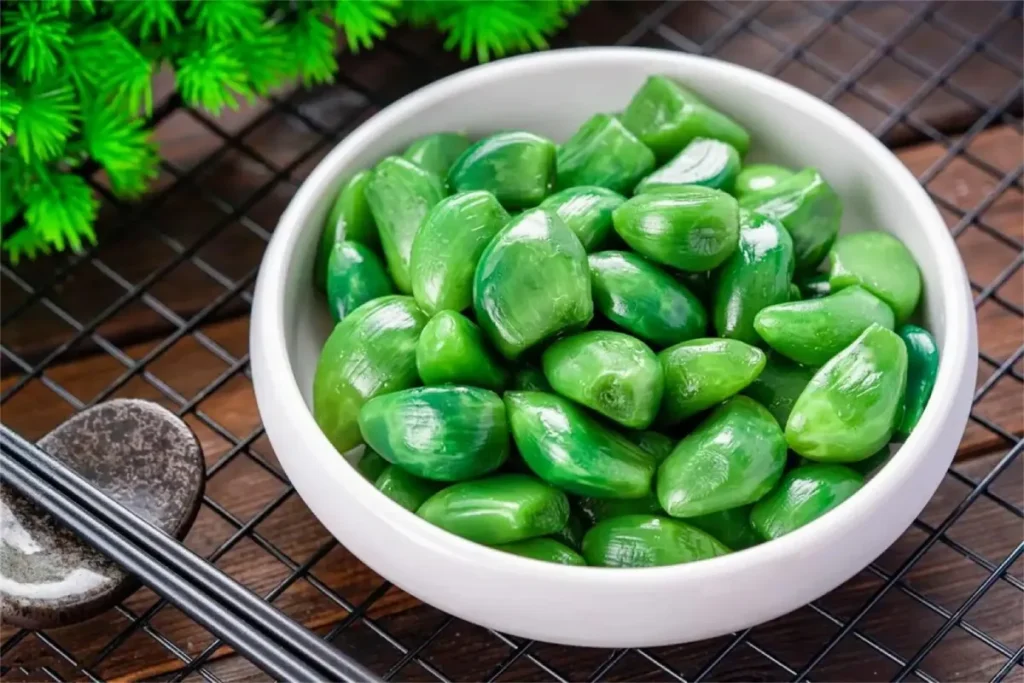
In northern China, especially around Beijing and Tianjin, another Laba custom is just as beloved as the porridge: making Laba garlic (腊八蒜). Peeled garlic cloves are submerged in rice vinegar and sealed in a jar on Laba day, then left to pickle for roughly three weeks.
By the time Chinese New Year’s Eve arrives, the garlic cloves have turned a striking jade green and taken on a mellow, tangy-sweet flavor. Laba garlic is traditionally served alongside jiaozi (dumplings) during the New Year’s Eve meal, cutting through the richness of the dumplings with its sharp, pickled bite.
While the porridge and the garlic are the two most widespread customs, Laba traditions vary by region and community.
| Region | Custom |
|---|---|
| Beijing & Tianjin | Making Laba garlic and Laba vinegar for the New Year’s Eve dumpling dinner |
| Henan | Some communities cook “da jia fan” (大家饭, a large communal pot of porridge, sometimes written locally as 大锅饭), a custom linked in local folklore to the Song Dynasty general Yue Fei |
| Shaanxi | Eating Laba noodles instead of porridge in some areas |
| Buddhist temples nationwide | Preparing and distributing free porridge to visitors and the community |
In many households, the day also includes ancestor worship, burning incense, and offering food to household deities, a direct echo of the festival’s older sacrificial roots.
Laba Festival is often described as the opening bell of Spring Festival season. Once the porridge pot has been put away, households across China shift into New Year preparation mode: deep-cleaning the home, buying new clothes, stocking up on festive food, and putting up red decorations. This stretch of weeks between Laba and Chinese New Year’s Eve is steeped in anticipation, building steadily toward the biggest celebration on the Chinese calendar.
Today, Laba Festival is celebrated in a lower-key way than Chinese New Year itself, but its customs remain very much alive. Supermarkets sell pre-mixed Laba porridge grain packets in the weeks leading up to the date, Buddhist temples still host large-scale porridge giveaways that draw long lines of visitors, and many families treat the day as a cozy, informal gathering built around a shared pot of porridge. For the Chinese diaspora, Laba Festival is often one of the first cultural touchpoints of the winter season, a warm and low-pressure way to reconnect with tradition before the busier demands of Chinese New Year take over.
Laba Festival may not carry the scale of Chinese New Year, but it plays an important role in the rhythm of the Chinese winter. It marks the symbolic start of New Year preparations, keeps centuries-old food traditions alive at the family table, and links an ancient harvest ritual with a Buddhist story of compassion and renewal. For many families, it’s less about the ceremony and more about the warmth of a shared bowl of porridge on a cold winter morning, a small but meaningful signal that the New Year is on its way.
Is Laba Festival a public holiday in China?
No. Unlike Chinese New Year, Laba Festival is not an official public holiday, so schools and workplaces remain open. It’s observed as a folk and religious custom rather than a statutory day off.
Is Laba Festival the same as Chinese New Year?
No, they’re different holidays. Laba Festival falls on the eighth day of the twelfth lunar month and is widely seen as the informal start of New Year preparations, while Chinese New Year itself falls about five weeks later, on the first day of the first lunar month, and is the far bigger celebration.
Why does Laba porridge use eight ingredients?
The number eight ties directly to the festival’s name, since “ba” means eight. The classic recipe calls for eight ingredients, though this is treated more as a tradition than a strict rule in most households today.
Is Laba porridge the same as Eight Treasure Porridge?
They’re closely related but not always exactly the same dish. Both typically combine grains, beans, nuts, and dried fruit, but Laba porridge (腊八粥) refers specifically to the version tied to Laba Festival, while Eight Treasure Porridge (八宝粥) is a broader dish that can be eaten any time of year. Recipes for both vary widely by region and household.