
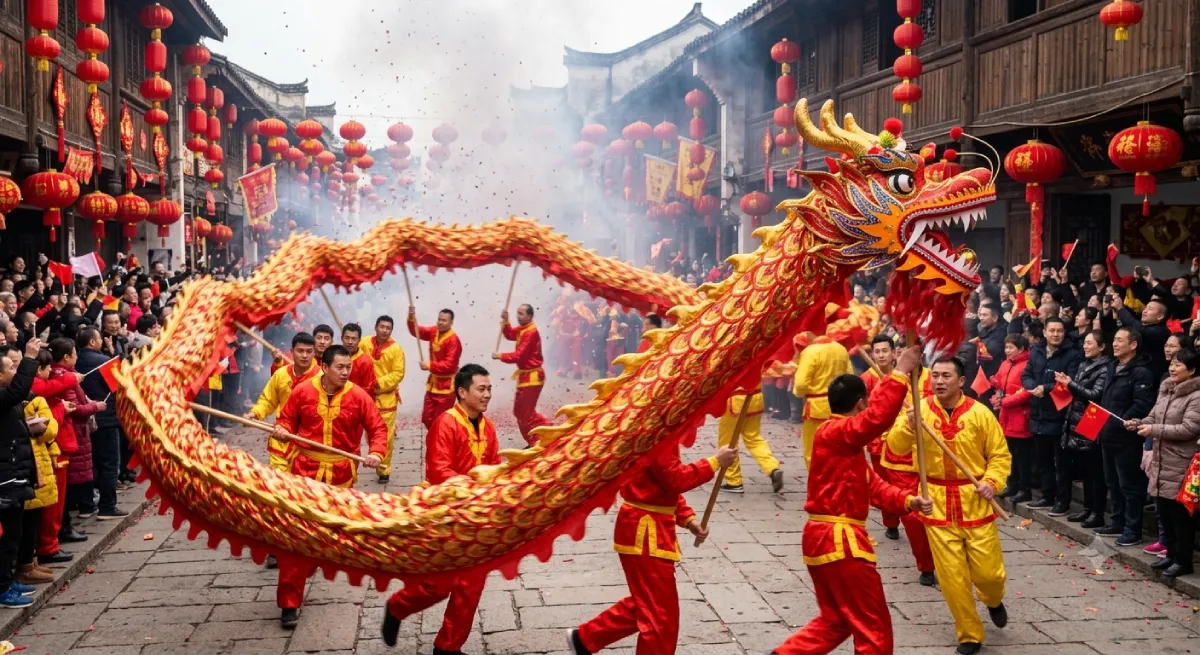
Few sights capture the energy of Chinese festivals quite like the dragon dance. A long, sinuous dragon made of silk, bamboo, and paper ripples through the streets, chasing a glowing pearl held aloft by a lead performer, while drums and cymbals drive the crowd into a state of collective celebration. For centuries, this performance has been one of the most recognizable symbols of Chinese culture — and today it remains a centerpiece of Chinese New Year festivities around the world.
This guide explains what the Chinese dragon dance is, where it comes from, what its movements symbolize, how it differs from the lion dance, and why it continues to thrive in modern celebrations from Beijing to Los Angeles.
The Chinese dragon dance (舞龙, wǔ lóng) is a traditional performance in which a team of dancers manipulates a long, segmented dragon puppet to simulate the animal’s undulating, serpentine movement. Unlike the lion dance, which is performed by just two people inside a single costume, the dragon dance requires a coordinated team — often ranging from nine to more than fifty performers — each holding a pole connected to one segment of the dragon’s body.
The dragon itself is constructed from a lightweight frame, typically bamboo or wire, covered in silk or fabric and painted with scales, whiskers, and a horned head. Some ceremonial dragons stretch well over 100 feet in length, requiring dozens of performers working in tight synchronization to make the creature appear to fly, coil, and chase a pearl through the air.
Common name variations you may encounter include Chinese dragon dance, dragon dancing, and simply “the dragon dance” — all referring to the same performance tradition.
The dragon dance traces back over 1,700 years, with early forms documented during the Han Dynasty (206 BCE–220 CE). In ancient agricultural society, the dragon was closely associated with rain, water, and the harvest, since dragons were believed to control rivers, seas, and rainfall. Dragon dances were originally performed as part of rain-prayer ceremonies, meant to appeal to the dragon spirits for a good growing season.
Over time, the practice expanded beyond agricultural ritual into a broader symbol of protection, strength, and good fortune, eventually becoming a fixture of major festivals, temple celebrations, and later — Chinese New Year itself.
Every element of the performance carries meaning rooted in traditional Chinese belief systems.
The dragon (long, 龙) is one of the most powerful and auspicious symbols in Chinese culture. Unlike the fire-breathing, menacing dragons of Western folklore, the Chinese dragon is a benevolent guardian associated with wisdom, strength, nobility, and the power to bring rain and prosperity. It is also linked to imperial authority — historically, the dragon was the emblem of the emperor.
The pearl (often called the “dragon pearl”) that the dragon chases throughout the performance typically represents wisdom, spiritual energy, or the sun itself. The dragon’s pursuit of the pearl is often interpreted as the eternal pursuit of knowledge and enlightenment, or the cyclical chase between the dragon and the sun across the sky.
The undulating movement mimics a dragon flying through clouds and swimming through water, reflecting the creature’s dominion over both sky and sea. Skilled troupes choreograph formations that spell out the character for good fortune, form a spiral, or create a wave-like ripple down the entire length of the dragon’s body.
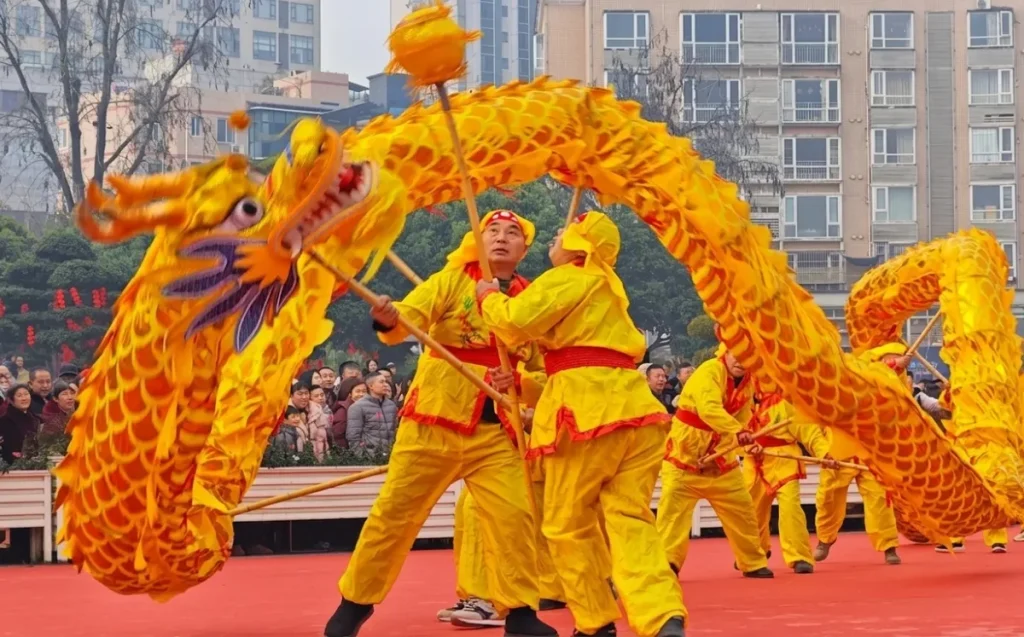
A dragon dance performance requires extensive coordination and physical stamina. Here is how a typical performance comes together.
Team roles. One performer, known as the pearl bearer, leads the dragon by holding a decorated ball or pearl on a pole, dictating the direction and pace of the entire routine. Behind them, a line of performers each hold a pole attached to a segment of the dragon’s body, working together to create the illusion of continuous, fluid motion rather than a series of disconnected parts.
Choreography. Routines typically include weaving patterns, full-body spirals, wave motions down the spine, and formations where the dragon appears to leap or dive. Advanced troupes may incorporate acrobatics, with performers running, crouching, or lifting the poles overhead to make the dragon appear to soar.
Music and rhythm. A drum, gong, and cymbal ensemble sets the tempo for the performers, with the intensity of the music rising and falling to match the dragon’s movements — slow and sweeping during graceful glides, fast and percussive during energetic spins.
Dragon length and team size. Ceremonial and competition dragons vary widely in length. A shorter practice or school dragon might use 7 to 9 segments and a similar number of performers, while festival dragons used in major parades can extend to 30 or more segments, requiring dozens of dancers moving in unison.
Like many Chinese performing arts, the dragon dance developed distinct regional styles over time.
Northern-style dragon dance tends to emphasize speed, athleticism, and dramatic aerial formations. Northern troupes often perform with shorter, lighter dragons that allow for faster, more acrobatic routines, including jumps and rapid spirals.
Southern-style dragon dance favors longer dragons and more elaborate, flowing choreography, with an emphasis on wave-like body movements and intricate formations. Southern styles are especially prominent in Guangdong and Hong Kong, where dragon dance troupes are closely tied to local clan associations and martial arts schools. Some southern communities also maintain older folk variants, such as the grass dragon (草龙), woven entirely from straw or rice stalks, and the fire dragon (火龙), studded with burning incense sticks and paraded at night.
Northern troupes, by contrast, sometimes favor a lantern dragon (also called a bench dragon), with individual segments carrying small lit lanterns, creating a glowing trail as the dragon winds through the dark.
The dragon dance is most widely recognized today as a centerpiece of Chinese New Year celebrations. During the Spring Festival period, dragon dance troupes parade through streets, shopping districts, and temple fairs, believed to sweep away bad luck from the previous year and usher in prosperity for the new one.
Business owners frequently invite dragon dance troupes to perform outside shops and restaurants at the start of the new year, a practice thought to bring good fortune and financial success for the year ahead. The dragon is also a common sight at other major celebrations, including lantern festivals, temple openings, and significant community or cultural events, both within China and among Chinese communities worldwide.
Dragon dance and lion dance are often performed together at the same events, leading many people outside Chinese culture to mix the two up. While related, they are distinct traditions with different origins, team structures, and symbolism.
| Feature | Dragon Dance | Lion Dance |
|---|---|---|
| Performers per costume | 9 to 50+ people | 2 people (head and tail) |
| Costume structure | Long, segmented body on poles | Single costume worn over two dancers |
| Core symbolism | Rain, power, imperial authority, wisdom | Courage, protection from evil spirits |
| Movement style | Flowing, wave-like, aerial | Playful, expressive, acrobatic footwork |
| Common role | Parade centerpiece, large-scale celebration | Storefront blessings, close-up interaction with crowds |
In many festivals, the two performances complement each other: lion dance troupes often perform first, moving through crowds and interacting closely with spectators and shop entrances, while the dragon dance follows as a larger, more visually dramatic finale.
Today, the dragon dance has spread well beyond China’s borders, performed at Chinese New Year parades, cultural festivals, and international celebrations across North America, Europe, Southeast Asia, and Australia. Competitive dragon dance has also emerged as a formal sport, with international federations hosting championships that judge teams on technical difficulty, formation complexity, and synchronization.
One of the most striking modern traditions is the Tai Hang Fire Dragon Dance in Hong Kong, held every mid-autumn festival, where a 67-meter dragon covered in thousands of burning incense sticks winds through the neighborhood after dark, filling the streets with smoke and glowing embers. Alongside these older fire dragon customs, many contemporary troupes have also adopted LED and glow-in-the-dark dragons, using fiber-optic or battery-lit fabric to create a luminous effect for night parades — a modern twist that keeps the tradition visually striking for new generations.
Despite its evolution into a globally recognized performance art, the dragon dance remains rooted in its original symbolism — a living expression of strength, unity, and the enduring hope for prosperity that has carried the tradition across more than a thousand years.
Is the Chinese dragon friendly or evil?
The Chinese dragon is a benevolent and auspicious creature, unlike the fire-breathing, villainous dragons common in Western folklore. It is associated with wisdom, strength, and the power to bring rain and prosperity, and is historically linked to imperial authority rather than destruction.
What is the dragon chasing in the dragon dance?
The dragon chases a decorated pearl, sometimes called the “dragon pearl,” carried by a lead performer. The pearl is generally interpreted as a symbol of wisdom, spiritual energy, or the sun, with the dragon’s pursuit representing an eternal quest for knowledge and enlightenment.
How heavy is a dragon dance prop?
Weight varies by size and material. A single segment of a traditional bamboo-and-silk dragon typically weighs a few pounds, but a full ceremonial dragon with 20 to 30 segments can weigh well over 100 pounds in total, which is why performances require large, well-coordinated teams.
How many people are needed to perform a dragon dance?
A basic school or practice dragon can be performed with as few as 9 people, including the pearl bearer. Larger festival dragons used in major parades often require 20 to 50 or more performers moving in close coordination.