
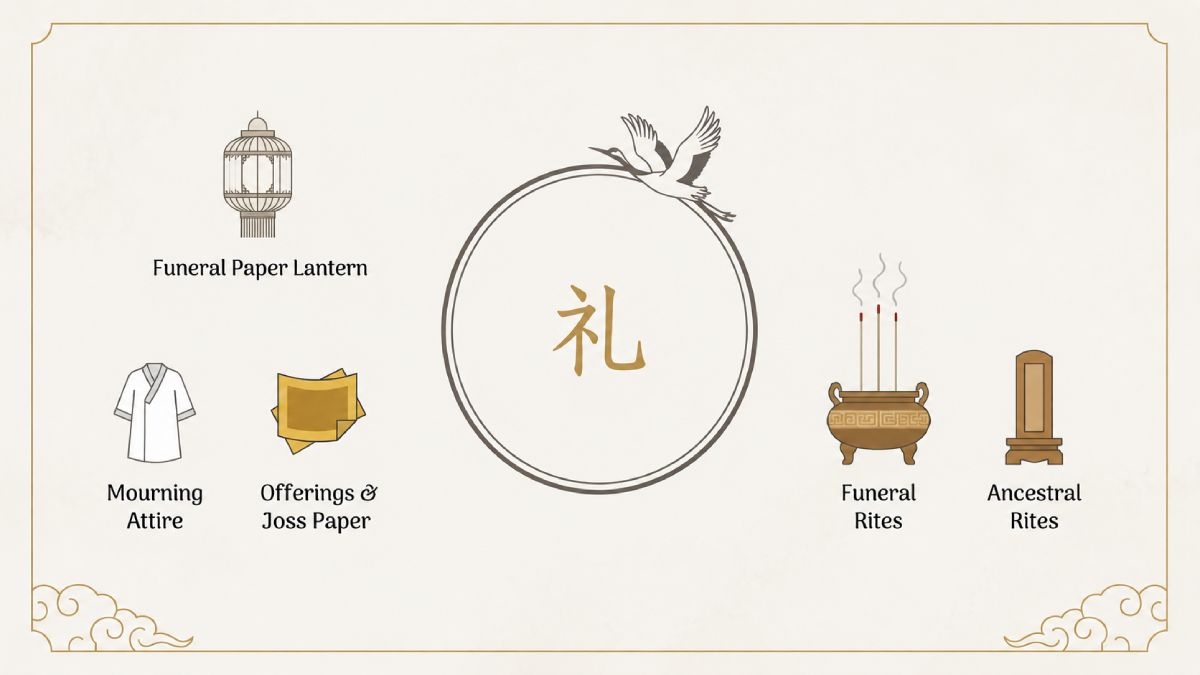
Chinese funeral traditions are among the most structured and symbolically rich mourning customs in the world, shaped by thousands of years of Confucian filial piety, Taoist cosmology, and Buddhist beliefs about the afterlife. Rather than a single fixed ritual, these customs form a layered system designed to honor the deceased, guide their spirit safely into the next life, and preserve harmony for the surviving family. Understanding these traditions offers insight into how Chinese culture views death not as an ending, but as a transition requiring proper ceremony and respect. Practices can vary significantly across different regions of China and among overseas Chinese communities, so the customs described here represent widely recognized traditions rather than a single fixed set of rules.
In traditional Chinese belief, death disrupts the balance between the living and the spirit world. Funeral rites exist to restore that balance — ensuring the deceased’s spirit is properly guided to the afterlife while protecting the living from misfortune. Confucian values emphasize filial duty, meaning children and descendants are expected to demonstrate devotion through elaborate, correctly performed rituals. Taoist and Buddhist elements layer on top of this, contributing beliefs about reincarnation, ancestor worship, and the journey of the soul through the underworld.
Ancestor veneration: The funeral is only the beginning of an ongoing relationship. Once buried, the deceased becomes an ancestor to be honored through regular offerings, especially during festivals like Qingming and Hungry Ghost Festival.
Fear of a “bad death”: Traditional belief holds that an improperly conducted funeral can result in a restless or vengeful spirit. This is part of why funeral rites are followed with such precision, especially around timing and symbolism.
One of the most distinctive aspects of Chinese funeral traditions is the reversal of Western mourning color conventions. White, not black, is the primary color of mourning and death in Chinese culture, symbolizing purity, the fading of life, and the passage into the spirit world.
Mourning attire: Immediate family traditionally wears plain white or unbleached fabric, often made of coarse, undyed hemp or cotton to signify grief and humility. The rougher the fabric, the closer the relation to the deceased — a custom rooted in Confucian mourning hierarchy.
Colors to avoid: Red is strictly avoided at funerals, as it represents joy, luck, and celebration — the opposite of the somber occasion. Guests are also advised against wearing bright or festive colors.
| Mourning Rank | Relation to Deceased | Traditional Fabric |
|---|---|---|
| Deepest mourning | Children, spouse | Coarse unhemmed hemp |
| Close mourning | Grandchildren, siblings | Finer hemp or coarse cotton |
| Distant mourning | Extended relatives | Plain white cloth |
| Symbolic mourning | Friends, guests | Small white cloth pin or armband |
Traditional preparation rites are handled with great care, as this stage is believed to directly affect the deceased’s comfort in the afterlife.
Washing and dressing: The body is ritually cleansed and dressed in special longevity clothing, historically odd-numbered layers (often five, seven, or nine), avoiding buttons in favor of ties or knots. Buttons are considered inauspicious for two reasons: the word for “button” sounds similar to a phrase associated with cutting off descendants, and buttons are also believed to risk trapping the soul, preventing a smooth passage to the afterlife.
Placement and vigil: The body is placed in a coffin or on a viewing platform at home or in a funeral hall, with the head typically oriented in a specific direction according to feng shui principles. Family members keep vigil, and incense is burned continuously to guide the spirit.
Notifying the community: Traditionally, white banners or paper notices were hung outside the home to inform neighbors and the community of the death, a practice that has become less common in modern cities but persists in some rural areas.
The ceremony itself blends solemn ritual with practical logistics, often lasting several days depending on regional custom and family wealth.
Choosing an auspicious date: Families frequently consult a Chinese almanac or a feng shui practitioner to select the most favorable date and time for the funeral and burial, avoiding dates considered unlucky.
Burning of joss paper and offerings: Paper money (joss paper), and increasingly paper replicas of houses, cars, and other goods, are burned so the deceased can use them in the afterlife. This practice, known as “sending” offerings, remains widespread even among urban and overseas Chinese families.
Wailing and mourning music: In some regional traditions, particularly in parts of southern and central China, professional mourners or musicians are hired to perform expressions of grief, seen as a sign of respect and a way to honor the deceased publicly. Traditional funeral music, often played on the suona horn, a traditional Chinese double-reed instrument, accompanies the procession. This practice is not universal, and many regions, especially in the north, do not follow it.
The funeral procession: Family members follow the coffin in order of mourning rank, sometimes accompanied by a portrait of the deceased carried at the front. Firecrackers may be set off to ward off evil spirits along the route.
While traditional burial was historically preferred — tied to beliefs about the body remaining whole and feng shui grave placement affecting descendants’ fortune — cremation has become increasingly common, particularly in mainland China, due to land scarcity and government policy.
Grave siting: When burial is chosen, the grave’s location and orientation are selected using feng shui principles, believed to influence the fortune of surviving descendants for generations.
Cremation and urn placement: Ashes are typically placed in a columbarium or family grave site. Some families still observe modified versions of traditional rituals, such as burning offerings, even when cremation is chosen over burial.
Overseas and diaspora adaptations: Chinese communities abroad often blend local funeral home procedures with traditional elements — white mourning clothes, joss paper burning, and specific offerings — adapted to local regulations and available services.
The funeral itself is only the first stage. Traditional mourning continues well beyond burial, with specific rituals marking key intervals.
The 49-day mourning period: Rooted in Buddhist belief, the soul is thought to pass through a series of judgments over 49 days following death, with rites performed every seven days to assist its journey. This system runs alongside the older Confucian mourning code, which traditionally called for a formal three-year mourning period for one’s parents — a structure that also underlies the five-tier mourning hierarchy (Zhan Cui – raw unhemmed sackcloth, Qi Cui – trimmed sackcloth, Da Gong – coarse linen, Xiao Gong – fine linen, Si Ma – thin cloth) referenced in the fabric table above, though full observance of the three-year code is rare in modern practice.
100-day and annual observances: Further memorial rites are often held 100 days after death, and then annually on the death anniversary, alongside broader ancestor-honoring festivals such as Qingming Festival (Tomb-Sweeping Day) in spring and Hungry Ghost Festival in the seventh lunar month.
Ancestral tablets: Many families install a memorial tablet for the deceased on the home altar or in a temple, where descendants can continue to offer incense, food, and prayers.
For those attending a Chinese funeral, especially without close family ties, a few etiquette points are commonly expected.
What to wear: Dark, muted clothing is appropriate; avoid red and other bright, festive colors. Some funerals provide a small white cloth or black armband for guests to wear as a sign of respect.
Gift-giving customs: Condolence money is traditionally given in a white envelope, in contrast to the red envelopes used for celebratory occasions. The amount is typically an odd number — often ending in a single digit, such as 101 or 301 — symbolizing that the loss is a one-time occurrence, unlike the even-number preference at weddings, which symbolizes doubled happiness. Exact conventions vary by region, so it is generally safe to follow the amount suggested by close family or local custom.
Behavior at the ceremony: Guests bow to the portrait or coffin of the deceased, sometimes multiple times depending on regional custom, and offer condolences to the family quietly and briefly rather than engaging in extended conversation.
What is a traditional Chinese funeral like? It blends Confucian, Buddhist, and Taoist practices into a multi-day process — preparing and dressing the deceased, a wake with continuous incense, a procession, burial or cremation, and ongoing ancestor rites afterward, all guided by family-specific and regional custom.
Why do Chinese funerals use white instead of black? White symbolizes purity and the soul’s transition to the afterlife, while red is avoided entirely because it represents joy and celebration.
How long is the traditional mourning period? Beliefs vary, but many families observe rites at seven-day intervals over 49 days, with further observances at 100 days and on annual death anniversaries; historically, Confucian custom called for a full three-year mourning period for one’s parents.
Chinese funeral traditions reflect a worldview in which death is not a rupture but a transition, carefully managed through ritual to honor the deceased and protect the living. While modern urban life and cremation have reshaped some practices, the underlying values — filial piety, respect for ancestors, and the belief that proper ceremony matters — continue to shape how Chinese families approach loss today.