
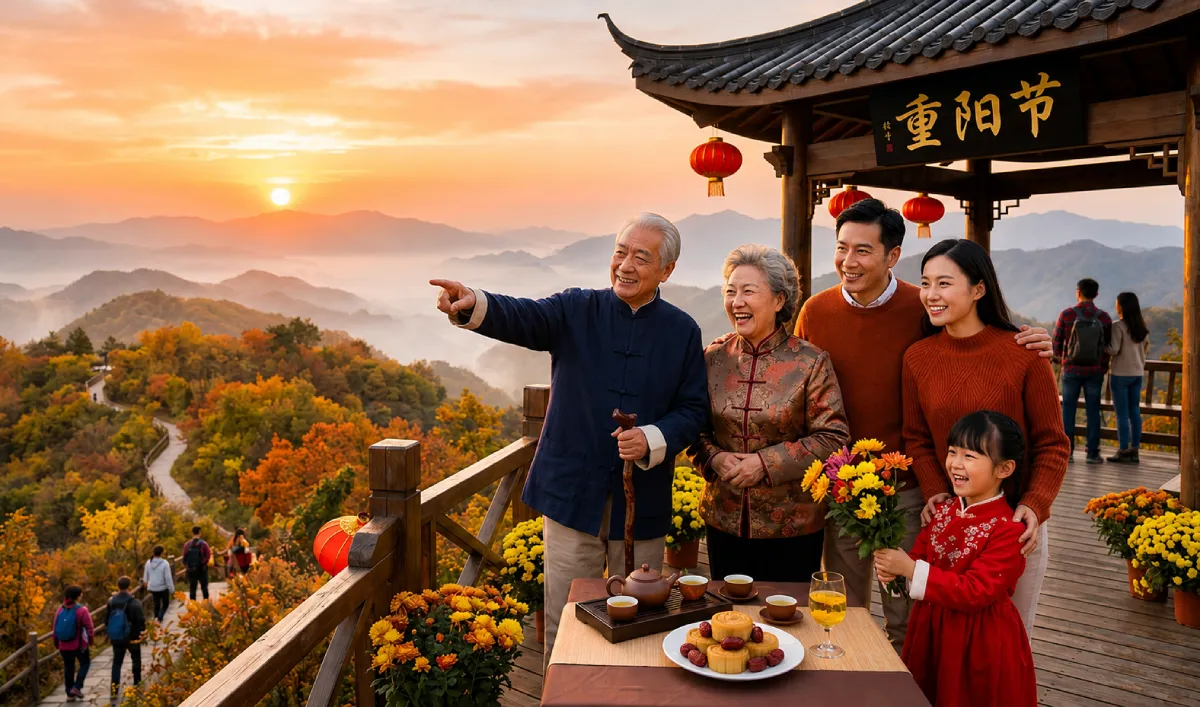
Every autumn, as chrysanthemums bloom across China, families climb hills, sip chrysanthemum wine, and think of relatives who have passed on. This is the Double Ninth Festival, one of the oldest traditional Chinese holidays still widely observed today. Falling on the ninth day of the ninth lunar month, it carries layers of meaning that range from ancient legend to modern-day respect for the elderly.
Whether you’re curious about its origins, its customs, or simply why the number nine matters so much in Chinese culture, this guide covers everything worth knowing about this centuries-old holiday.
The Double Ninth Festival, also known as the Chongyang Festival (重阳节), is a traditional Chinese holiday held on the ninth day of the ninth month of the lunar calendar. Because the number nine appears twice, the day is called “Double Ninth” or “Double Yang,” referencing the ancient Chinese philosophy of yin and yang.
The festival goes by several other names depending on the tradition being emphasized: the Height Ascending Festival, for its custom of climbing mountains; the Chrysanthemum Festival, for the flower most associated with the season; and, in modern China and Taiwan, Senior Citizens’ Day, since 1989 designated as a time to honor and care for the elderly.
The Double Ninth Festival always lands on the ninth day of the ninth month of the Chinese lunar calendar. Because the lunar calendar doesn’t line up exactly with the Gregorian calendar used in most of the world, the corresponding Western date shifts from year to year, typically falling somewhere between late September and late October.
Unlike Chinese New Year or the Mid-Autumn Festival, the Double Ninth Festival is not a public holiday in mainland China, so most businesses and schools follow their regular schedule. It is, however, a statutory public holiday in Hong Kong and Macau.
Here are the confirmed Gregorian dates for the next ten years:
| Year | Gregorian Date |
|---|---|
| 2026 | October 18 |
| 2027 | October 8 |
| 2028 | October 26 |
| 2029 | October 16 |
| 2030 | October 5 |
| 2031 | October 24 |
| 2032 | October 12 |
| 2033 | October 31 |
| 2034 | October 20 |
| 2035 | October 9 |
The name traces back to the I Ching, the ancient Chinese classic of divination, where odd numbers are classified as yang (masculine, active, bright) and even numbers as yin (feminine, passive, dark). Nine is the largest single-digit yang number, so a day and month that are both nine creates an unusually strong concentration of yang energy.
Traditionally, too much yang was considered dangerous rather than purely fortunate, which is why the day became associated with rituals meant to ward off misfortune: climbing to high ground, drinking chrysanthemum wine, and carrying sprigs of dogwood, also known as zhuyu.
Like most major Chinese festivals, the Double Ninth Festival has an origin story passed down through generations. The most widely told version comes from the Eastern Han dynasty.
According to the tale, a plague demon lived in the Ru River and brought sickness to a nearby village every year. A young man named Huan Jing sought out an immortal named Fei Changfang to learn how to defeat it. After years of training, Fei instructed Huan to return to his village on the ninth day of the ninth month, carrying dogwood leaves and chrysanthemum wine, and to lead the villagers up a nearby mountain to escape the demon’s reach. Huan followed the instructions exactly, the villagers survived, and the demon was ultimately defeated. From that day on, climbing mountains, drinking chrysanthemum wine, and wearing dogwood became annual customs to protect against misfortune.
Historians trace the festival’s roots even further back, to harvest and ancestor-worship rituals from the Warring States period, with the holiday becoming formally recognized during the Tang dynasty.
It was also during the Tang dynasty that the festival found its way into some of the most enduring lines in Chinese literature. The poet Wang Wei, writing far from home, captured the particular ache of being a stranger in a distant land during a holiday built around family reunion and remembrance, in a poem still memorized by Chinese schoolchildren today. That sense of longing, of thinking of loved ones from afar while everyone else climbs the mountain together, remains one of the emotional threads that ties the modern festival back to its ancient roots.
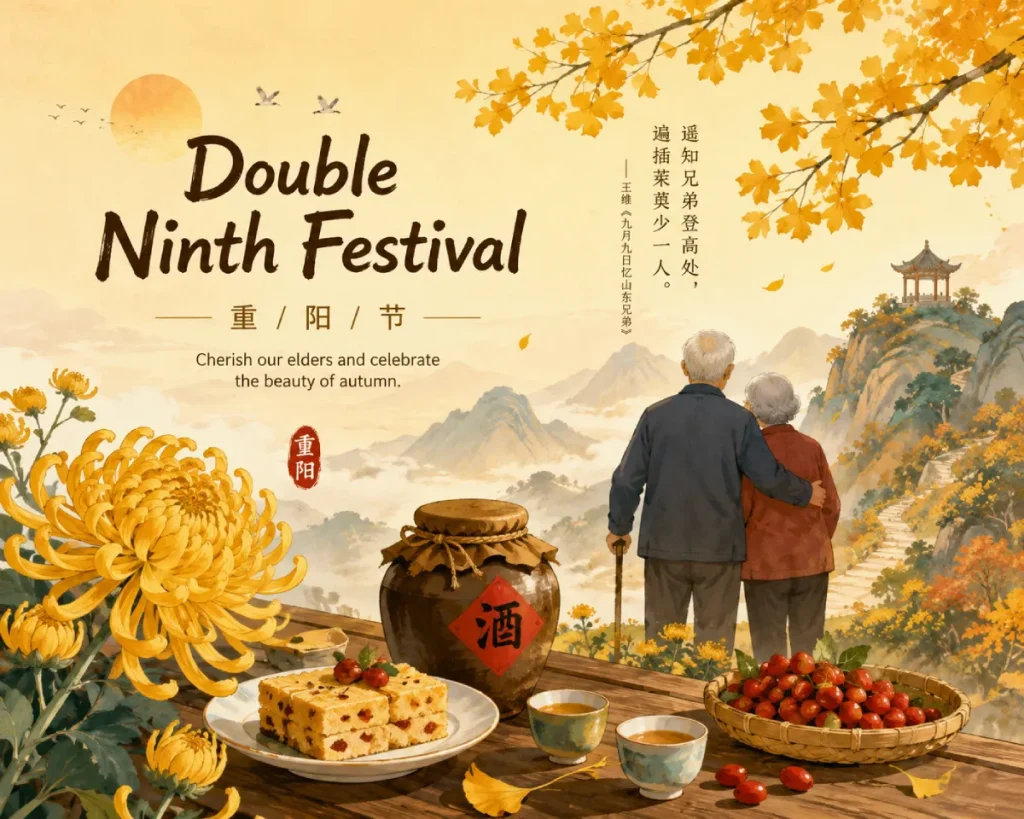
Over more than a thousand years, the Double Ninth Festival has developed a distinct set of customs, many of which are still practiced across China, Hong Kong, Macau, and Chinese communities worldwide.
Climbing Mountains
Also called “ascending to height,” this is the festival’s signature activity. Families and friends hike to a scenic peak or hill, believing that the higher ground offers protection from the excess yang energy of the day and brings good fortune for the year ahead. In cities without nearby mountains, climbing a tall building or pagoda serves the same symbolic purpose.
Drinking Chrysanthemum Wine
Chrysanthemums bloom in late autumn, exactly when the festival takes place, and are considered a symbol of longevity and resilience. Steeping the flowers in wine was believed to promote health and ward off illness. The poet Tao Yuanming of the Jin dynasty is often credited as the first to popularize appreciating chrysanthemums and drinking chrysanthemum wine on this day.
Eating Chongyang Cake
Because the Chinese word for “cake” (糕, gāo) sounds like the word for “height” or “high” (高), eating Chongyang cake symbolically substitutes for mountain climbing when a real ascent isn’t practical. The cake is traditionally layered, sometimes topped with small flour figures shaped like sheep or goats, and occasionally decorated with a small paper flag.
Wearing Zhuyu (Cornelian Cherry)
During the Tang dynasty, it became popular to pin sprigs of zhuyu, a fragrant plant related to the dogwood, to clothing or hair, or to hang small sachets filled with it. The plant was thought to have protective properties capable of dispelling misfortune and illness.
Flying Kites
In parts of southern China, kite flying is just as closely tied to the Double Ninth Festival as climbing and chrysanthemums. Clear autumn skies and steady winds make it an ideal time to fly kites outdoors, and in some regions, sending a kite up into the sky was believed to carry bad luck away with it. Today it remains a simple, family-friendly way to enjoy the season, especially popular with children.
Because “double nine” (jiǔjiǔ, 九九) sounds similar to the word for “forever” or “long-lasting” in Chinese, the festival also carries strong associations with longevity. Many families use the day to visit ancestral graves, clean headstones, and make offerings, similar in spirit to the Qingming Festival in spring.
In 1989, the Chinese government formally designated the Double Ninth Festival as Senior Citizens’ Day, encouraging families to spend time with older relatives and communities to organize outings, gift-giving, and other events honoring the elderly. Taiwan adopted a similar designation decades earlier, and local governments there often distribute small cash gifts to senior citizens around the holiday.
While the Double Ninth Festival originated in China, its traditions have spread across East Asia, taking on local names and variations along the way.
| Region | Local Name & Notes |
|---|---|
| Hong Kong & Macau | Known as Chung Yeung Festival; a statutory public holiday with family grave visits. |
| Taiwan | Observed as Senior Citizens’ Day since 1966, with local cash gifts for elders. |
| Japan | Called Choyo or the Chrysanthemum Festival, one of Japan’s five ancient seasonal festivals. |
| Korea | Known as Jungyangjeol, once marked with chrysanthemum-leaf pancakes. |
Modern celebrations blend old customs with contemporary life. City parks host chrysanthemum exhibitions that draw large crowds each October, hiking clubs organize group climbs, and bakeries sell Chongyang cake alongside their usual offerings. Some cultural events and photography days built around the festival also feature people dressed in Hanfu, the historical clothing of the Han Chinese, as a way of connecting the holiday’s ancient roots to a visual, shareable experience.
For many younger city dwellers, the original idea of climbing to escape misfortune has quietly evolved into something closer to a seasonal ritual for unplugging. Hiking trips and casual city walks have become a popular way to mark the holiday, less about warding off evil spirits and more about getting outside, enjoying the crisp autumn air, and taking a break from screens and deadlines before winter sets in.
For families abroad, especially in cities with large Chinese communities, the day is often observed with a quieter version of the tradition: a visit to a cemetery, a shared meal, or simply a phone call to check in on older relatives.
Is the Double Ninth Festival a public holiday?
It is a public holiday in Hong Kong and Macau, but not in mainland China, where people generally follow their regular work schedules.
What foods are eaten during the festival?
Chongyang cake and chrysanthemum wine or tea are the two most traditional foods associated with the holiday.
Can I drink regular chrysanthemum tea instead of wine?
Absolutely, and most people do these days. While chrysanthemum wine is the historical custom, chrysanthemum tea is the far more common choice in modern celebrations, seen as a lighter, healthier way to carry on the same tradition.
Does the festival have a connection to family and ancestors?
Yes. Because “nine-nine” sounds like the word for “forever,” the day is closely tied to wishes for longevity, and many families visit ancestral graves or spend extra time with elderly relatives.
The Double Ninth Festival may not carry the fireworks and fanfare of Chinese New Year, but its quiet blend of legend, nature, and family duty makes it one of the most meaningful days on the traditional Chinese calendar. Whether it’s climbing a hill, sharing a cup of chrysanthemum wine, or simply calling a grandparent, the customs of this ancient festival continue to find new expression more than a thousand years after they began.