

Types of Hanfu: A Comprehensive Classification
Hanfu, the traditional clothing of the Han Chinese, boasts a vast array of styles. Its classification varies based on different criteria, with the following being the most common categories and specific types:
1. Classification by Structure
Hanfu’s structure is defined by how its upper and lower parts are tailored and connected, forming four core systems:
- Yishang System (Separated Top and Skirt/Pants)
The oldest structure of Hanfu, featuring a separately tailored upper garment (“yi”) and lower garment (“shang,” which can be a skirt or pants).
- Mianfu: The highest-ranking ceremonial attire, reserved for grand rituals like state sacrifices. It is adorned with symbolic patterns and follows strict etiquette.
- Xuanduan: A formal robe worn by nobles and scholars for court meetings or sacrificial ceremonies. It is plain-colored without decorative patterns, emphasizing solemnity.

- Shenyi System (Connected Top and Skirt with Waist Seam)
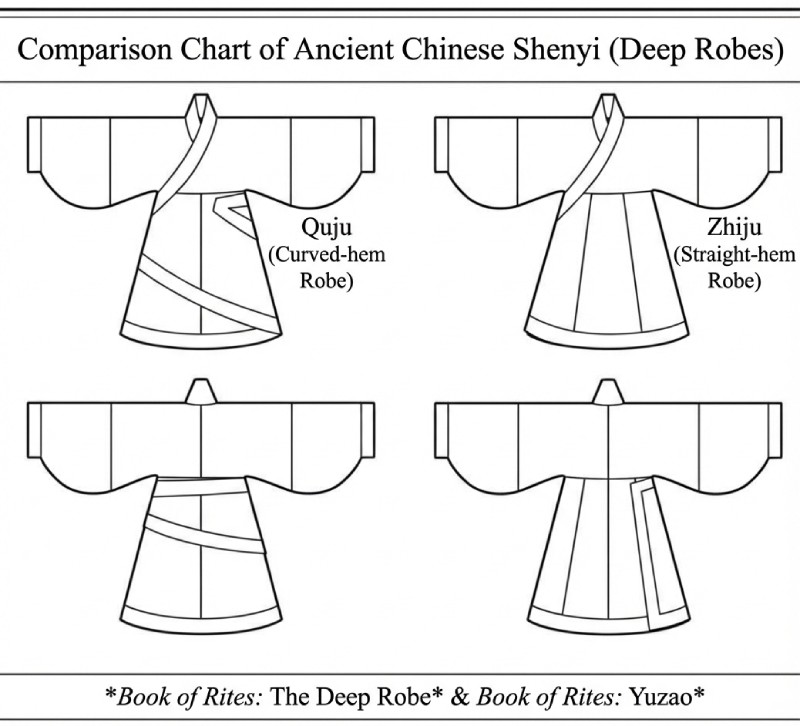
The top and skirt are cut separately but joined at the waist, forming a single integrated garment. It mainly includes two styles:
- Zhiju: A straight-front robe where the left front panel wraps around to the right back and hangs vertically. It is sleek, neat, and widely used in both formal and semi-formal occasions.
- Quju: A robe with a curved front panel that wraps around the lower body in layers, then fastens at the waist. Its flowing, winding lines create an elegant and graceful silhouette, popular in the Western Han Dynasty.
- Paofu System (One-Piece Robe with No Waist Seam)
A seamless garment cut from a single piece of fabric, integrating the top and lower parts. It was particularly prevalent in the Song and Ming Dynasties:
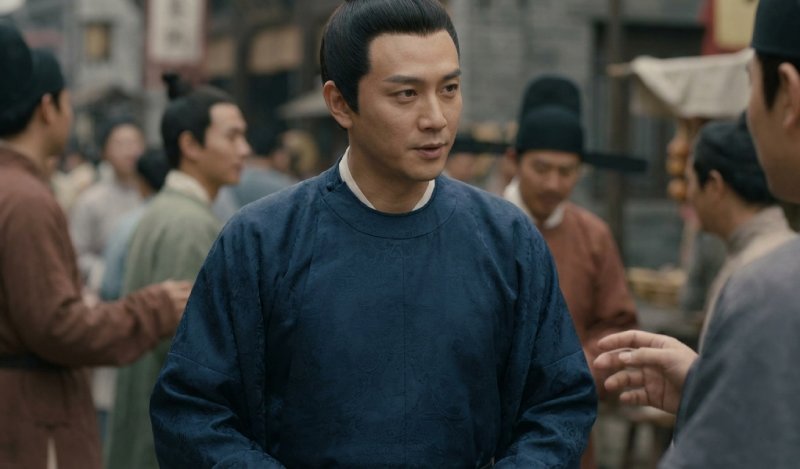
- Yuanlingpao (Round-Collar Robe): A versatile robe with a round collar, worn by emperors, officials, and commoners alike (differentiated by fabric and accessories).
- Lanshan: A long robe with a narrow hem, often worn by scholars for academic or casual activities.
- Zhidao & Zhishen: Simple, loose-fitting robes for daily wear, favored for their comfort.
- Beizi: A long, outer robe with an open front, worn by both men and women. It can be layered over other garments and is suitable for transitional seasons.
- Ruqun System (Evolved Separated Top and Skirt)
A general term for outfits consisting of a short upper garment (“ru”) and a skirt (“qun”), essentially a derivative of the Yishang system. It is the most common daily attire for women across dynasties:
- Gaoyaoruqun (High-Waisted Ruqun): The skirt is tied above the waist, elongating the figure.
- Banbi Ruqun (Ruqun with Short-Sleeve Outer Garment): A “banbi” (short-sleeve jacket) is added over the “ru” for layering, popular in the Tang Dynasty.
- Duijin Ruqun (Front-Buttoned Ruqun): The “ru” fastens with buttons down the front, creating a fresh and lively look.
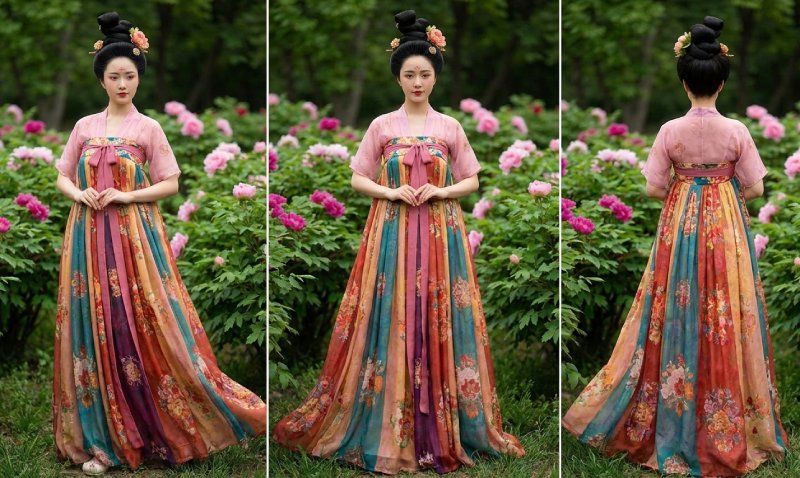
- Qixiong Ruqun (High-Chest Ruqun): The skirt is tied above the chest, a iconic style of the Tang Dynasty known for its bold, glamorous aesthetic.
2. Classification by Dynastic Style
Hanfu evolved with each dynasty, reflecting the era’s aesthetic trends and social culture:
- Han Dynasty Style
Centered on the Shenyi and Yishang systems. Unisex Shenyi was widely used as ceremonial attire; Quju was popular in the Western Han, while Zhiju became more common in the Eastern Han. Fabrics were primarily linen and silk, with simple, muted colors.

- Tang Dynasty Style
Characterized by opulence, grandeur, and vibrancy.
- Women’s attire: Qixiong Ruqun (high-chest ruqun) was the most representative, paired with wide sleeves and elaborate hair accessories.
- Men’s attire: Yuanlingpao (round-collar robe) was often matched with a diexie belt (a belt with hanging pouches and tools), reflecting the dynasty’s martial spirit.

- Song Dynasty Style
Embraced simplicity, elegance, and minimalism.
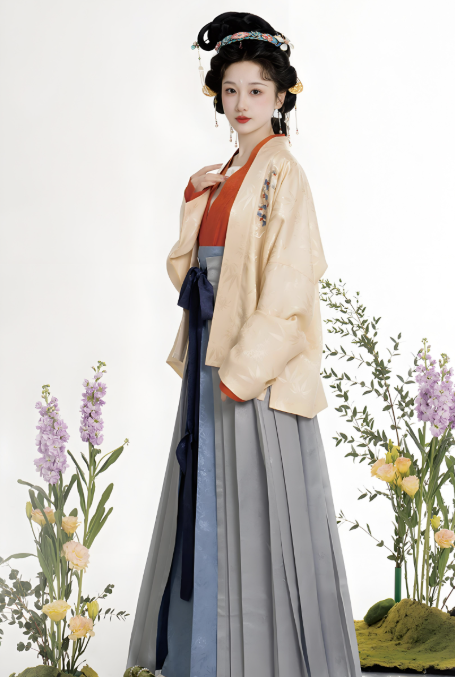
- Women’s attire: Baidiequn (pleated skirt) and Liangpianqun (two-panel skirt) were popular, often paired with a long Beizi (outer robe). Garment edges were usually embroidered with subtle twisted branch patterns.
- Men’s attire: Simple Zhidao (robes) and Lanshan (scholarly robes) dominated, with light fabrics and neutral tones like gray and indigo.
- Ming Dynasty Style
Known for its rigor, formality, and intricate details.
- Women’s attire: Mianqun (horse-face skirt) with dense pleats was iconic, paired with a Shuling Ao (stand-collar jacket) or Jiaoling Ao (cross-collar jacket). Noble women’s ceremonial attire was inlaid with pearls and gemstones.
- Men’s attire: Formal Yuanlingpao (round-collar robe) and casual Zhishen (robes) were common, with strict rules for color and pattern based on social status.

3. Classification by Function & Occasion
Hanfu’s design and fabric vary significantly based on its intended use:
- Ceremonial Attire
Used for important events like sacrifices, weddings, and coming-of-age ceremonies. It uses high-end fabrics (e.g., silk and brocade) and follows strict etiquette:
- Jifu (Sacrificial Robe): Worn by emperors and officials for state sacrifices, with symbolic patterns (e.g., the “Twelve Ornaments” representing imperial authority).
- Hunfu (Wedding Attire): Brides often wear red Shenyi or embroidered Ming-style jackets with Mianqun; grooms typically wear dark Xuanduan or red Yuanlingpao.
- Guankeli (Coming-of-Age Attire): Used for the Capping Ceremony (for men) and Hair-Pinning Ceremony (for women), featuring elegant, modest designs.
- Daily Attire
Designed for comfort and practicality in daily life. Fabrics are lightweight and durable (e.g., cotton and linen):
- Song Dynasty: Commoners wore short-sleeved “ru” with pants for manual labor.
- Ming Dynasty: Women wore simple Duijin Ruqun; men wore loose Zhidao robes for daily activities.
- Military Attire
Focused on functionality and protection for military use:
- Mingguang Kai (Bright Light Armor): A iconic Tang Dynasty armor with metal plates, providing both protection and a majestic appearance.
- Han Dynasty: Soldiers wore tight pants with leather boots and short jackets for ease of movement during battles.