
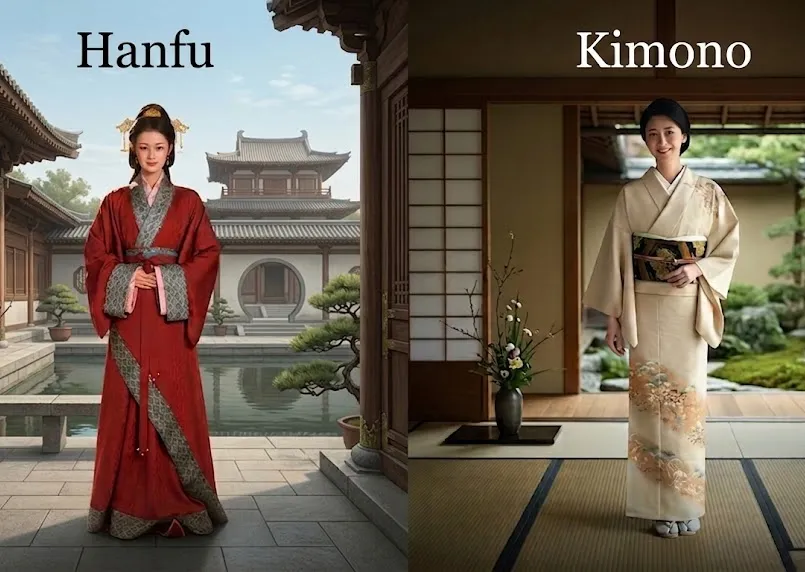
You’ve likely seen both: the flowing sleeves of hanfu, the structured elegance of the kimono. To the untrained eye, they may look similar—long robes, intricate patterns, a sense of timeless grace. But behind these silhouettes lie two distinct cultural histories, each shaped by centuries of philosophy, aesthetics, and tradition.
Let’s explore what makes hanfu and kimono unique—not as rivals, but as masterpieces of their own heritage.
Hanfu (China)
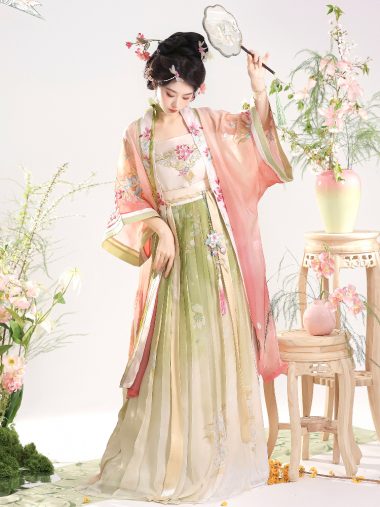
Hanfu is the traditional clothing of the Han Chinese people, with origins tracing back to the Xia and Zhou Dynasties (over 3,000 years ago). It evolved continuously through major dynasties—Han, Tang, Song, Ming—reflecting shifts in society, art, and thought. The term “hanfu” itself means “Han clothing,” emphasizing its ethnic and cultural identity.
Kimono (Japan)
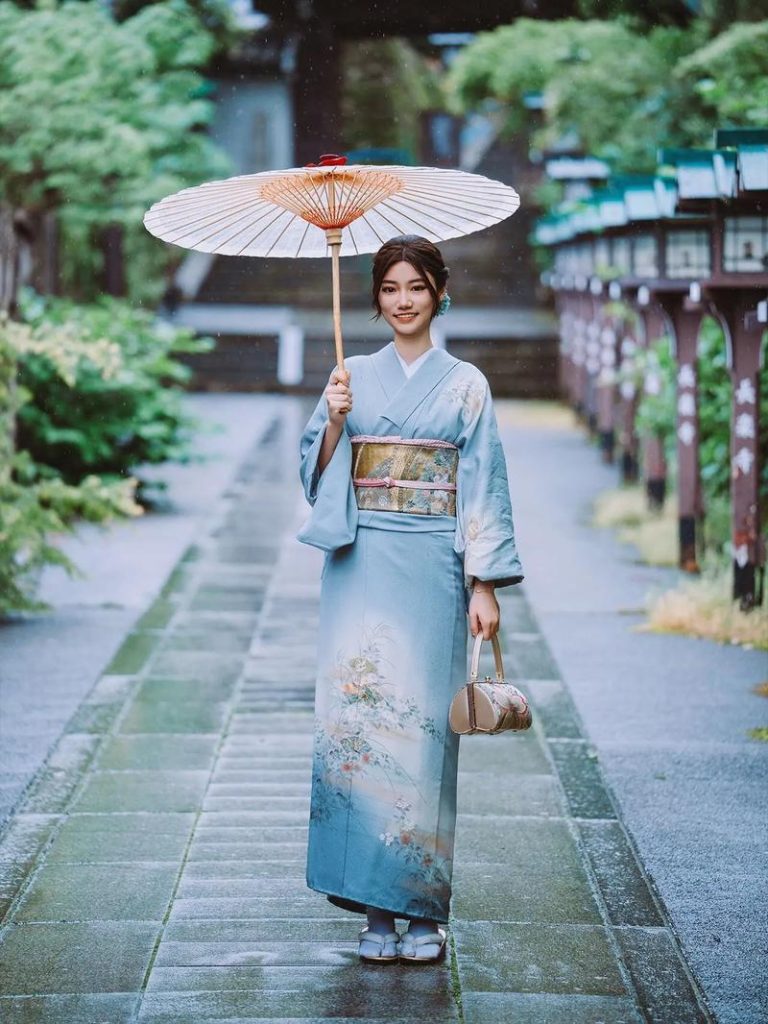
The kimono (“thing to wear”) developed in Japan during the Heian period (794–1185 CE), evolving from earlier garments influenced by Chinese Tang Dynasty fashion. Over time, it became distinctly Japanese, shaped by local customs, climate, and aesthetics like wabi-sabi (beauty in imperfection) and ma (negative space).
Key Insight: While early Japanese court dress was inspired by Chinese styles, the kimono as we know it today is a uniquely Japanese creation, refined over centuries to reflect Japanese values and social structure.
| Feature | Hanfu | Kimono |
|---|---|---|
| Silhouette | Flowing, layered, often with wide sleeves and a cross-collar (right over left) | Straight-lined, T-shaped, wrapped left over right, secured with an obi (wide sash) |
| Closure | Tied with fabric ribbons or sashes; no buttons | Wrapped and secured with a stiff obi belt, often tied in elaborate knots |
| Sleeves | Deep, open, and often very wide; vary by dynasty and gender | Long, tubular, and sewn shut at the end (especially for women); length indicates formality |
| Wearing Style | Multiple pieces (top, skirt, outer robe) layered together | Typically a single long robe, worn with underlayers and accessories |
Hanfu emphasizes natural movement and asymmetry in layering. The cross-collar and flowing lines create a sense of harmony with the body.
Kimono prioritizes structured formality and geometric precision. The stiff obi and straight cut create a sculptural effect.
Hanfu: Harmony & Philosophy
Hanfu is deeply tied to Confucian, Daoist, and Buddhist ideals. The way it drapes reflects the concept of qi (energy flow), and its design often embodies tian ren he yi (天人合一)—the unity of humans and nature. Wearing hanfu today is often seen as a revival of cultural identity and historical continuity.
Kimono: Ritual & Status
The kimono has long been associated with seasonal changes, life milestones, and social hierarchy. Specific patterns, colors, and obi styles indicate age, marital status, and occasion (e.g., weddings, tea ceremonies, funerals). It’s a garment of ritual precision and quiet elegance.
Hanfu Today
Hanfu is experiencing a youth-led revival across China and the global Chinese community. Wearers pair it with sneakers, wear simplified styles to school, or attend “hanfu meetups.” It’s less about daily wear and more about cultural pride, identity, and creative expression.
Kimono Today
In Japan, the kimono is mostly worn for formal occasions—weddings, coming-of-age day (Seijin Shiki), tea ceremonies, or festivals. While less common in daily life, there’s growing interest in kimono casual (modern, simplified versions) and sustainable fashion movements.
No. While both garments share a broad East Asian aesthetic—grace, symbolism, craftsmanship—they are products of different histories, philosophies, and cultural values.
Hanfu flows like a river—organic, layered, connected to ancient Chinese cosmology.
Kimono stands like a sculpture—structured, intentional, rooted in Japanese seasonal and social rituals.
Appreciating one doesn’t require diminishing the other. In fact, understanding their differences deepens our respect for both.
In a globalized world, it’s easy to blur cultural lines. But when we take the time to understand the roots, meanings, and evolution of traditional garments, we move beyond “exotic fashion” and toward authentic cultural appreciation.
Whether you’re drawn to the poetic drape of hanfu or the refined symmetry of the kimono, you’re engaging with centuries of human creativity, identity, and beauty.
Curious to see hanfu in motion?
Discover the elegance of [Tang Dynasty Hanfu]
Learn how to [Style Your First Hanfu Outfit]
Explore the connection between hanfu and [Chinese Calligraphy & Art]
Hanfu isn’t just a garment.
It’s a conversation across time.